reFX Rippler: Modal Synthesis Without a Single Sample
reFX Rippler is a dual-layer physical modeling synth with 12 acoustic models and 441 presets. Full specs, sound, how it compares to Chromaphone 3, and price.
See full specs, price, and alternatives in the plugin database →
reFX released Rippler, a physical modeling synthesizer that generates its sound from banks of resonators rather than samples or wavetables. It is the commercial evolution of a free, open physical modeling synth, rebuilt into a dual-layer instrument with subtractive synthesis, wavefolders, and a full modular effects section. The current first look is Jas-i Khorlo.
At a glance: €99 intro (regular €129), with a 30-day free trial. A dual-layer physical modeling synth with 12 acoustic models, 32 exciter samples, two oscillators, two filters, 64 LFO shapes, 441 presets, MPE, and microtuning. Runs as AU, VST3, and AAX on Windows 10/11 and macOS 10.13 or later.
What is reFX Rippler?
Rippler is a physical modeling synth. Instead of playing back recordings or scanning wavetables, it models how physical objects vibrate and resonate, using banks of tuned resonators to recreate the behavior of strings, drumheads, bells, tubes, and more. The result is sound that reacts and evolves the way an acoustic instrument does, without a single sample in the signal path. A newer physical-modeling synth in this lane is Modartt Airteq.
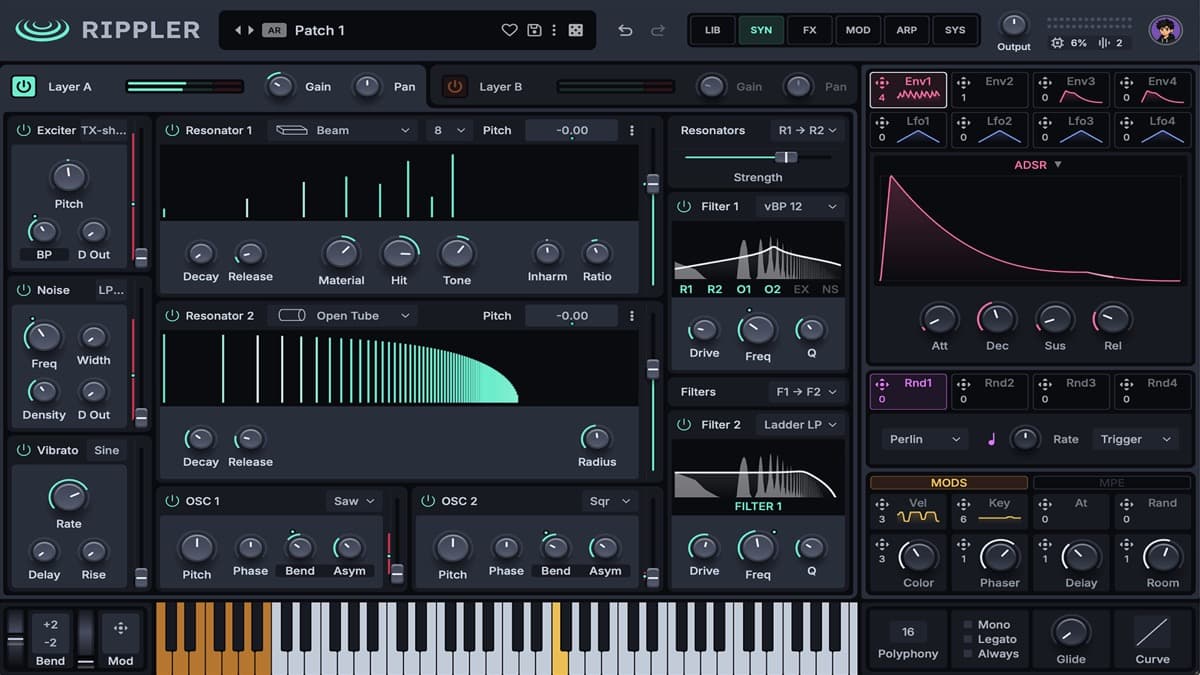
What sets Rippler apart from most modal synths is its two-layer design with bi-directional energy coupling. The two synthesis layers do not just sit side by side. Energy passes between them in both directions, so one layer can excite and be excited by the other. That feedback is where the more complex, living tones come from. The coupling is the reason it sounds less static than simpler resonator instruments.
It lands directly opposite Chromaphone 3 from Applied Acoustics Systems, the best-known acoustic-object synth. Rippler covers similar ground with sample-free organic tones, but it adds bi-directional coupling and comes in well under Chromaphone's price.
What Rippler does, feature by feature
Twelve acoustic models
The core of the instrument is 12 acoustic models: String, Drumhead, Beam, Djembe, Squared, Vibraphone, Bell, Marimba, Membrane, Open Tube, Plate, and Closed Tube. Each behaves like the physical object it is named after, so a Marimba model rings and decays like a mallet instrument, while an Open Tube model has the hollow, breathy resonance of a pipe. These are your starting characters, and the interesting work begins when you combine and detune them across the two layers.
Two coupled layers with parallel and serial routing
Rippler runs two independent synthesis layers, and you can route their resonators in parallel or in series. In parallel, the layers stack into a fuller, wider tone. In series, one layer feeds the next, so the second resonator colors and reshapes the output of the first. Add the bi-directional energy coupling on top, and you get evolving, interactive tones rather than two static sounds glued together.
Exciters, oscillators, filters, and wavefolders
Physical models need something to set them vibrating, and Rippler supplies 32 exciter samples for that job, alongside two oscillators and two filters that bring in classic subtractive shaping. That hybrid of modal resonance and subtractive synthesis is what makes the instrument more than a one-trick modal box: you can start from an acoustic model and then filter, fold, and drive it into territory that no real instrument occupies.
Deep modulation and effects
Every parameter can be modulated by multiple sources, including envelopes and LFOs, and Mod Mapping lets you draw custom response curves so a modulator hits a parameter exactly how you want. There are 64 LFO shapes to choose from. On the output side, Rippler carries 13 effects on the master bus and 12 per layer in a fully modular chain, which means you can finish a patch, reverb, delay, distortion, and all, without leaving the plugin. It also supports MPE, aftertouch, and microtuning via Scala files and MTS.
reFX Rippler specifications
| Spec | Detail |
|---|---|
| Product | reFX Rippler |
| Type | Dual-layer physical modeling + subtractive synth |
| Acoustic models | 12 (String, Drumhead, Beam, Djembe, Squared, Vibraphone, Bell, Marimba, Membrane, Open Tube, Plate, Closed Tube) |
| Layer routing | Parallel or serial, with bi-directional energy coupling |
| Sound sources | 2 oscillators, 2 filters, 32 exciter samples |
| Modulation | Envelopes, LFOs (64 shapes), Mod Mapping curves, MPE, aftertouch |
| Effects | 13 on master bus, 12 per layer, modular chain |
| Presets | 441 factory presets, 10 arpeggiator presets |
| Formats | AU, VST3, AAX |
| System | Windows 10/11; macOS 10.13+ (Intel or Apple Silicon), 8GB RAM |
| Price | €99 intro (regular €129) |
Rippler vs Chromaphone 3
The two go head to head on sample-free, physically modeled sound. Here is how they line up.
| reFX Rippler | Chromaphone 3 | |
|---|---|---|
| Developer | reFX | Applied Acoustics Systems |
| Models | 12 acoustic models | 8 resonator types |
| Architecture | Two coupled layers, bi-directional energy transfer | Two-voice multitimbral |
| Hybrid synthesis | Adds oscillators, filters, wavefolders | Resonator-focused |
| Presets | 441 | 1,090+ |
| Formats | AU, VST3, AAX | VST2, VST3, AU, AAX, NKS, standalone |
| Price | €99 intro / €129 | $199 |
Which to pick. Choose Rippler if you want the bi-directional coupling and the added subtractive layer, and if the lower price appeals. Choose Chromaphone 3 if you want the larger factory library, wider format support including standalone and NKS, and a longer track record. Both make sample-free organic sound their whole purpose, and both do it well; Rippler is the newer, cheaper, more experimental take, while Chromaphone is the established deep library.
Who Rippler is for
Consider it if you are a sound designer or a film and game composer who needs original percussion, mallets, plucks, and evolving textures that a sample library cannot provide. Physical modeling shines exactly where sampling runs out of variation, and Rippler's coupling gives you tones that keep moving.
It also rewards anyone who likes starting from an acoustic character and pushing it somewhere strange. The oscillators, filters, and wavefolders let you deform a realistic model into something clearly synthetic, which is a productive way to design a signature sound.
Skip it if your work leans on classic subtractive staples: fat analog basses, saw-stack leads, and lush pads. Rippler handles textures and tuned percussion beautifully, but a wavetable or virtual-analog synth like Pigments or Vital is the better home base for conventional synth sounds.
How much does Rippler cost?
Rippler is €99 as an introductory price, rising to €129 as the regular price after the promotion. A 30-day free trial is available directly from reFX, which is the best way to hear whether physical modeling fits your music before committing. It installs as AU, VST3, and AAX and needs only about 51 MB of storage, so it is light to run.
FAQ
Is reFX Rippler worth it?
For sound designers and anyone who values organic, sample-free tones, yes. At €99 intro it is roughly half the price of the best-known physical modeling synth, and the bi-directional coupling gives it a genuinely different, more evolving character. If you only make conventional subtractive sounds, it is a specialist you may not need. We covered the current release in Modartt Airteq.
Rippler vs Chromaphone 3: which is better?
Both are excellent physical modeling synths. Rippler adds bi-directional energy coupling and a subtractive layer and costs €99 intro; Chromaphone 3 has a bigger 1,090-plus preset library, wider format support, and a longer history at $199. Pick Rippler for the newer engine and lower price, Chromaphone for the deeper library and format coverage.
What formats and systems does Rippler support?
Rippler runs as AU, VST3, and AAX on Windows 10 and 11 and on macOS 10.13 or later, with native Apple Silicon support. It needs 8GB of RAM (16GB or more recommended) and around 51 MB of disk space. There is no CLAP or standalone build.
Is Rippler based on a free synth?
Yes. Rippler is the commercial evolution of a free, open physical modeling synth, rebuilt by reFX into a dual-layer instrument with added oscillators, filters, wavefolders, and a modular effects section.
The bottom line
Rippler makes a strong case for physical modeling as a mainstream sound-design tool rather than a curiosity. Twelve acoustic models, two coupled layers, and a hybrid of modal resonance and subtractive synthesis give it a range that runs from convincing acoustic percussion to tones that could only exist inside a computer. It is a specialist, and it will not replace your analog synth. But at €99 intro, sample-free and endlessly tweakable, it is one of the most interesting instruments of the year for anyone who designs their own sounds.