Inside Modartt Airteq: Dynamic Aerophone Modeling
Modartt Airteq is a 99-euro physical-modeling instrument that generates sound from airflow through virtual pipes. Full specs, MPE support, and who should buy.
On 15 September 2026, Modartt shipped Airteq, a physically modelled sound-design instrument that starts from airflow rather than an oscillator or a sample. The company calls the engine Dynamic Aerophone Modeling. It computes how virtual pipes react to a changing wind supply, then lets you play that reaction from a keyboard, an MPE controller, or a breath and wind setup. The perpetual price is €99 / $99, and a free trial is on the official site.
At a glance: €99 / $99, perpetual licence, free trial. Standalone plus VST3, AU, AAX, and LV2 on macOS, Windows, and Linux. More than 170 factory presets. This is a first look at the live Modartt storefront and official videos. We have not used it in a session.
What is Modartt Airteq?
Modartt already models pianos in Pianoteq 9 and pipe organs in Organteq. Airteq sits next to those instruments and then walks away from the recital hall. Official copy is blunt: it is not a sample library and not a traditional synthesizer. Sound is generated in real time from a physical model of air moving through virtual pipes.
That is a different starting point from a wavetable or a recorded flute. A sample plays back a take. A typical synth starts from a periodic oscillator and then filters it. Airteq starts from the supply of air. When you change that supply, the pipe itself changes how it speaks. Official language puts it this way: modulation does not simply move a filter, it changes the behaviour of the sound source.
The Airteq overview aims it at composers, sound designers, and musicians who want organic movement and evolving acoustic-like textures. The factory library follows that brief: evolving pads, cinematic textures, organic airy sounds, rhythmic pulses, and MPE presets.
Dynamic Aerophone Modeling, feature by feature
The official press release frames airflow as a creative parameter. You continuously control, modulate, and transform the wind supply of each virtual pipe. The open beta included more than 100 testers. Official short videos on the product page walk through Air Response, Modulation, Sustain Modes, and Breath/Wind Controllers. Pedals get their own quick tip. Here is what that surface actually gives a producer.
- Air as the oscillator. Each pipe is a model of how a column of air speaks, not a loop of a recording. Change the air and the tone, the attack chiff, and the instability change with it. That is the difference between riding a filter cutoff and riding the thing that is making the sound.
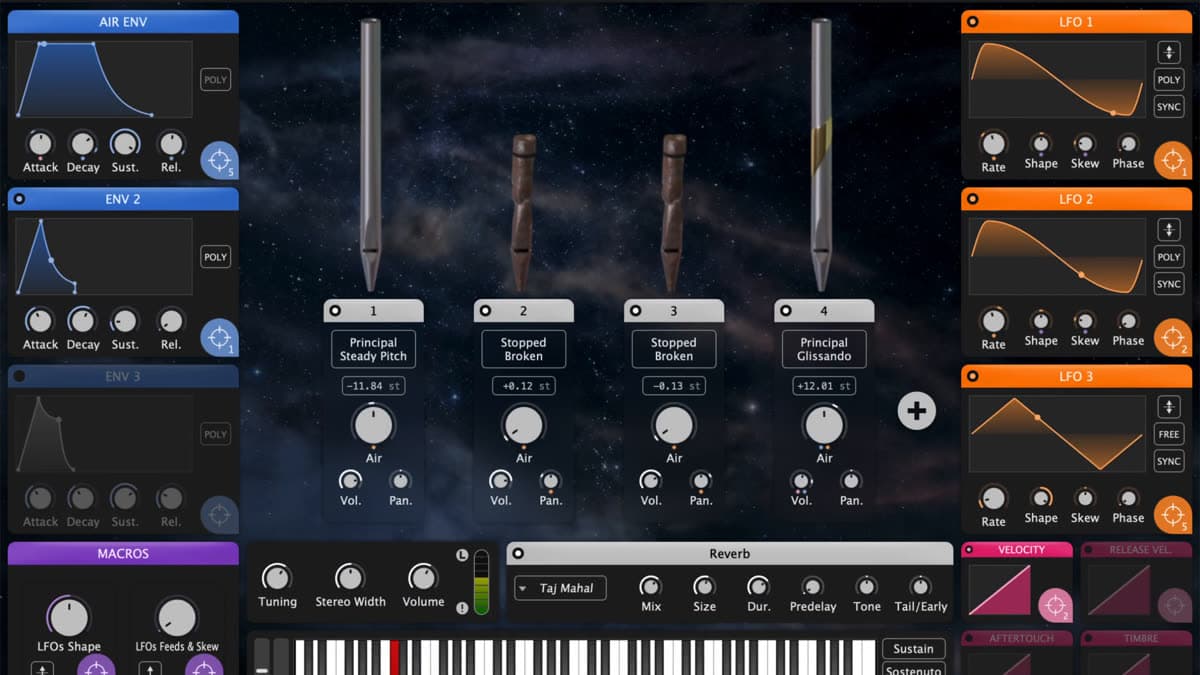
- Pipe families you can combine. Official copy lists flutes, reeds, and mixtures, each with its own timbre and its own reaction to airflow. The official interface shows several pipe slots on one patch, with an add control for another voice. You build an imaginary instrument by stacking families instead of loading a multi-sample.
- Air-response models. Official videos isolate Air Response as a first lesson. The live GUI shows pipes set to behaviours such as Steady Pitch, Broken, and Glissando, next to pipe names such as Principal and Stopped. Steady Pitch holds the note. Glissando lets pitch move with the air. Broken is the unstable, overblown edge. Those choices decide whether a pad sits still or climbs and splits as you push air.
- Four per-pipe controls. Each loaded pipe has Pitch, Air, Volume, and Pan. Pitch is the tuning offset. Air is how hard the model is blown. Volume and Pan place that pipe in the image. Detune two Principals a few cents, open Air on one of them, and the stack starts to breathe instead of sitting as a static unison.
- Air envelope plus two more ADSRs. Official product clips are titled around an air envelope, LFOs, and macros. The interface shows an Air Env with attack, decay, sustain, and release, plus Env 2 and Env 3. The air envelope is the one that matters most: it shapes the wind supply over the life of the note. The other two envelopes are general-purpose shapers for the rest of the patch. Poly toggles sit on those envelopes, so each voice can carry its own contour.
- Three LFOs. Official LFO clips match a panel with LFO 1, LFO 2, and LFO 3. Rate, shape, skew, and phase are on each one, with poly and sync switches. Sync locks a pulse to host tempo. Poly lets every voice wander on its own. Skew is how you turn a polite triangle into an asymmetric gust.
- Macros and gestures. Official copy and official video titles both call out macros. Two macro controls sit on the panel so you can grab a group of pipe and air parameters with one move. That is the control you ride in a cue when you do not want to automate twelve air knobs.
- MIDI, MPE, and breath. Airteq responds to velocity, pitch bend, and aftertouch, and it fully supports MIDI Polyphonic Expression. The official MIDI assignment workflow maps continuous CCs from keyboards, MPE devices, and breath or wind controllers. If you already play a wind controller into a physical-modeling instrument, this is the control path Modartt built for.
- Pedals and keyboard expression. Official quick tips cover pedals. The GUI shows sustain and sostenuto next to velocity, release velocity, aftertouch, and a timbre control.
- A space at the end of the chain. The official interface includes a reverb section with mix, size, duration, predelay, tone, and tail/early controls, plus tuning, stereo width, and volume.
The factory library is the on-ramp. More than 170 presets cover those same categories. Official copy invites you to tweak, transform, and save your own variations.
Modartt Airteq specifications
| Spec | Detail |
|---|---|
| Developer | Modartt |
| Type | Physically modelled sound-design instrument (Dynamic Aerophone Modeling) |
| Released | 15 September 2026 |
| Price | €99 / $99 perpetual |
| Trial | Free trial on the official site |
| Sound source | Real-time model of airflow through virtual pipes. No sample library |
| Pipe families | Flutes, reeds, mixtures |
| Pipe controls | Pitch, Air, Volume, Pan per pipe |
| Modulation | Air envelope plus two additional ADSRs, three LFOs, macros |
| Expression | Velocity, pitch bend, aftertouch, MPE, continuous CCs, breath/wind |
| Pedals | Sustain and sostenuto on the official interface |
| Factory presets | More than 170 |
| Formats | Standalone, VST3, AU, AAX, LV2 |
| Operating systems | macOS, Windows, Linux |
| Buy | Official Modartt shop |
Airteq vs Organteq vs Baby Audio Atoms
Organteq is Modartt's physically modelled church organ. Baby Audio Atoms is a $99 physical-modeling synth aimed at organic, evolving textures. Chromaphone 3 is the other named resonator instrument in our database, at a higher $199 street price.
| Modartt Airteq | Modartt Organteq | Baby Audio Atoms | |
|---|---|---|---|
| Price | €99 / $99 | Sold on the official Organteq page | $99 on our Atoms card |
| Job | Imaginary aerophone for pads, air, and cinematic texture | Faithful pipe-organ instrument | Organic pads and evolving modelled tones |
| Engine | Dynamic Aerophone Modeling of airflow and pipes | Physically modelled organ, about 20 MB | Physical modeling of masses and connections |
| Building blocks | Flute, reed, and mixture pipes you combine | Stops, keyboards, couplers, and pedals | A focused modelled architecture, not pipe families |
| Expression | MPE, aftertouch, breath/wind, macros | Organ pedals, swell, and stop control | Standard MIDI plus Baby Audio macros |
| Formats | Standalone, VST3, AU, AAX, LV2 | Standalone, VST, AAX, AU | VST, AU, AAX |
| Linux | Yes | Yes | No |
| Reach for it when | You want pipe physics with synth control | You need a playable organ | You want modelled motion without thinking about pipes |
Which to pick. Choose Airteq when the picture is air, chiff, and unstable pipe speech under synth envelopes, and you want that as a writing instrument rather than a sampled texture pack. Choose Organteq when you need a church organ that behaves like one. Choose Atoms when you want Baby Audio's simpler modelled-texture workflow and you do not care about flutes, reeds, or wind controllers. Chromaphone 3 is the pick if mallet, plate, and tube resonators are the language you already speak. For a different physics sandbox that draws masses in 3D, see Anukari.
Airteq does not replace Pianoteq 9. It is the same modelling house and a different instrument.
Who Airteq is for
Consider it if you write to picture and you want pads and atmospheres that move like air instead of like a looped choir.
Consider it if you already like Organteq or Pianoteq and you want the same modelling philosophy on an instrument you can twist.
Consider it if you play MPE or a breath controller and you want the gesture to change the source, not only a filter.
Consider it if €99 / $99 is the budget and you would rather own a focused aerophone than another wavetable.
Skip it if you need a conventional analog or wavetable workhorse for bass, leads, and supersaws. Airteq is not that synth.
Skip it if you want a sampled woodwind library with named instruments and recorded articulations. There is no sample set.
Skip it if you only need a straight church organ. That is Organteq.
How much does Modartt Airteq cost?
€99 / $99 at modartt.com/airteq. That is a perpetual licence. A free trial is on the same page. Official copy lists the price in both euros and US dollars, so you do not have to guess a conversion.
Modartt sells Airteq direct. Plugin Boutique does not list it. If you want a physical-modeling instrument that is on an affiliate retailer, Atoms at Best Service and Chromaphone 3 at Best Service are the named alternatives in our database.
The plugin card lives at /plugins/modartt-airteq.
FAQ
Is Airteq a virtual pipe organ?
No. Organteq is the organ. Airteq keeps the pipe physics and then treats those pipes as a sound-design instrument. You combine flute, reed, and mixture families, shape the air with envelopes and LFOs, and play the result like a synth.
Does Airteq use samples?
No. Official copy says it is not a sample library. Every note is computed from the model.
What formats and operating systems does it support?
Standalone, VST3, AU, AAX, and LV2 on macOS, Windows, and Linux. That Linux build matters if you already run Pianoteq or Organteq on the same machine.
Airteq vs Atoms, which one?
Atoms is a $99 modelled-texture synth with a simpler, more general physical-modeling voice. Airteq is specifically air through pipes, with MPE and breath support and more than 170 presets aimed at pads, air, and cinematic movement. Buy Atoms for fast organic motion. Buy Airteq when the pipes and the wind supply are the instrument. Detail is on the Atoms card.
Is there a demo?
Yes. Modartt posts a free trial on the official Airteq page. Install that before you spend €99.
Verdict
Airteq is Modartt taking twenty years of physical modeling and pointing it at sound design instead of a named acoustic instrument. €99 / $99 is the perpetual price. Dynamic Aerophone Modeling, flute/reed/mixture pipes, an air envelope, three LFOs, macros, MPE, and breath control are the product.
It will not replace a wavetable for everyday parts, and it will not replace Organteq for liturgy or score-library organ. For a first instrument in this lane, the official control list is complete and the price is the reason to run the trial. Map a breath controller or an MPE keyboard, load a cinematic preset, and ride Air until the pipe speaks. The live storefront is modartt.com/airteq.