Some links on this page are affiliate links. If you buy through them, Dubspot may earn a commission at no extra cost to you. It never affects our scores or what we recommend — read our policy.
Jas-i Khorlo: A Free Synth Built on a Spinning Cylinder
Jas-i Khorlo is a free physical-modeling synth built on a rotating cylinder with eight strings and eight pluckers. Full feature breakdown, specs, and how it compares.
P
Priya Raman
October 1, 2026 · 8 min read
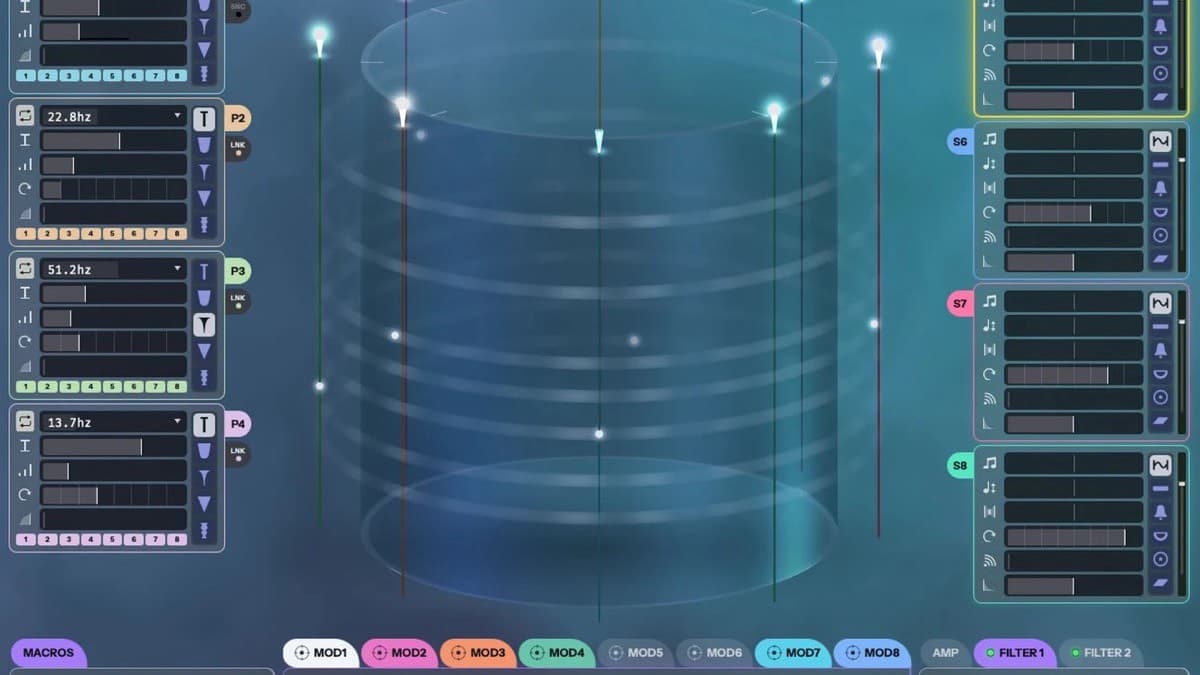
Khorlo is a free physical-modeling synth from Aaron Jasinski, who releases software under the name JAS-I. It does not work like anything else on your drive. Instead of oscillators and wavetables, it gives you a spinning virtual cylinder ringed with eight physically modeled strings, struck by eight independent pluckers. The speed and position of that rotation decide when each string sounds, so the instrument builds evolving, self-playing polyrhythms on its own.
At a glance: Free, no account and no time limit. A rotating-cylinder physical-modeling synth with eight strings, eight pluckers, bowed resonators, nine filter models, eight modulator banks, and a ten-slot reorderable effects rack. VST3, AU, and CLAP on macOS, Windows, and Linux. Currently in beta (version 0.9.03).
What is Khorlo?
Most physical-modeling synths ask you to pick an exciter, such as a mallet or a pick, and a resonator, such as a string or a membrane, and then play notes in the usual way. Khorlo keeps the exciter-and-resonator core but wraps it in a rotating mechanism that changes how the whole thing is played. A virtual glass cylinder spins in the center of the interface, and up to eight pluckers reach in to strike up to eight strings as the cylinder turns. Change the rotation and you change the rhythm, the order, and the interplay of the notes.
That makes Khorlo part synth and part generative sequencer. You can play it from the keyboard like a normal instrument, but its signature trick is the emergent polyrhythm that comes out of the spinning model. It sits in the same broad family as Chromaphone 3 and the resonator experiments in tools like Audio Damage Tessera, but the rotating-cylinder concept is its own. The result is organic, bell-like, and often beautiful, which is exactly what physical modeling does best.
What Khorlo does, feature by feature
The rotating cylinder, strings, and pluckers
The heart of Khorlo is the spinning cylinder with its eight strings. Eight independent pluckers strike those strings at variable speeds and positions, and because each can move on its own, you get complex interlocking rhythms from a single held note. The strings are physically modeled, so their tone responds to how and where they are struck, the way a real string does. Khorlo also offers bowed resonators, which trade the plucked attack for a sustained, singing tone closer to a bowed instrument.
Nine filter models
Khorlo ships with nine filter models, including three recent additions named Cascade, Squelch, and Scream. The names hint at the range on offer, from smooth, stacked filtering to aggressive, vocal-style resonance and outright distortion-adjacent screaming. The raw tone from a physical model can be delicate or harsh depending on how hard the strings are driven. Having this many filter characters means you can tame or sharpen the sound without leaving the plugin.
Eight modulator banks and deep routing
Modulation is where Khorlo turns from a novelty into a real instrument. It has eight modulator banks: the first six are versatile, graph-based shapes that work as either envelopes or LFOs, so you can draw custom contours and loop them. Banks seven and eight hold nine slots for four macros plus velocity, mod wheel, aftertouch, and full MPE. Nearly every parameter can be a modulation target through the routing page, which means the rotation, the string behavior, the filters, and the effects can all move under performance control or self-generated modulation.
A reorderable effects rack
The output runs through a rack of ten effects: chorus, compressor, delay, phaser, flanger, filter, distortion, reverb, EQ, and a limiter. Each effect has its own display, and the rack is reorderable, so you can place the distortion before or after the reverb, or run the EQ at the end to tame the result. For a free plugin, a full, flexible FX chain like this is unusual, and it means Khorlo can finish a sound rather than handing you a dry tone to process elsewhere.
Preset browser and appearance panel
A proper preset browser rounds it out, with folders, instrument badges, characteristic tags, favorites, and arrow-key navigation, so exploring the factory content is quick. There is also an appearance panel that controls background colors, the fog in the 3D view, the cylinder's color and opacity, and the ripple effects. The visuals are not just decoration here, since watching the cylinder turn helps you understand what the sound is doing.
Khorlo specifications
| Spec | Detail |
|---|---|
| Type | Rotating physical-modeling / resonator synth |
| Sound engine | Virtual cylinder with 8 strings and 8 independent pluckers, plus bowed resonators |
| Filters | 9 models (including Cascade, Squelch, Scream) |
| Modulation | 8 banks (6 graph-based env/LFO), 4 macros, velocity, mod wheel, aftertouch, MPE |
| Effects | 10-slot reorderable rack: chorus, compressor, delay, phaser, flanger, filter, distortion, reverb, EQ, limiter |
| Presets | Browser with folders, tags, badges, favorites |
| Formats | VST3, AU, CLAP |
| macOS | 11 or later, universal (Apple silicon and Intel) |
| Windows | 10 or later, 64-bit (requires WebView2) |
| Linux | x86-64 (requires WebKitGTK) |
| Notes | 64-bit hosts only, 3D view uses hardware acceleration, Performance mode for slower machines |
| Version | 0.9.03 (beta) |
| Price | Free |
Khorlo vs Chromaphone 3
The closest paid reference is Applied Acoustics Systems Chromaphone 3, the best-known acoustic-object physical-modeling synth. The two share an engine family but feel very different in use.
| Khorlo | Chromaphone 3 | |
|---|---|---|
| Price | Free | $199 |
| Engine | Rotating cylinder, 8 strings, 8 pluckers, self-generating rhythms | Dual resonators (strings, beams, plates, membranes, drumheads) |
| Playing model | Generative polyrhythms from rotation, plus keyboard | Standard keyboard-played voice |
| Effects | 10-slot reorderable rack | Multi-effects and a large preset library |
| Status | Beta (0.9.03) | Mature, stable release |
| Best pick | Experimental, evolving, free organic textures | Polished, dependable acoustic modeling for production |
Chromaphone 3 is the mature, stable choice, with a deep preset library and the reliability of a long-running product. It is the one to buy when you need dependable acoustic-instrument modeling in a session, and you can check its price at Plugin Boutique. Khorlo is the experimental, generative, and free option, and its rotating-cylinder approach produces motion that a conventional physical-modeling synth simply will not.
Who Khorlo is for
Khorlo rewards sound designers, ambient and experimental producers, and anyone who likes an instrument that plays back. The generative rhythms make it a strong source for evolving pads, pattern beds, and organic percussion that you capture and arrange rather than sequence by hand. It is also a free, low-risk way to learn how physical modeling behaves, since the visuals make cause and effect clear.
Treat it with the usual care for beta software. It is version 0.9.03, so expect the occasional rough edge and save often, and keep a stable instrument on hand for deadline work. If you want a finished, dependable physical-modeling synth today, Chromaphone 3 is the safer pick.
How much does Khorlo cost?
Khorlo is free. You download it directly from JAS-I at jas-i.com, with no account and no time limit, in VST3, AU, and CLAP formats for macOS, Windows, and Linux. It is one of the more original free instruments to appear this year, and it fits neatly alongside the picks in our roundup of the best free synth VSTs of 2026 and the broader best free VST plugins of 2026.
FAQ
Is Khorlo really free?
Yes. Khorlo is a free download from JAS-I, with no purchase, no account, and no time limit. It is currently in beta at version 0.9.03, and updates have been free so far.
What makes Khorlo different from other physical-modeling synths?
The rotating cylinder. Instead of only playing notes from the keyboard, Khorlo spins a virtual cylinder whose eight pluckers strike eight strings as it turns, which generates emergent polyrhythms. That self-playing, generative behavior is the core of its sound and sets it apart from a standard resonator synth.
What are the Khorlo system requirements?
It runs on macOS 11 or later as a universal binary, Windows 10 or later (which needs WebView2), and Linux x86-64 (which needs WebKitGTK). It requires a 64-bit host and installs as VST3, AU, and CLAP. The 3D view uses hardware acceleration, and a Performance mode is available for slower machines.
Khorlo vs Chromaphone 3, which should I use?
Use Khorlo for free, experimental, generative physical-modeling textures and evolving rhythms. Choose Chromaphone 3 when you need a mature, stable synth with a large preset library for dependable acoustic modeling in production.