Baby Audio Grainferno Review: Samples as Oscillators
Grainferno is Baby Audio's granular synth that turns any sample into a playable, in-tune oscillator. Full review: engine, specs, pricing and how it compares to Output Portal.
Dubspot's best Black Friday dealsDubspot Tracker Pro: $15, was $24.99 ↗Drum Programming and Groove Production Course: $19, was $99 ↗
Black Friday 2026Baby Audio Black Friday 2026: dates and deals →
See full specs, price, and alternatives in the plugin database →
Baby Audio released Grainferno on 11 March 2026, and it's the company's most advanced instrument to date. It's a granular synthesizer that breaks any audio file into microscopic grains and rebuilds them into new sounds. The headline trick is speed: the grain engine runs fast enough to cross into the audio range, so a sample stops behaving like texture and starts acting like a playable oscillator. Eight months on, it's still uncovered here, and with Baby Audio's Black Friday sale live, it's worth a proper look.
At a glance: a granular synth plugin in VST, VST3, AU, AAX and standalone, for macOS 10.11+ (native Apple Silicon) and Windows 10+. It loads two independent sample slots with seven morph modes, generates grains all the way to audio rate, and ships 325 presets, 378 royalty-free samples and 1.5 GB of content. Modulation runs deep: three envelopes, three LFOs and three random generators, all drag-and-drop. $129 one-time, with a demo and a subscribe-to-own option.
What is Grainferno?
Granular synthesis chops a sound into tiny fragments, or grains, and replays them in clouds. Done well, it produces shimmering pads, evolving drones and glitchy motion that no oscillator can fake. Done badly, it produces a mess that drifts out of tune and never resolves into something you can use in a track. Grainferno's whole design goal is the first result, not the second.
It sits in the same corner as Output Portal and the granular engine inside Arturia Pigments, but it approaches the problem from a different angle. Portal is an effect that granularises audio passing through it. Grainferno is an instrument you play from the keyboard, with its own pitch tracking, polyphony and modulation, built to turn a static sample into a responsive synth voice. If you keep a folder of loops and one-shots, Grainferno treats that folder as raw oscillator material.
What's new in Grainferno
An audio-rate grain engine
Most granular tools generate grains slowly enough that you hear them as separate events, which is how you get texture. Grainferno can generate them fast enough that the grains fuse into a continuous pitched tone, the way an oscillator's cycles do. At those rates the plugin behaves like a synth whose waveform carries the spectral fingerprint of your source audio. Feed it a vocal and you get a synth voice that still remembers the vocal. Feed it a cymbal and you get a metallic oscillator. That audio-rate behaviour is the single feature that sets Grainferno apart from a conventional granular box.
Two sample slots and seven morph modes
Grainferno loads two independent source files and morphs between them in real time, with seven distinct morph modes. This is where the hybrid sounds come from. You can cross a felt piano with a field recording, or an 808 with a breath, and sweep between their characters as a note sustains. Because the morph is a modulation destination like anything else, an LFO or envelope can keep the blend moving on its own.
Per-grain processing: G-Filter, G-Comp, G-Blur
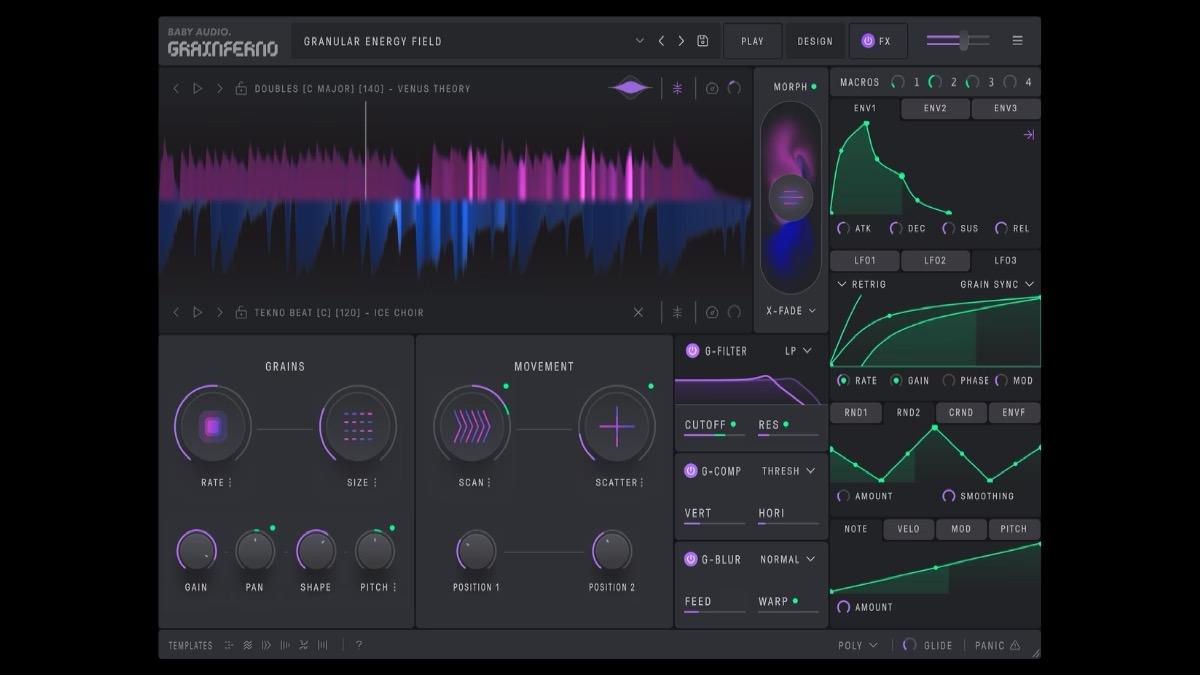
The most unusual part of Grainferno is that it shapes each grain at the moment it is born, before the grains stack into a cloud. G-Filter applies a multimode filter per grain, G-Comp compresses each grain with selectable detection modes, and G-Blur feeds previous grains into new ones for enveloping pads, with a Violent mode that adds a seasick pitch warp. Processing at the grain level rather than the output gives textures a detail and internal movement you cannot reach by filtering the final signal.
Deep drag-and-drop modulation
Nearly every parameter is a modulation target. Three envelopes, three drawable LFOs and three random value generators, plus an envelope follower tied to the loaded sample, connect to any destination by dragging, including modulators cross-modulating each other. Stack as many assignments as you like and the sound keeps unfolding with new variations on the source. For an instrument this deep, the drag-and-drop workflow is what keeps patching fast instead of menu-driven.
Grain controls that keep it in tune
Rate, Size, Scan, Scatter and Position are the core controls. Rate sets how often grains fire, Size sets how long each one lasts, Scan moves the playhead through the sample, Scatter randomises the read position, and Position sets the start point. A sample pre-processing stage can normalise audio and auto-pitch it to the nearest C, so the granular output stays in tune with your song rather than fighting it. That tuning discipline is what makes Grainferno usable in an arrangement, rather than only a sound-effects toy.
Onboard effects that are part of the instrument
Grainferno includes a reorderable effects chain with delay, reverb, analog-style modulation and multimode saturation. Because the effects slots are also modulation destinations, they behave as part of the synthesis rather than static post-processing. A Play view with four macros sits on top of everything for fast auditioning, with a deeper Design view and a dedicated FX view underneath.
Grainferno specifications
| Spec | Detail |
|---|---|
| Plugin type | Granular synthesizer instrument |
| Formats | VST, VST3, AU, AAX (64-bit), plus standalone |
| macOS | 10.11 and up, native Apple Silicon |
| Windows | 10 and newer |
| Sample formats | WAV, AIFF, FLAC, MP3, Ogg Vorbis |
| Sample slots | Two independent sources, seven morph modes |
| Grain engine | Variable rate up to audio rate; per-grain pitch, level, pan, window |
| Per-grain processors | G-Filter, G-Comp, G-Blur |
| Modulation | 3 envelopes, 3 LFOs, 3 random generators, envelope follower, drag-and-drop |
| Polyphony | Mono, poly and legato with variable glide |
| Content | 325 presets, 378 samples, 1.5 GB total |
Grainferno vs Output Portal
The obvious comparison is Output Portal, the plugin that made granular feel playable for a lot of producers. The difference comes down to instrument versus effect.
| Grainferno | Output Portal | |
|---|---|---|
| Type | Granular synth instrument | Granular effect |
| How you use it | Play patches from the keyboard | Process audio passing through it |
| Sources | Two sample slots, morphable | Live input signal |
| Audio-rate grains | Yes, turns samples into oscillators | No, effect-focused |
| Per-grain processing | G-Filter, G-Comp, G-Blur | Macro XY plus built-in FX |
| Price | $129 | $149 |
Pick Portal when you want to drop a granular colour onto a vocal, a drum bus or a guitar inside a mix, and get an inspiring result in one gesture. Pick Grainferno when you want to build an instrument from scratch, tune it to your track, and keep per-grain control over how the texture evolves. They overlap less than their shared label suggests, and plenty of sound designers will want both. For a lighter, pattern-driven take on granular inside a full synth, the engine in Arturia Pigments is also worth a look.
Who Grainferno is for
Grainferno is for producers and sound designers who build their own material. If you treat your sample folder as raw oscillator fuel, want textures nobody else has because they come from your own audio, and enjoy deep modulation, this is close to a dream tool. Ambient, cinematic, electronic and experimental producers will get the most out of it. Endorsements from the likes of Virtual Riot, Germaine Franco and Liam Howlett point at that range, from film scoring to heavy electronic.
Skip it if you only want a quick granular wash over existing audio with minimal setup. That's Portal's job, and Grainferno's depth would be overkill. The learning curve is real: the payoff is high, but you have to spend time with the grain controls and modulation before it clicks.
How much does Grainferno cost?
Grainferno is $129 USD as a one-time purchase to own forever, and it launched at a $79 intro price that has since settled to full price. Baby Audio runs frequent sales, and during Black Friday the plugin drops to around €49 / $59, which is the cheapest it gets. There's also a subscribe-to-own plan at €13.99 per month that bundles access to every Baby Audio and Denise Audio plugin, with Grainferno among the titles you can keep. A free trial is available, and Baby Audio offers a loyalty discount to existing customers.
Check price on Plugin BoutiqueIf you're weighing it against other instruments this season, our best synth VST plugins guide and the Baby Audio Black Friday deals page put the price in context.
FAQ
Is Grainferno worth it?
If you design your own sounds, yes. The audio-rate engine and per-grain processing produce textures you cannot get from a standard sampler or effect, and the 1.5 GB of presets and samples make it productive immediately. If you only want an occasional granular effect, Output Portal is a simpler fit.
Grainferno vs Output Portal: which should I buy?
Grainferno is a granular instrument you play from the keyboard, with two sample slots, audio-rate grains and deep modulation. Portal is a granular effect you run audio through. Buy Grainferno to build sounds from scratch, buy Portal for fast granular colour inside a mix. They solve different problems.
What are the system requirements?
Grainferno runs on macOS 10.11 and newer with native Apple Silicon support, and Windows 10 and newer. It's available as VST, VST3, AU and AAX, plus a standalone app, and it reads WAV, AIFF, FLAC, MP3 and Ogg Vorbis samples.
Does Grainferno stay in tune with my project?
Yes. A sample pre-processing stage can auto-pitch loaded audio to the nearest C, and per-grain pitch maps to incoming MIDI notes, so patches play in tune with your song rather than drifting.
Is there a free trial?
Yes. Baby Audio offers a fully functional free trial, and existing customers get a loyalty discount on the full version.