Some links on this page are affiliate links. If you buy through them, Dubspot may earn a commission at no extra cost to you. It never affects our scores or what we recommend — read our policy.
Nolvra RIDGE and IMAGER: Scan, Then Print Width
Nolvra RIDGE is an $89 24-band dynamic EQ with resonance scan. IMAGER is a $79 three-band stereo width tool that prints mono fold-down in dB. AU/VST3.
T
Theo Nakamura
September 11, 2026 · 10 min read
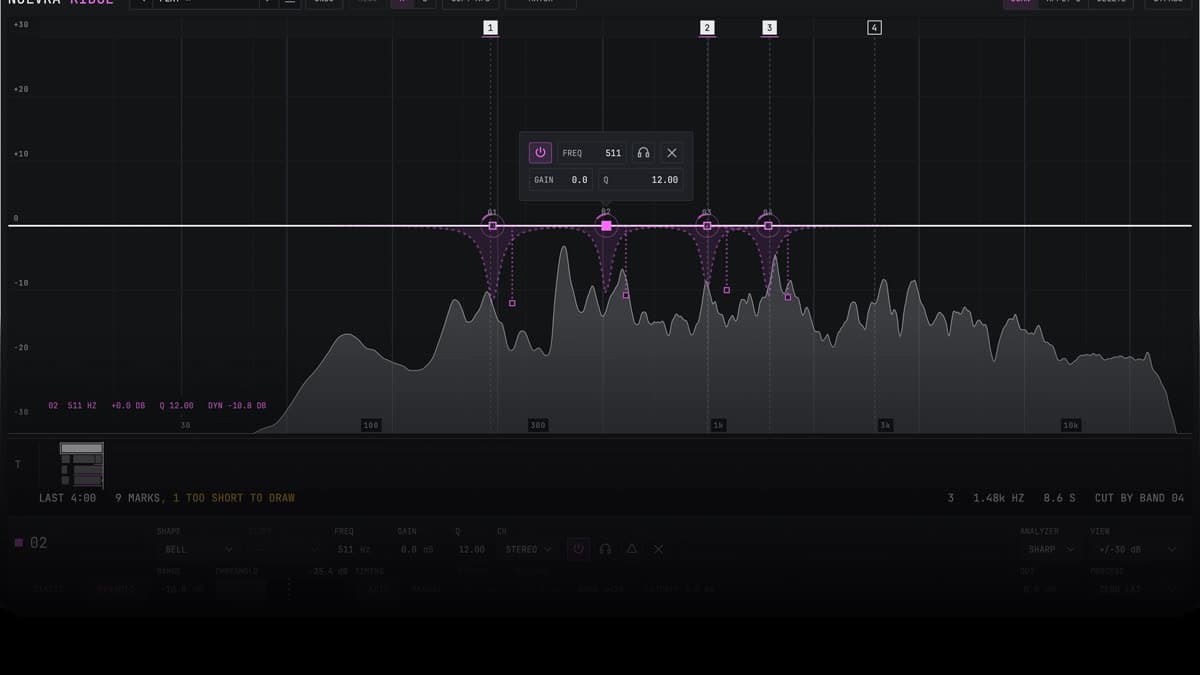
Nolvra shipped RIDGE and IMAGER as two mixing plugins with the same install path. RIDGE is a 24-band dynamic EQ with a resonance scan. Street price is $89. IMAGER is a three-band stereo width tool that prints mono fold-down loss in dB. Street price is $79. Both sit in Nolvra All-Access at $19.99/month or $199/year. A 7-day trial opens them with no card.
At a glance: RIDGE $89. IMAGER $79. Both in All-Access. AU, VST3, and standalone on macOS 11+ Apple Silicon. RIDGE is VST3 on 64-bit Windows. IMAGER is VST3 and standalone on 64-bit Windows. Two machines per licence. Install from Nolvra Hub, or activate a paid plugin with its key.
This is a first look at the shipping plugins and the official product pages. We have not run RIDGE or IMAGER in a session yet.
What Nolvra is shipping
Nolvra's public pitch is "tools that sound finished." The catalog already has PRISM (talkbox), RAW (de-reverb), RELIC (free vintage FX), PLUNGE, and SURGE. RIDGE and IMAGER are the mix-desk pair: one finds ringing, one prices stereo width in decibels.
Both plugins are versioned as first releases. RIDGE is 0.24.3. IMAGER is 0.8.7. The official changelog dates those drops 6 September 2026. Updates go through Hub. Hub itself wants macOS 14+ Apple Silicon or 64-bit Windows. The plugins' own floor is lower: macOS 11+ Apple Silicon. A licensed plugin can be activated with its key if you would rather skip Hub.
It sits next to tools we already cover, with a cheaper street and a narrower format list. FabFilter Pro-Q 4 is the surgical EQ with spectral dynamics and surround. soothe3 is a resonance suppressor, not a 24-band EQ. TDR Nova is the free dynamic EQ. IMAGER's closest named comparison on the official page is iZotope's free Ozone Imager. Nolvra's pair is two separate purchases, or one All-Access plan.
RIDGE: 24 bands and a scan
RIDGE is an equalizer you can finish a record in, plus a button that does the resonance hunt. Press SCAN. It listens to the take, marks up to eight resonances, and leaves those marks on a time axis. A ring is a moment as well as a frequency. Official argument: loudness cannot tell a sung note from a planted ring, because the note is also a narrow peak. Time can. SCAN watches a five-second window and only reports what stayed through enough of it.
APPLY turns the standing marks into bands. Static gain stays flat. The cut lives in the dynamic range, so a band moves when that frequency rings and sits still when it does not. One undo takes the whole APPLY back. DELETE removes only the scan-made bands.
Scan controls are the ones you will actually set:
- Sensitivity — how far above its neighbourhood a peak has to stand. Default 50%.
- Min / max — the window. Default 60 Hz to 16 kHz.
- Max count — one to eight marks. Default four.
MATCH reads how much level your moves added or took away and prints the figure, so A/B is the same loudness.
The rest of the EQ is the full desk. Twenty-four bands. Six shapes: bell, low shelf, high shelf, low cut, high cut, notch. Ten slope rungs from 6 dB/oct up to a 192 dB/oct brickwall. Five placements: stereo, mid, side, left, right. Each band has its own dynamics: threshold, attack, release, range, and a sidechain filter. Threshold is a level in dBFS, not a running average. AUTO can estimate a band's ordinary level and offset from there. Range means what it says: at threshold plus span, applied gain is the range. Positive opens. Negative ducks.
This release is zero latency. PROCESS lists natural phase and linear phase. If the engine falls back, the bar prints MODE FELL BACK. The analyzer has three smoothing steps: SMOOTH, MID, SHARP. 453 parameters are published and locked from the first release. Twenty-seven factory presets ship, sorted by job.
What it does not have is on Nolvra's own comparison table: no spectral dynamics, no surround / Atmos, no vintage models, no saturation stage.
Q numbers are narrower than Pro-Q 4 at the same dial value. RIDGE uses textbook Q. Pro-Q's dial is softer by a factor of √2, so RIDGE at Q 2.0 matches Pro-Q at about Q 2.8. That is Nolvra's measured figure, not a review-desk claim.
IMAGER: three bands and a needle
IMAGER is a three-band stereo width plugin whose headline is a number. It measures broadband mono fold-down loss at its own output and prints it in dB against two lines: 3.01 dB, where correlation hits zero and half the power is gone, and 6.02 dB, where three quarters of it is. The reading is measured, not predicted, and it is taken after the plugin, so it is the figure for what you are sending out.
Width is 0.00 to 2.00, linear in the ratio. Zero is mono. One is unchanged. Two is twice the side level. The low band is capped at unity, and that ceiling sits on the parameter, so the host, the preset, and the automation lane can all see it. Low crossover: 40 Hz to 400 Hz, opens at 120 Hz. High crossover: 800 Hz to 8 kHz, opens at 2500 Hz. They stay at least 100 Hz apart. The low crossover is skewed to resolve single hertz near the bottom.
Three listen switches sit after the needle's tap, so none of them can move the reading:
- DELTA — output minus the same signal at unity width.
- MONO — the same sum the needle measures.
- SOLO — one band's mid or side, six taps.
There is no AI and no analysis pass. There is also no automatic width correction. An earlier version pulled width down when a band went out of phase. Nolvra measured that guard back out: it moved level most where it helped least. The official decision is warning over silent correction. IMAGER can break its own 3 dB line on real material, and it says so while doing it.
Nine controls publish to the host. Light and dark themes share the same geometry. Installer is 6.1 MB on macOS and 5.4 MB on Windows.
RIDGE and IMAGER specifications
| Spec | RIDGE | IMAGER |
|---|---|---|
| Job | 24-band dynamic EQ + resonance scan | 3-band stereo width + fold-down needle |
| Headline control | SCAN / APPLY / MATCH | Needle at 3.01 dB and 6.02 dB |
| Price | $89 | $79 |
| Trial | 7 days, no card | 7 days, no card |
| All-Access | Yes | Yes |
| macOS | 11+, Apple Silicon, AU / VST3 / standalone | 11+, Apple Silicon, AU / VST3 / standalone |
| Windows | 64-bit VST3 | 64-bit VST3 + standalone |
| Version | 0.24.3 | 0.8.7 |
| Installer | 11.1 MB macOS / 4.8 MB Windows | 6.1 MB macOS / 5.4 MB Windows |
| Licence | 2 machines, Hub or key | 2 machines, Hub or key |
| Latency | Zero in this release | No analysis pass |
RIDGE vs Pro-Q 4, soothe3, and Nova
| RIDGE | Pro-Q 4 | soothe3 | TDR Nova | |
|---|---|---|---|---|
| Bands | 24 | up to 24 | Dynamic resonances | 4 dynamic + HP/LP |
| Resonance scan | Yes, up to 8, with a time axis | No | Continuous dynamic | No |
| Spectral dynamics | No | Yes | That is the product | No |
| Surround | No | up to 9.1.6 | No | No |
| Price | $89 | $199 | $259 / €229 / £199 | Free |
| Formats | AU, VST3, standalone (Win VST3) | VST, VST3, AU, CLAP, AAX | VST3, AU, AAX | VST, VST3, AU, AAX |
Pick RIDGE when you want a 24-band dynamic EQ that will mark ringing for you, and you can live without spectral dynamics, Atmos, and AAX. Pick Pro-Q 4 when those missing rows are the job. Pick soothe3 when you want a suppressor that hunts harshness, not an EQ you finish the record in. Pick TDR Nova when free is the constraint. MDrumCleaner is the other current cleaner on this desk, and it treats drum-mic bleed, not mix resonances.
IMAGER vs a free imager
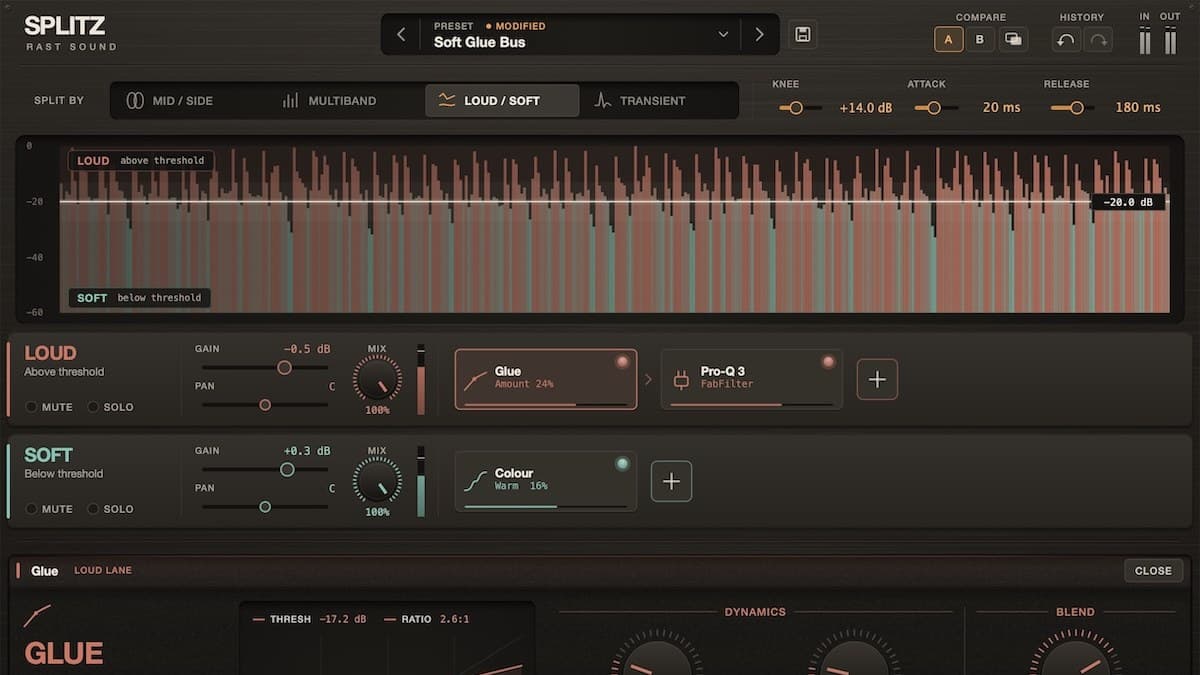
Nolvra's own table puts IMAGER next to Ozone Imager. The free tool draws the stereo field with vectorscopes. IMAGER prints a fold-down number and splits width into three bands with a hard low-band ceiling. iZotope's imager is the picture. Nolvra's is the meter plus the three faders. If you want separate effects on the centre and the sides rather than a width meter, see our Splitz first look.
Ozone 11 is a mastering suite that happens to include imaging. IMAGER is one insert with nine controls. If you already live in Ozone, you may not need a second width tool. If you want the fold-down figure on the mix bus while you move low / mid / high, IMAGER is the dedicated plugin.
Who these are for
RIDGE suits mixers who still sweep a bell to find ringing and would rather press SCAN, then finish the EQ by hand. IMAGER suits anyone who already folds the mix to mono and wants a number next to that habit. The 7-day trial, no card, is the reason to try both before you pick a single licence or All-Access.
Skip RIDGE if you need AAX, Intel Mac, spectral dynamics, or surround. Skip IMAGER if you only wanted a vectorscope. Skip both if your "Mac" is an Intel machine: Apple Silicon is the floor.
All-Access also opens PRISM PRO, RAW, PLUNGE, SURGE, and the sample side of the catalog. If you already wanted two Nolvra tools, the plan is the cheaper path. $19.99/month or $199/year (about $16.58/month). Cancel and access runs to the end of the period you paid for.
How much do RIDGE and IMAGER cost?
RIDGE is $89. IMAGER is $79. Both figures are on nolvra.com and the product pages. All-Access is $19.99/month or $199/year. The trial is 7 days, no card, and nothing charges itself when it ends.
Two machines per paid licence, any mix of Mac and Windows. Hub can free a slot through support@nolvra.com with the order number. Sample packs are not on the plugin trial; they open with a purchase or a membership.
FAQ
What is Nolvra RIDGE?
A 24-band dynamic EQ with a resonance scan. SCAN marks up to eight rings on a time axis. APPLY writes those marks into dynamic bands.
What is Nolvra IMAGER?
A three-band stereo width plugin that prints mono fold-down loss in dB against 3.01 dB and 6.02 dB lines. The low band cannot go wider than unity.
How much do they cost?
RIDGE $89. IMAGER $79. Both are in All-Access at $19.99/month or $199/year. Seven-day trial, no card.
Do they run on Windows and Intel Mac?
Windows is 64-bit VST3 (IMAGER also standalone). Mac is Apple Silicon, macOS 11+. No Intel Mac. No AAX.
Does IMAGER fix mono problems for me?
No. It measures the loss and leaves the width where you put it. Nolvra removed an automatic guard on purpose.
Verdict
RIDGE and IMAGER are two focused mix inserts from the same Hub. One scans ringing and gives you a 24-band dynamic EQ at $89. The other prints fold-down in dB and caps the low band at $79. The trial is a week with no card. They will not replace Pro-Q 4 or a full Ozone suite. If the jobs are "find the ring" and "price the width," these are the Nolvra tools for those two sentences.