oeksound soothe3 Review: The Resonance Suppressor Grows Up
soothe3 review: oeksound's dynamic resonance suppressor gets a Detail knob, Soft mode, and low-latency processing. Pricing, upgrades, and how it beats soothe2.
See full specs, price, and alternatives in the plugin database →
oeksound released soothe3 on May 19, 2026, and it is the most meaningful update the resonance suppressor has seen. soothe2 already sat on countless vocal chains and mastering buses. soothe3 keeps that engine intact and rebuilds the parts that slowed you down. The result is faster to dial in and, on the right source, cleaner. The current first look is Northstar.
Key facts: soothe3 costs $259 / €229 / £199. It processes in VST3, AU, and AAX, up to 9.1.6 channels. The headline additions are a single Detail knob, a new Soft mode, a low-latency mode, flexible node editing, and a collapsible interface. A fully featured 20-day trial is available from oeksound.
soothe3 at a glance
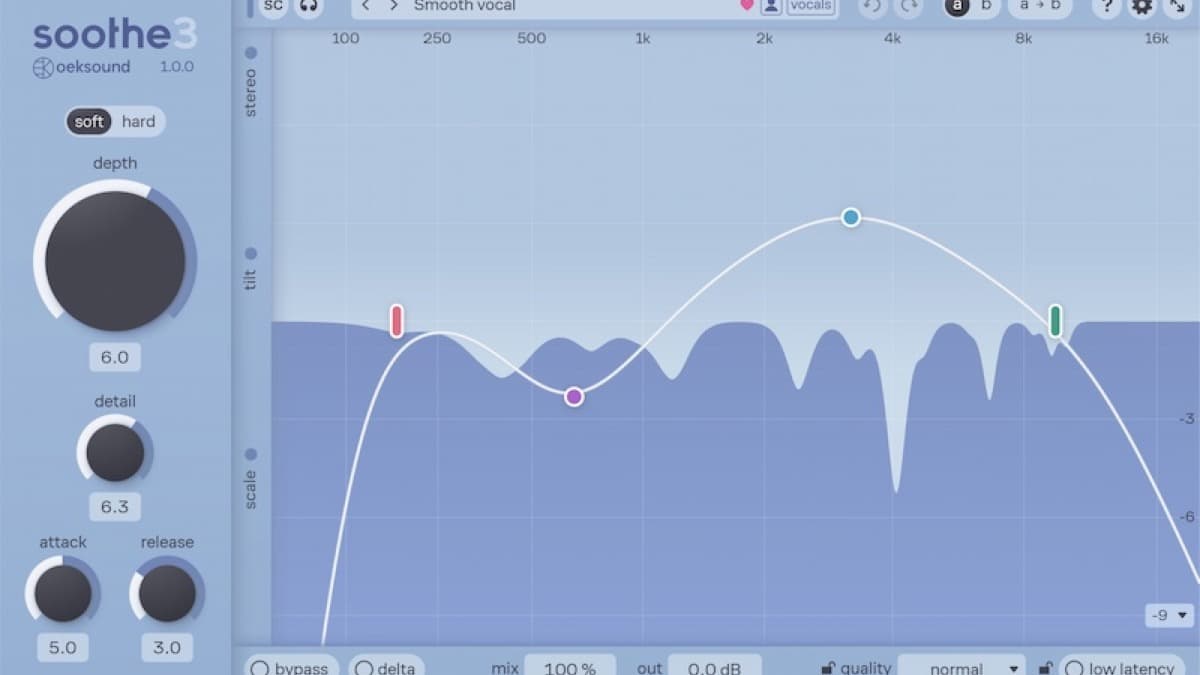
soothe3 is a dynamic resonance suppressor. It scans your signal in real time, finds resonant peaks as they spike, and ducks only those frequencies only when they misbehave. You get harshness control without gutting the tone. That is the same core idea that made soothe2 a studio staple.
What changed is control. soothe2 asked you to balance two overlapping parameters. soothe3 merges them, adds a smarter processing mode, and lets you build the detection curve node by node. The plugin now feels less like a science experiment and more like an instrument.
Here is the short version of what you are buying:
- Detail knob — one control that replaces soothe2's sharpness and selectivity
- Soft and Hard modes — adaptive versus fixed threshold behavior
- Low-latency mode — zero samples at base sample rates
- Node editing — create, delete, and reshape detection bands
- Eight band shapes — including bandpass and tilt
- Collapsible panel — essentials up front, advanced controls hidden
- Up to 9.1.6 — full immersive channel support
What is new in soothe3
The Detail knob
oeksound calls the Detail knob the biggest upgrade in soothe3, and it is easy to see why. soothe2 split the reduction character across two controls, sharpness and selectivity. They interacted in ways that were hard to predict, so dialing in a vocal often meant nudging both and listening carefully.
soothe3 folds that behavior into one knob. Turn it up for tighter, more precise reduction. Turn it down for broader, gentler smoothing. On vocals especially, the response feels smoother and more musical across the range. Fewer controls, better results. That is a good trade.
Soft mode and Hard mode
soothe3 ships with two processing modes. Soft mode uses a new adaptive-threshold algorithm that tracks the level of the source and adjusts as it moves. That makes it a strong fit for dynamic instruments, where a fixed threshold can over-react on loud passages and under-react on quiet ones.
Hard mode keeps soothe2's fixed-threshold behavior. It hits harder and more predictably, which is what you want for aggressive control on stubborn resonances. Hard mode also preserves the popular sidechain trick, where you drive the detection from a separate signal for creative ducking. You lose nothing from the old workflow and gain a gentler option.
Low-latency mode
This is the practical one. soothe2's lookahead made it awkward to run while tracking. soothe3 adds a low-latency mode that reports zero samples at base sample rates and roughly 1 ms at higher rates. That means you can leave soothe3 on a vocal or guitar during recording without a distracting delay in the performer's headphones.
Nodes, shapes, and tilt
soothe3 lets you build the detection profile directly. You can create and delete nodes, then choose from eight band shapes, including bandpass and tilt. Add a new tilt control, a max cut parameter to cap how much the plugin removes, and a linear phase mode for parallel and mastering work, and the targeting gets genuinely surgical. A collapsible side panel hides the advanced settings until you want them, so the everyday view stays clean. A newer mastering plugin in this lane is Northstar.
soothe3 specifications
| Spec | Detail |
|---|---|
| Plugin type | Dynamic resonance suppressor |
| Release date | May 19, 2026 |
| Price | $259 / €229 / £199 |
| Formats | VST3, AU (macOS), AAX (Pro Tools 2018.1+) |
| Architecture | 64-bit only; no Windows ARM |
| Windows | Windows 10 and 11 |
| macOS | macOS 10.14 Mojave through macOS 26 Tahoe |
| Apple Silicon | Supported natively; Intel through macOS 15 |
| Channels | Mono through 9.1.6 immersive |
| Processing modes | Soft (adaptive threshold), Hard (fixed threshold) |
| Latency | Low-latency mode: 0 samples at base rates, ~1 ms at higher rates |
| Notable controls | Detail, tilt, max cut, linear phase, eight band shapes |
| Trial | Fully featured 20-day trial |
soothe3 vs soothe2: what actually changed
If you already own soothe2, this is the comparison that matters. The engine is familiar. The workflow is not.
| Feature | soothe2 | soothe3 |
|---|---|---|
| Reduction character | Sharpness + selectivity (two controls) | Single Detail knob |
| Processing modes | Soft and Hard (fixed threshold) | Soft (adaptive) and Hard (fixed) |
| Low-latency option | No | Yes, 0 samples at base rates |
| Node editing | Limited | Create, delete, reshape nodes |
| Band shapes | Fewer | Eight, including bandpass and tilt |
| Tilt / max cut controls | No | Yes |
| Linear phase mode | No | Yes |
| Channel support | Stereo and mid/side | Up to 9.1.6 immersive |
| Interface | Fixed layout | Collapsible advanced panel |
| Sidechain trick | Yes | Yes, retained in Hard mode |
The takeaway is simple. soothe3 keeps everything engineers relied on and removes the friction. The Detail knob alone saves time on every vocal. Low-latency mode opens up tracking. The extra shapes and nodes turn broad suppression into precise sculpting.
Who soothe3 is for
soothe3 earns its place on demanding sources. It shines on vocals, where sibilance and midrange harshness sit right where the ear is most sensitive. It tames the ringing on acoustic guitars, the ice-pick top of cymbals and overheads, and the buildup on a busy master. If you mix and master regularly, it replaces a rack of manual dynamic-EQ moves with one adaptive process.
It is less essential if your sessions are simple. A clean, well-recorded source with an occasional harsh note may not need a dedicated suppressor. In those cases a good de-esser or a couple of dynamic-EQ bands will do. soothe3 is a specialist tool that repays heavy, repeated use.
One habit to watch: restraint. Like transient shaping and other corrective tools, soothe3 is easy to overuse. Push it too hard and a mix loses air and life along with the harshness. Set the max cut parameter, trust your ears, and pull back until you only hear the problem leave.
Pricing, upgrades, and the trial
soothe3 costs $259 / €229 / £199 direct from oeksound. There is no separate "intro" tier — that is the full price.
Upgrade pricing is generous. If you own soothe2, the upgrade to soothe3 is $55 / €50 / £45. Better still, anyone who bought soothe2 on or after February 18, 2026 gets soothe3 free under oeksound's grace period. If you purchased soothe2 recently, check your account before paying for anything.
Two more routes make it easier to try or spread the cost:
- 20-day trial — the full plugin, no feature limits, so you can test it on real sessions
- Rent-to-own — $14.90/month across 18 payments, which ends at ownership
oeksound sells soothe3 exclusively through its own store, so the official soothe3 page is the place to buy, upgrade, or start the trial.
soothe3 vs the alternatives
soothe3 occupies a narrow, well-defended lane. The closest tools solve related problems in different ways.
FabFilter Pro-Q 4, available at Plugin Boutique, is a superb dynamic EQ, but it asks you to find and target each resonance yourself. soothe3 does the hunting automatically. Soundtheory Gullfoss is a broadband tonal balancer that reshapes the whole spectrum rather than ducking specific resonances. And iZotope Ozone 11 — from a company now part of Boris FX — is a full mastering suite, not a dedicated suppressor. If your specific problem is resonance, soothe3 remains the sharpest tool for it.
Verdict
soothe3 is a sequel done right. oeksound left the celebrated engine alone and fixed the things that slowed people down. The Detail knob makes tuning intuitive. Soft mode sounds cleaner on dynamic sources. Low-latency processing finally lets you run it while tracking. The extras — nodes, shapes, tilt, max cut, linear phase — turn a great suppressor into a precise one.
The trade-offs are the same ones soothe has always carried. It leans on your CPU, and it rewards a light touch. Neither is a dealbreaker. For anyone who fights harshness on vocals, guitars, or masters, soothe3 is an easy recommendation, and the free upgrade for recent soothe2 buyers makes it easier still.
soothe3 FAQ
What does soothe3 do?
soothe3 is a dynamic resonance suppressor. It scans your audio, detects resonant peaks in real time, and reduces those frequencies only when they spike. That removes harshness, sibilance, and ringing while keeping the underlying tone intact.
How much does soothe3 cost?
soothe3 costs $259 / €229 / £199 direct from oeksound. Upgrading from soothe2 is $55 / €50 / £45, and it is free for anyone who bought soothe2 on or after February 18, 2026. A rent-to-own plan runs $14.90 per month across 18 payments.
What is the difference between soothe3 and soothe2?
soothe3 replaces soothe2's sharpness and selectivity controls with a single Detail knob, adds an adaptive-threshold Soft mode, and introduces a low-latency mode. It also adds node editing, eight band shapes, tilt and max cut controls, linear phase processing, and immersive channel support up to 9.1.6.
Can I run soothe3 while recording?
Yes. soothe3's new low-latency mode reports zero samples of latency at base sample rates and about 1 ms at higher rates. That makes it practical to leave on a vocal or guitar during tracking without a noticeable delay in the headphones.
What formats and systems does soothe3 support?
soothe3 runs as a VST3, AU, and AAX plugin (Pro Tools 2018.1 and up). It is 64-bit only, with no Windows ARM support. It works on Windows 10 and 11, and on macOS from 10.14 Mojave through macOS 26 Tahoe, with native Apple Silicon support and Intel support through macOS 15.