mo0kid wave: An Open-Source Waldorf Wave for Your DAW
mo0kid wave is a free, open-source emulation of the 1993 Waldorf Wave that runs the original firmware, with 48 voices, for macOS. Here is how it works.
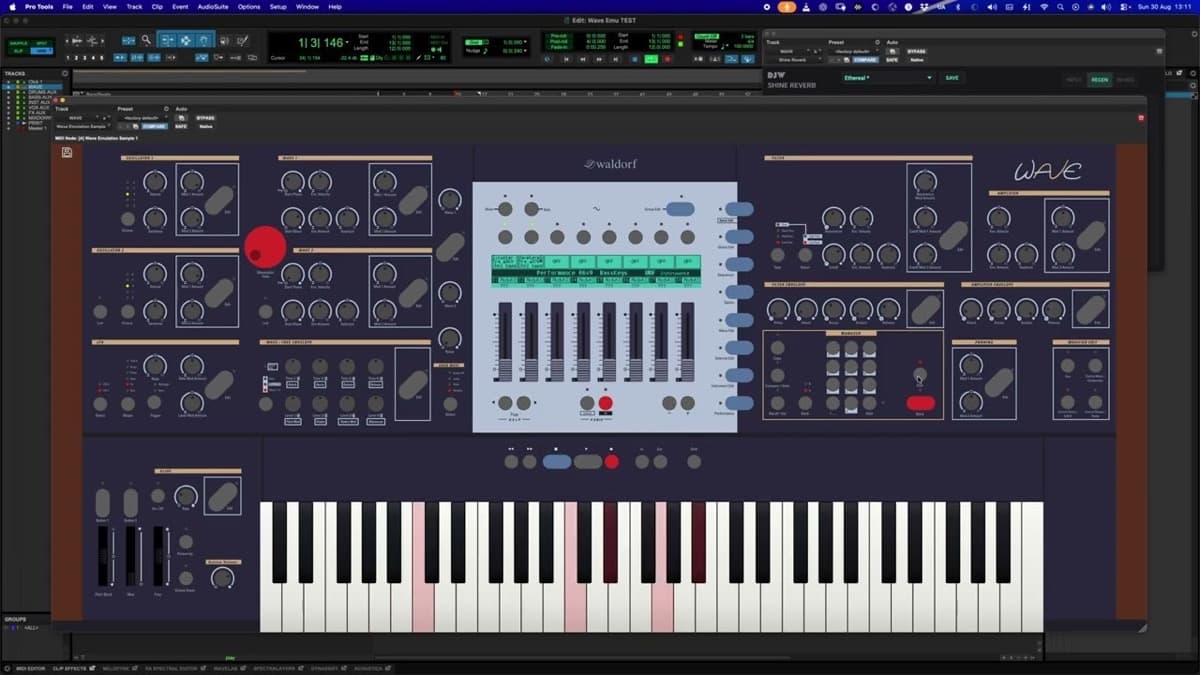
Developer Dave Whiting, who works under the name mo0kid, has released wave, a free and open-source emulation of the Waldorf Wave. The Wave was a hybrid wavetable synthesizer from 1993: big, rare, and expensive. This project rebuilds its signal path in software. It is a first look based on the developer's own repository and release notes, not a hands-on review.
At a glance: mo0kid wave is free and open source under the GPL-3.0 license. It runs on macOS Ventura 13.0 or later, native on Apple Silicon and Intel, as a standalone app and as AU, VST3, and AAX plugins. It emulates 48 voices. It is not a lookalike synth. It executes the real Waldorf firmware, which means you must supply your own Wave system files, so this is a project for the technically curious as much as for musicians.
What is mo0kid wave?
The original Waldorf Wave was the German company's flagship, a hybrid instrument that paired huge digital wavetable oscillators with resonant analog filters. It shipped with up to 48 voices in its largest configuration and a reputation for enormous, complex sound. Very few were made, and clean examples now sell for the price of a car. That rarity is exactly why a faithful software version matters.
mo0kid wave takes an unusual route to that faithfulness. Rather than approximate the Wave with modern DSP, it emulates the machine itself. An emulated 68000 CPU runs the original main operating system, while a second runtime executes the genuine WDV voice-board program. The project models the hardware signal path, including the ES2 oscillator ASIC, the CEM3387 filters, and even the 480 by 64 monochrome display. In other words, it is closer to a hardware emulator than to a synth inspired by the Wave. This is the same firmware-level approach used by projects that emulate old ROM-based instruments, and it comes from a developer with form: Whiting also built the well-regarded MM and MD emulator with Maschine integration.
What mo0kid wave gives you
A firmware-level Waldorf Wave. The headline is authenticity of method. Because the project runs the original operating system and voice-board code, its behavior follows the hardware rather than a modern reinterpretation of it. The oscillators, wavetables, and filters respond the way the machine did, since it is the machine's own logic doing the work.
48 voices across three cards. The emulation models three 16-voice cards for 48 voices in total, matching the fully expanded hardware. At higher polyphony it spreads rendering across multiple CPU threads, which keeps a large voice count practical on a modern computer.
Standalone and plugin formats. It builds as a standalone application and as AU, VST3, and AAX plugins, so it slots into a DAW or runs on its own. The current release targets macOS Ventura 13.0 and later, with universal builds for Apple Silicon and Intel.
Open source you can read and change. Everything is published under the GPL-3.0-or-later license, so you can study the code, build it yourself, and contribute. For anyone interested in how a classic digital synth actually worked under the hood, the repository is a resource in its own right.
The firmware requirement
There is an important condition. mo0kid wave does not include Waldorf's firmware or factory sounds. To run the real emulation, you must obtain your own Waldorf Wave OS 1.700 system files, specifically the files named w2sys.bin and wdv.sys. The project ships only its own GPL code, plus a set of decoded PPG V6 wavetables as a fallback, and no executable firmware.
That mirrors how other firmware-level emulators work, and it exists for good legal reasons. The code is free and open, but the copyrighted firmware is not the developer's to distribute. In practice this means the smoothest path is owning or having legitimate access to a Wave and its system files. It is worth knowing before you download, so the requirement does not come as a surprise.
The developer is also clear about scope. The project describes itself as a useful, buildable hardware-model foundation rather than a claim of bit-perfect emulation. The oscillator ASIC remains, in the developer's words, an undocumented black box, and further calibration will need real hardware measurements. This is version 0.1.6, an early release, not a finished commercial product.
mo0kid wave specifications
| Spec | Detail |
|---|---|
| Type | Firmware-level emulation of the Waldorf Wave (hybrid wavetable) |
| Developer | Dave Whiting (mo0kid) |
| Method | Emulated 68000 CPU running original OS, plus WDV voice-board runtime |
| Modeled hardware | ES2 oscillator ASIC, CEM3387 filters, 480 by 64 display |
| Voices | 48 (three 16-voice cards), multi-threaded rendering |
| License | GPL-3.0-or-later (JUCE 8 under AGPLv3 or commercial) |
| Formats | Standalone, AU, VST3, AAX |
| System | macOS Ventura 13.0 or later, Apple Silicon and Intel |
| Firmware | User must supply Waldorf Wave OS 1.700 files (not included) |
| Version | 0.1.6 |
mo0kid wave vs Vital
For most producers who just want a free wavetable synth, the practical alternative is Vital, the modern spectral wavetable instrument. Vital is polished, cross-platform, and installs in seconds with a full preset library. mo0kid wave is a different proposition, a historically accurate recreation of a specific 1993 machine that asks for effort and firmware files in return for authenticity.
| mo0kid wave | Vital | |
|---|---|---|
| What it is | Emulation of the 1993 Waldorf Wave | Modern spectral wavetable synth |
| Sound goal | Faithful to the original hardware | New, flexible wavetable design |
| Setup | Needs original firmware files | Download and go |
| Platforms | macOS (Ventura 13.0-plus) | macOS, Windows, Linux |
| Price | Free, open source | Free, with paid tiers |
| Reach for it when | You want the real Wave | You want a fast modern synth |
Which to pick. If you want a wavetable synth to make music now, Vital is the obvious choice. If you are chasing the specific sound and behavior of the Waldorf Wave, or you love the idea of running its real firmware in your DAW, mo0kid wave is a rare free way to do it. Fans of the Waldorf sound can also look at the Waldorf Microwave 1 for the wavetable lineage that led here.
Who mo0kid wave is for
Download it if you are a Waldorf devotee, a vintage-digital synth enthusiast, or a developer curious about how these machines worked. The firmware-level approach is unusual, and the price is zero.
It suits you if you already have access to a Wave and its system files, since that removes the one real hurdle to hearing the full emulation.
Skip it if you just need a plug-and-play wavetable synth, you are on Windows or Linux today, or you are not comfortable sourcing firmware and possibly building from source. In that case a ready-made option serves you better.
How much does mo0kid wave cost?
Nothing. mo0kid wave is free and open source, published on GitHub under the GPL-3.0-or-later license. You can get mo0kid wave from the repository, where the release notes cover the current build and requirements. Remember that you supply the Waldorf firmware files yourself.
If you would rather have a supported, no-firmware synth alongside it, Arturia Pigments is a strong modern option, and our guide to the best free synth VSTs of 2026 rounds up the best no-cost instruments. Whiting's other emulation work is worth a look too, in our coverage of the MD and MM emulator.
FAQ
Is mo0kid wave really free?
Yes. It is free and open source under the GPL-3.0-or-later license. There is no cost for the software, though you must legally supply the original Waldorf Wave firmware files to run the full emulation.
Why does mo0kid wave need firmware files?
Because it is a firmware-level emulator. It runs the Waldorf Wave's actual operating system and voice-board code, which are copyrighted and not the developer's to share. The project provides only its own GPL code and a wavetable fallback, so you must obtain the Wave OS 1.700 files yourself.
What platforms does mo0kid wave support?
The current release targets macOS Ventura 13.0 or later, with universal builds for Apple Silicon and Intel. It runs as a standalone app and as AU, VST3, and AAX plugins.
Is mo0kid wave a finished, accurate emulation?
It is an early release, version 0.1.6, and the developer describes it honestly as a buildable hardware-model foundation rather than a bit-perfect emulation. The oscillator ASIC is not fully documented yet, so accuracy will improve with further work.