Behringer D Mini: Minimoog Sound for €99
Behringer D Mini is a €99 portable analog synth inspired by the Minimoog Model D, with three oscillators, a 16-step sequencer, MIDI and USB-C. Specs and verdict.
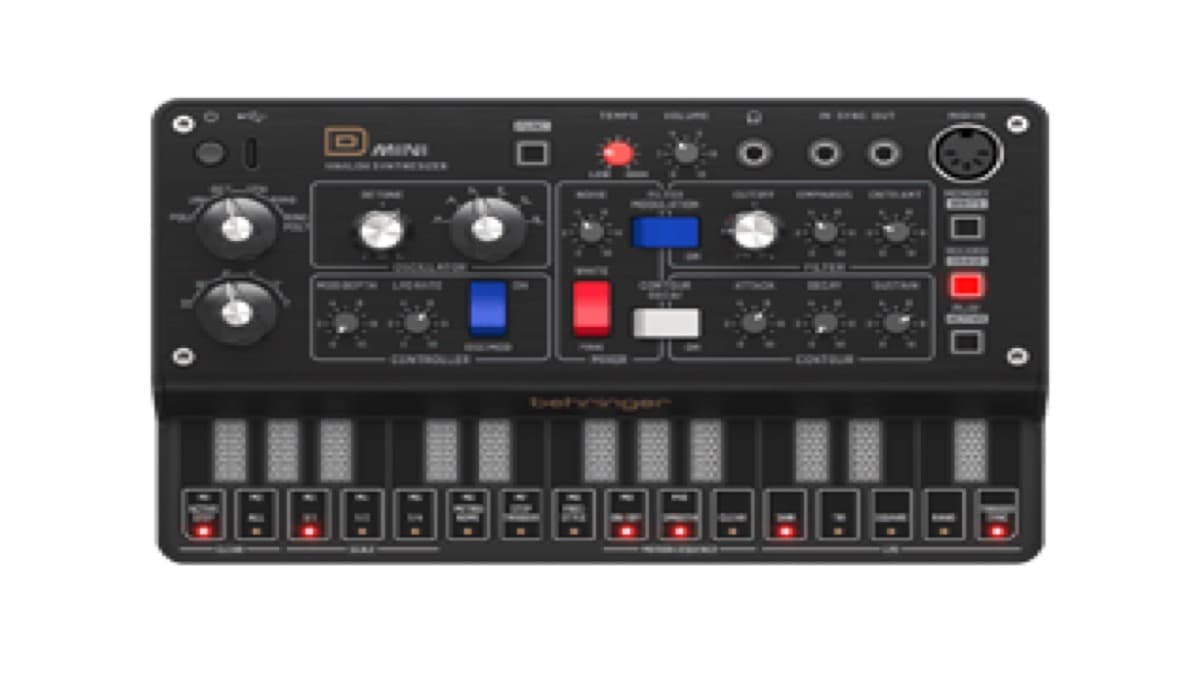
Behringer has started shipping the D Mini, a pocket-sized analog synthesizer built around the classic Minimoog Model D voice. It landed in Europe in mid-August 2026 at €99, after first appearing at NAMM 2026. The first batch sold out almost immediately. This is a first look at the published specification and the shipping product.
At a glance: €99 / $99 direct from Behringer dealers. You get three analog oscillators with five waveforms each, a resonant low-pass filter, a 16-step sequencer, six voice modes, USB-C power, MIDI and sync I/O, and a 27-key touch keyboard. It is monophonic at heart, with a three-voice paraphonic mode on top.
What the Behringer D Mini is
The D Mini is Behringer's smallest take on the Minimoog Model D, the 1970 monosynth that defined analog bass and lead for half a century. Behringer already sells a full-size Model D clone in Eurorack form, plus the four-voice Poly D. The D Mini shrinks that lineage into a slab you can drop in a laptop bag.
It sits in the same pocket-synth category as Korg's Volca line and Behringer's own mini range. But it leads with a specific promise: three real analog oscillators, rather than the one or two you usually get at this size. That is the Model D signature. Stacking and detuning three oscillators into a single filter is how the original made bass lines feel enormous, and the D Mini keeps that architecture intact.
What is new in the D Mini
Three oscillators, five waveforms each
The core of the D Mini is three analog VCOs, each offering five selectable waveforms: sawtooth, triangle, sharktooth, square, and pulse. The sharktooth shape is a Behringer addition the original never had. It adds a brighter, more aggressive edge for leads. Detune the three oscillators slightly and the voice thickens the way a Model D does. Tune them to intervals and a single key plays a chord.
Six voice modes, including paraphonic
The original Minimoog was strictly monophonic. The D Mini adds a voice-mode selector with six options. Alongside standard mono and unison, there is a three-voice paraphonic mode that assigns the three oscillators to three separate notes through the shared filter. A ring-modulator mode covers metallic and clangorous tones. This is not true polyphony, since all voices share one filter and envelope. But paraphony lets you hold simple triads from a monosynth architecture.
The filter, LFO, and noise
A resonant low-pass filter handles the classic Moog-style sweep. It takes the sound from round and dark to a screaming resonant peak. A single LFO with four waveforms drives modulation of pitch, filter, and pulse width. Two envelope generators shape the filter and the amplifier, the same split the original used. White and pink noise generators with their own level control feed the mixer, which matters for percussion, wind effects, and textural layers.
Built-in sequencer and connectivity
The D Mini includes a 16-step sequencer on board. You can lay down a bass line or an arpeggio and let it run without a computer. On the back sit USB-C power, MIDI, and sync I/O, so it slots into a hardware rig or syncs to a DAW. Running the whole thing off a USB power bank makes it a genuine couch or train synth.
Behringer D Mini specifications
| Spec | Detail |
|---|---|
| Product | Behringer D Mini |
| Type | Portable analog synthesizer, Minimoog Model D-inspired |
| Price | €99 / $99 |
| Oscillators | 3 analog VCOs, five waveforms each (saw, triangle, sharktooth, square, pulse) |
| Voice modes | Six, including mono, unison, three-voice paraphonic, and ring modulation |
| Filter | Resonant analog low-pass |
| Envelopes | Two (filter and amplifier) |
| LFO | 1, four waveforms |
| Noise | White and pink, with dedicated level |
| Sequencer | 16-step, built in |
| Keyboard | 27 touch keys |
| Controls | 18 hands-on knobs and switches |
| Power | USB-C (bus power / power bank) |
| Connectivity | MIDI, sync I/O, USB-C |
| Patch memory | None for the analog panel |
| Availability | Shipping in the EU from August 2026 |
Behringer D Mini vs Behringer Poly D vs Korg Monologue
The D Mini's obvious rivals are its bigger sibling and Korg's compact analog mono.
| D Mini | Behringer Poly D | Korg Monologue | |
|---|---|---|---|
| Price | €99 / $99 | Around €400 | Around €300 |
| Oscillators | 3 VCOs | 4 VCOs | 1 VCO + sub |
| Voices | Mono / 3-voice paraphonic | Mono / 4-voice paraphonic | Monophonic |
| Filter | Resonant low-pass | Ladder low-pass | 2-pole analog |
| Sequencer | 16-step | 32-step | 16-step |
| Keyboard | 27 touch keys | 37 full-size keys | 25 slim keys |
| Patch memory | None | None | 100 presets |
| Best for | Cheapest portable Model D voice | Desktop Model D with a real keyboard | Gigging mono with presets |
Which to pick. Choose the D Mini if the goal is a real three-oscillator analog voice at the lowest possible price and size. Choose the Poly D if you want the same lineage with a playable keyboard and a fourth oscillator. Choose the Korg Monologue if you need patch memory and a sturdier keybed for the stage. For a software route to the same sound, our Moog Model D plugin card covers the original in your DAW.
Who the D Mini is for
Consider it if you want an analog Minimoog-style voice and €99 is an easy yes. Three oscillators through a resonant filter is the real thing, not a digital model, and it runs off a power bank.
Consider it if you already have a controller keyboard and MIDI rig. Drive the D Mini over MIDI and the touch keyboard stops mattering.
Skip it if you need an expressive velocity keyboard or saved presets. The touch plate is fine for triggering the sequencer and sketching, but it is not a performance keybed, and the analog panel does not store patches.
Skip it if you already own a Model D or Poly D. The voice is the same family, so you would mainly be buying portability.
How much the D Mini costs
The Behringer D Mini streets at €99 / $99. In Europe it is available now, and stock has been selling out in batches. Check the current price at Thomann, or find it through Behringer's dealer network. There is no subscription, no account, and no copy protection. It is a hardware instrument you own outright.
FAQ
Is the Behringer D Mini polyphonic?
Not fully. It is monophonic by design, with a three-voice paraphonic mode that lets the three oscillators sound three notes through one shared filter and envelope. That is enough for simple held chords, but it is not true polyphony.
Does the D Mini have a real keyboard?
It has a 27-key touch-plate keyboard, not a mechanical velocity keybed. For expressive playing, drive it from a MIDI controller over its MIDI input.
Is the D Mini analog?
Yes. The three oscillators and the low-pass filter are analog. The sequencer and MIDI handling are digital, as they are on most modern analog synths.
D Mini vs Poly D?
The Poly D is larger, costs around four times as much, and adds a fourth oscillator and a full 37-key keyboard with four-voice paraphony. The D Mini trades the keyboard and a voice for a much smaller box and a €99 price.
What are the connections?
USB-C for power, MIDI for note and CC control, and sync I/O for clocking with other hardware.
The bottom line
The D Mini puts a three-oscillator, Model D-style analog voice into a box the size of a paperback for €99. A built-in sequencer, six voice modes, and full MIDI make it more flexible than its size suggests, and USB-C power keeps it genuinely portable. The touch keyboard and the lack of patch memory are the trade-offs you accept for that price and footprint.
This is a first look at Behringer's published specification, not a scored bench test in our own studio. If a cheap, real analog Minimoog voice is what you have been waiting for, the D Mini is the least expensive way in yet.