Some links on this page are affiliate links. If you buy through them, Dubspot may earn a commission at no extra cost to you. It never affects our scores or what we recommend — read our policy.
Microvolt 3901 Puts Pittsburgh Modular's Synth in a Plugin
Pittsburgh Modular's Microvolt 3901 rebuilds the 3900 semi-modular synth in software: seven oscillators, 19 effects, a full patch bay and six-voice polyphony.
M
Marcus Feld
October 28, 2026 · 9 min read
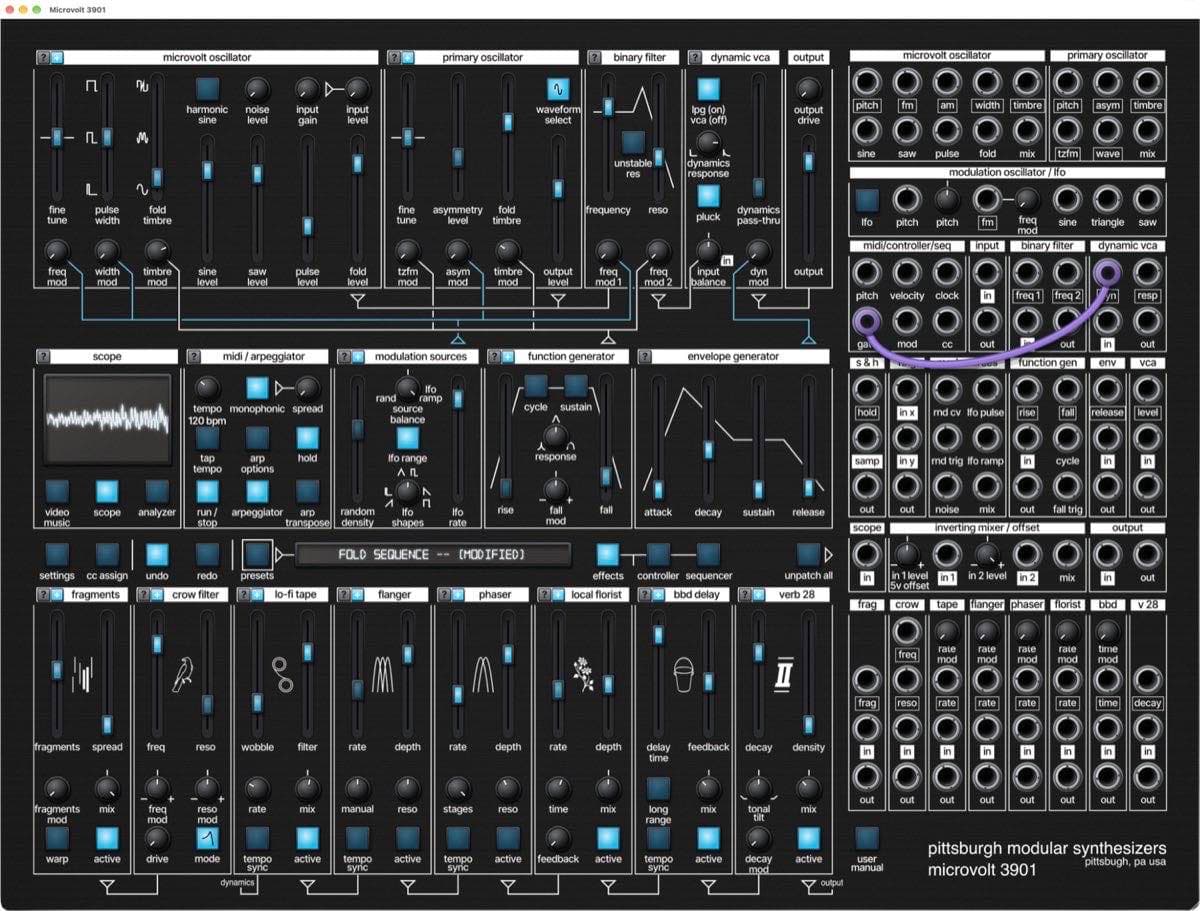
Pittsburgh Modular has released Microvolt 3901, a software version of its Microvolt 3900 semi-modular synth. It's a component-level emulation of the hardware, bundled with a collection of the company's classic Eurorack modules in one fully patchable instrument. The desktop version costs $69, with an iPad build on the way.
At a glance: a patchable virtual-analog synth with seven oscillators, ten modulation sources, 19 effects, a 16-step sequencer and a touch-plate keyboard. Six-voice polyphony, or mono with up to six unison voices. Standalone, VST3 and AU, with 200 presets and a 7-day free trial. $69 for Mac and Windows.
What is the Microvolt 3901?
The Microvolt 3900 is Pittsburgh Modular's desktop semi-modular synth, a monophonic instrument with a Eurorack-style patch bay that earned a following for its gritty, West Coast-leaning character and its willingness to go strange. Like any hardware synth, it takes desk space, ties up an audio input and saves nothing you can't write down on a patch sheet.
Microvolt 3901 is the software answer to that. Pittsburgh Modular models the 3900 at component level rather than sampling it, then goes further than a straight port: the plugin also folds in a set of the company's classic Eurorack modules, so you're patching a small modular system rather than a single fixed synth. The same trend runs through discoDSP's TED-8, which rebuilt the Oberheim TEO-5 as a plugin, and Behringer's Polyeight, which took the hardware route. The 3901 keeps the hardware's sound and patching, then adds what software does best: polyphony, total recall and portability.
What's new when the 3900 becomes software
Seven oscillators, not one. The 3901 carries a spread of oscillator sources rather than a single core. They include the Microvolt oscillator, the Lifeforms SV-1 oscillator, a Primary oscillator from the Voltage Lab mini, a deliberately unruly Generator, a second voltage-controlled oscillator built on the Microvolt core, a Double Helix Wavetable Processor and a DNA Symbiotic Waves waveform processor. That mixes classic analog-style tones with wavetable and waveform-shaping sources in one instrument.
A full patch bay with no cables to coil. Patch cables route audio and control voltage between modules exactly as they would on hardware, so you can send an envelope to a filter, an oscillator into another oscillator, or an effect back into the signal path. The difference is that every connection is recalled with your project and nothing physical gets in the way.
Ten modulation sources, including chaos. Modulation comes from ten sources: a VILFO, a dual LFO, a function generator, a Game System, the Microvolt modulation sources, a three-stage envelope, an envelope generator, a modulation oscillator, sample and hold, and a ring modulator. The Game System and the function generator in particular push patches into movement that is hard to plan and easy to stumble into.
Nineteen effects you can patch inside the synth. The effects list runs to 19: Fragments, Crow Filter, Lo-Fi Tape, Flanger, Phaser, Chorus, Local Florist, three delays (Digital, BBD and a 2399), three reverbs (Reverb, Verbtronic and 28 Verb), Fuzz, Overdrive, Resonator, Texture, Bit Crush and a Compressor. They can sit at the end of the chain or be patched inside the synth, so an effect can become part of the modulation or feedback path rather than just a final polish.
Polyphony the hardware never had. The desktop 3900 is monophonic. The 3901 runs up to six voices, or stays monophonic with up to six unison voices for thicker single-line sounds. For a patchable synth built around one voice, polyphony is a genuine change in what it can do, opening it up to chords and pads.
Sequencing, performance and recall. A built-in touch-plate keyboard lets you play without external gear, and a 16-step sequencer handles patterns. The plugin takes MIDI input and syncs to your host or to Ableton Link. It ships with 200 factory presets, imports and exports your own, and keeps 100 steps of undo, so experiments are cheap to walk back.
Microvolt 3901 specifications
| Spec | Microvolt 3901 |
|---|---|
| Developer | Pittsburgh Modular |
| Type | Patchable virtual-analog / semi-modular synth |
| Models | Microvolt 3900, plus classic Pittsburgh Modular Eurorack modules |
| Oscillators | Seven sources, including Microvolt, Lifeforms SV-1, Double Helix wavetable and DNA Symbiotic Waves |
| Modulation | Ten sources: VILFO, dual LFO, function generator, Game System, three-stage envelope, envelope generator, modulation oscillator, sample and hold, ring modulator |
| Patching | Full patch bay routing audio and CV between modules |
| Effects | 19, usable at the end of the chain or patched inside the synth |
| Polyphony | Six voices, or mono with up to six unison voices |
| Sequencer | 16-step; built-in touch-plate keyboard |
| Sync | MIDI input, Ableton Link, host sync |
| Presets | 200 factory presets, import and export, 100-step undo |
| Formats | macOS: Standalone, AU, VST3. Windows: Standalone, VST3. iPad (Standalone and AUv3) coming |
| Systems | macOS 12 Monterey or later (Apple Silicon or Intel); Windows 10 or 11 (64-bit, including ARM64); iPadOS 15 or later |
| Price | $69 (Mac and Windows); 7-day free trial |
Microvolt 3901 vs the hardware Microvolt 3900
The clearest comparison is with the hardware the plugin models. The two chase the same sound by different means.
| Microvolt 3901 (plugin) | Microvolt 3900 (hardware) | |
|---|---|---|
| Price | $69 | Launched around $629 |
| Voices | Up to six (or six unison) | One (monophonic) |
| Patching | Full patch bay, recalled with the project | Physical Eurorack-style patch bay |
| Recall | Total, saves with the session | Patch sheet only |
| Portability | Any session, any machine | One desk, one audio input |
| Signal path | Modelled at component level | Real analog circuits |
| Extras | Bundled classic Eurorack modules, 200 presets | The unit itself |
If you want real voltage, knobs under your hands and a box on the desk, the hardware is still the point, and the 3901 doesn't pretend otherwise. If you want the Microvolt sound across a dozen projects at once, now polyphonic and recalled with every session, with the bundled modules included for a fraction of the hardware price, the plugin is the obvious pick. Among software rivals, Surge XT offers free, deep, patch-friendly synthesis, Diva models analog circuits with a warmer studio polish, and Moog Model D covers the classic monosynth sound. The 3901's angle is the West Coast-style patchability and the strange modules.
Who the Microvolt 3901 is for
Reach for it if you like patchable, semi-modular sound design and want it in the box, if you're curious about Pittsburgh Modular's character without buying hardware, or if you own a 3900 and want recall and polyphony to go with it. The bundled Eurorack modules also make it a cheap way to explore that style of patching before committing to physical gear.
Skip it if you specifically want the feel of a real panel and real cables, since a plugin gives you neither, or if you already own a broad modular plugin that covers the same ground. The built-in touch-plate keyboard helps, but a MIDI controller will get far more out of it.
How much does the Microvolt 3901 cost?
The Microvolt 3901 costs $69 for macOS and Windows, with a 7-day free trial on both. An iPad version, as a standalone app and an AUv3 plugin, is listed as coming. Activation is a one-time online step, after which it runs offline, and a single activation covers every format on a computer. Pittsburgh Modular sells it directly. Get the Microvolt 3901 from Pittsburgh Modular.
FAQ
What is the Microvolt 3901?
It is a software version of Pittsburgh Modular's Microvolt 3900 semi-modular synth, modelled at component level and bundled with a set of the company's classic Eurorack modules in one fully patchable plugin.
How is the 3901 different from the hardware 3900?
It runs up to six voices where the hardware plays one, recalls every patch with your project, and throws in the bundled modules and 200 presets, all for $69 against roughly $629 for the hardware at launch. The hardware keeps real analog circuits and a physical panel.
What formats and systems does it support?
Standalone, AU and VST3 on macOS, and Standalone and VST3 on Windows. It needs macOS 12 or later, or Windows 10 or 11 (64-bit, including ARM64). An iPad build, as a standalone app and AUv3 plugin, is on the way.
Is there a free trial?
Yes. Pittsburgh Modular offers a 7-day free trial for the macOS and Windows versions.
Verdict
The Microvolt 3901 does the sensible thing with a cult semi-modular synth. It keeps the sound and the patching, drops the price to $69, and quietly solves what the hardware could not, from single-voice limits to zero recall. Whether the model captures the exact feel of the 3900's circuits is the question every emulation faces, and the demos are the place to judge that. For anyone who likes patchable, slightly unruly synthesis and doesn't need a physical box, it's an easy one to try, and it sits comfortably next to the best synth plugins of 2026.