Some links on this page are affiliate links. If you buy through them, Dubspot may earn a commission at no extra cost to you. It never affects our scores or what we recommend — read our policy.
Audio Damage AD-202: A $39 One-VCO Grey-Box Synth
Audio Damage AD-202 is a $39 intro one-VCO grey-box synth with a 24 dB ladder, eight-voice poly, MPE, and no DRM. Specs, formats, and who should buy it.
M
Marcus Feld
August 21, 2026 · 12 min read
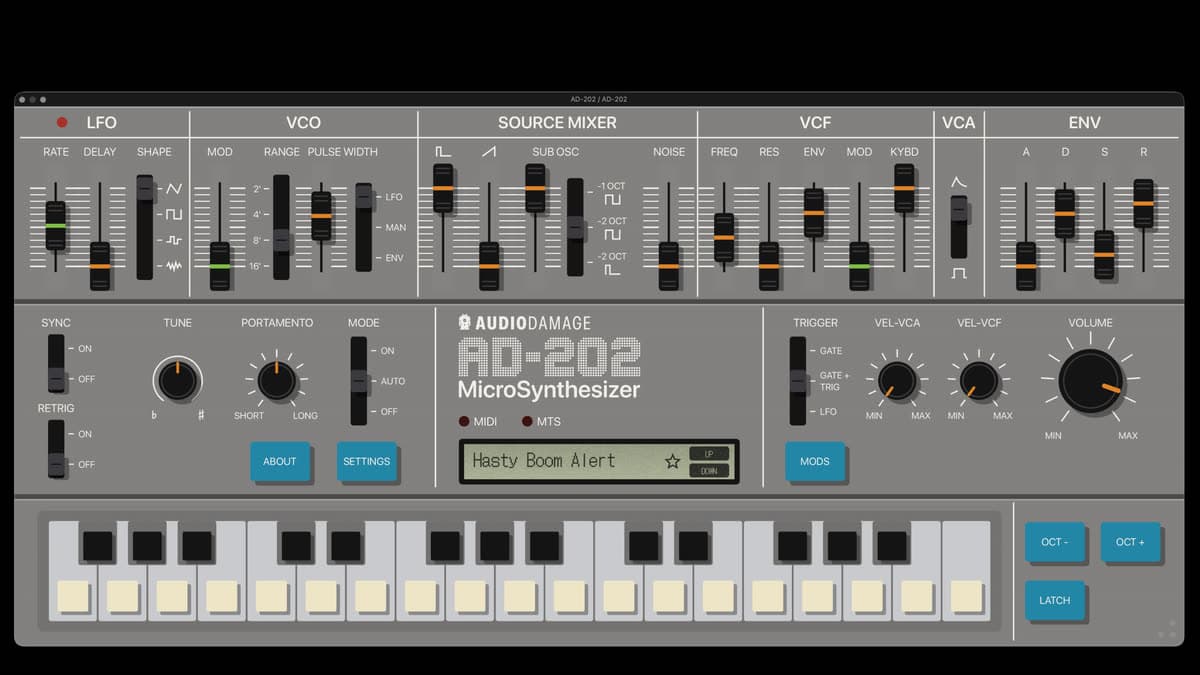
Audio Damage has released AD-202, a single-oscillator synth built in the small-grey-box tradition of the early 1980s. The cart lists $39 intro against a $49 regular price, and the license is perpetual with no copy protection attached to it. This is a first look at the published voice and the live store. We have not used it in a session.
At a glance: $39 intro / $49 regular from Audio Damage. One VCO, a 24 dB ladder, mono or eight-voice poly. Mac, Windows, Linux, and iOS, covering CLAP, VST3, AU, AAX, LV2, plus iOS AUv3 and standalone. The desktop demo is fully functional with a 20-minute session timer and saving disabled.
What AD-202 is, and what it is not
AD-202 is SKU AD066, and it is a synthesizer. That matters because it is not Tessera, the sequenced resonator Audio Damage shipped earlier this summer and we covered separately. Tessera is an effect that retunes incoming audio into chords. Same company, same no-DRM habit, completely different job.
Audio Damage is careful about the hardware story, and the wording on the product page is worth reading closely. This is their take on the classic single-oscillator monosynth that arrived in a small silver box with a red LED. They built the voice, the envelope behavior, and the trigger modes themselves. Nothing here is traced from one named circuit, so treat AD-202 as a tribute rather than a component-level model.
The published signal path is short on purpose. One VCO with saw, pulse, sub, and noise, a 24 dB ladder, one envelope, one LFO. All main controls sit on the front panel, and official copy promises exactly one path from a knob to a sound. Underneath that panel sits a much more modern instrument, with polyphony, per-voice drift, MPE, MTS-ESP, and a post-VCA color section.
If you want a deep hybrid with wavetables, FM, and a modulation matrix, look at Surge XT or Pigments 6 instead. AD-202 is selling a panel you can learn in an afternoon.
The voice: VCO, mixer, and ladder
Oscillator, sub, and the source mixer
The single VCO runs four footages: 16', 8', 4', and 2'. The sources are an alias-free sawtooth and a two-saw pulse that stays free of DC at any width. Pulse width is set manually, or it rides the LFO or the envelope.
The sub oscillator is a flip-flop divider off the main oscillator, offering one octave down, two octaves down, or a two-octave pulse. Audio Damage filters and DC-blocks it the way a hardware divider chain did. That is the bass move, and their own "in use" notes start there: sub up, a little resonance, short decay, envelope into the filter.
The source mixer gives independent levels for saw, pulse, sub, and noise, then sums them into a soft clipper. Pre-Filter Sat pushes up to eight times as hard into that clipper, with no makeup gain. Run all four sources wide open and the mixer overdrives on purpose.
Ladder filter and the shared ADSR
The 24 dB ladder is a resonant four-pole low pass with its own Drive control and soft clipping in the feedback path. Gain compensation keeps the level from collapsing as you push it. Cutoff takes the envelope, the LFO, keyboard tracking, and velocity, each with its own amount.
The shared ADSR uses time-based exponential segments, and its retrigger behavior is the detail carried over from hardware. A new attack starts from wherever the envelope currently sits, not from zero. The VCA runs from that envelope or straight off the gate, switchable on the panel.
Velocity to amp and filter is subtractive. Full velocity plays the panel setting, and lighter playing pulls back from it.
The modern layer under the vintage panel
LFO delay and trigger modes
The LFO is the sleeper control here. It offers triangle, square, stepped random, and sample-and-hold noise, running from 0.1 Hz to 30 Hz or synced to host tempo. The Delay control ramps depth in over as much as four seconds from each new gate, so held notes bloom into vibrato on their own without any automation. Sync and per-note Retrig sit on the panel as switches.
Three trigger modes cover the classic keyboard behaviors. Gate takes the lowest note and reuses the voice. Gate plus Trig takes the last note and retriggers the envelope. LFO retriggers the envelope once per LFO cycle, which is the rolling pattern those boxes were known for.
Portamento runs up to five seconds, with an Auto mode that only glides between overlapping notes, plus a fixed Tune control of ±50 cents.
Poly, Spread, and Age
Mono or eight-voice poly is a switch, not a separate product. Poly allocates the same voice eight ways with equal-power panning set by Spread, while Mono keeps the original note-priority stack, legato, and auto-glide rules intact.
Age applies per-voice fixed random drift across pitch, pulse width, cutoff, LFO rate, and mixer levels, and it is rolled fresh for every instance you load. Two copies of AD-202 in the same project are never quite the same synthesizer. Audio Damage treats that as the feature, and their suggested pad recipe is poly mode with Spread and Age both up.
MPE, MTS-ESP, and the MODS panel
MPE and aftertouch are fully supported, with per-note pitch bend and pressure. Four aftertouch destinations are on offer: oscillator mod depth, filter mod depth, filter cutoff, and LFO rate. Pressure gets separate attack and release smoothing.
MTS-ESP retunes continuously per note and per voice from any MTS-ESP master, and portamento survives a retune.
The output stage lives in the MODS panel as post-VCA distortion plus a bipolar tilt EQ pivoting at 1 kHz. The stated reason is refreshingly plain: they kept reaching for a distortion box and a channel EQ anyway.
There is no built-in sequencer. The patterns you hear in the browser live demo exist so the page can play itself, and they are not in the plugin. Drive AD-202 from your DAW or a controller.
AD-202 on iOS
The iOS build is a separate $4.99 purchase on the App Store, with early-bird pricing running through 15 September 2026. It ships as AUv3 and standalone, needs iOS 12 or later, and runs on iPhone and iPad.
The mobile version is not a cut-down port. Audio Damage lists the same eight-voice poly, MPE, MTS-ESP, Spread, Age, and full drive section. On top of that come the touch-specific parts: a chicklet keyboard with latch and octave shift, a preset manager with favorites and a factory bank, and five faceplate colors. The standalone app carries its own audio and MIDI settings, and the AUv3 loads in the usual hosts. There is no account and no subscription on either platform.
AD-202 specifications
| Spec | Official detail |
|---|---|
| Product | AD-202 (AD066) |
| Developer | Audio Damage |
| Type | One-VCO grey-box synth, mono or 8-voice poly |
| Intro price | $39 |
| Regular price | $49 |
| iOS | $4.99 on the App Store, early-bird pricing through 15 September 2026 |
| License | Perpetual, no DRM, no iLok, no subscription, no online activation |
| Demo | Fully functional, 20-minute session timer, save disabled; browser live demo on the product page |
| Windows | 10+, 64-bit: CLAP, VST3, AAX |
| macOS | 10.13+, Intel and Apple Silicon, 64-bit: CLAP, VST3, AU, AAX |
| Linux | Ubuntu 20+, 64-bit: CLAP, VST3, LV2 |
| iOS | 12+, iPhone and iPad: AUv3 and standalone |
| Oscillator | 1 VCO, saw + pulse, 16'/8'/4'/2', PWM from manual / LFO / envelope |
| Sub | Flip-flop divider: −1 oct, −2 oct, or −2 oct pulse |
| Mixer | Saw, pulse, sub, noise into pre-filter saturation (up to 8×) |
| Filter | 24 dB resonant ladder with Drive and gain compensation |
| Envelope | One shared ADSR; VCA from envelope or gate |
| LFO | Triangle, square, stepped random, S&H; 0.1–30 Hz or tempo sync; delay up to 4 s |
| Trigger modes | Gate, Gate + Trig, LFO |
| Portamento | Up to 5 s, Auto mode, Tune ±50 cents |
| Polyphony | Mono or 8 voices with Spread |
| Extras | Age drift, post-VCA distortion, 1 kHz tilt EQ, MPE, MTS-ESP |
| Buy from | audiodamage.com |
AD-202 vs TAL-U-No-LX vs FabFilter One
Shop this as a one-oscillator grey box rather than as a Juno or a deep virtual analog. TAL-U-No-LX is the chorus-and-architecture JUNO-style instrument, and FabFilter One is the other small, serious single-oscillator plugin in our catalog. Baby Audio BA-1 is worth a look if you want presets and a thicker vintage stack instead of a bare panel.
| AD-202 | TAL-U-No-LX | FabFilter One | |
|---|---|---|---|
| Job | Grey-box bass, leads, simple poly pads | JUNO-class virtual analog | Focused one-oscillator synth |
| Street / list | $39 intro / $49 at Audio Damage | €70 on our TAL card | $59 on our One card |
| Oscillators | 1 VCO + sub + noise | JUNO-style architecture | Single oscillator |
| Filter | 24 dB ladder with Drive | TAL's analog-model filter | FabFilter's One filter |
| Polyphony | Mono or 8 voices | Polyphonic | Polyphonic, small voice count |
| Tuning / MPE | MPE and MTS-ESP | Standard tuning | Standard tuning |
| Platforms | Mac, Windows, Linux, iOS | Mac and Windows plugin | Mac and Windows plugin |
| License | No DRM, install everywhere | Standard TAL license | Standard FabFilter license |
| Reach for it when | You want one panel, a ladder, and Linux or iOS in the same SKU | You want JUNO chorus and architecture | You want a tiny, precise one-osc synth |
Which to pick. Choose AD-202 if a grey-box bass line is the actual job and you want MPE, MTS-ESP, and a Linux build on day one. Choose TAL-U-No-LX if what you really want is a Juno, chorus included. Choose FabFilter One if you already live in FabFilter's interface and only need one oscillator. Surge XT is still the free deep alternative if $39 feels like a maybe.
Tessera does not belong in that table. If you want tuned resonators ringing out of a drum loop, that first look is here. If you want the vocabulary behind ladders, envelopes, and why a sub oscillator sits under a saw, start with our audio effects overview.
Who AD-202 is for
Consider it if you want a one-page bass and lead synth, you like the sound of a 24 dB ladder, and $39 is an easy yes. Play the browser demo first, because it runs the real voice in a tab.
Consider it if you work on Linux or iOS and want the same instrument in the DAW and on a phone. Desktop and mobile are separate purchases, and the App Store price is $4.99 through 15 September 2026.
Consider it if you write microtonally or play an MPE controller. MTS-ESP and per-note pressure are not common at this price.
Skip it if you need a built-in sequencer, a second oscillator, or wavetable and FM engines. AD-202 is the voice on its own, deliberately.
Skip it if you wanted Tessera. Different SKU, different job.
What AD-202 costs
$39 intro, $49 regular, direct from Audio Damage. The license is perpetual, you can install it on every machine you own, and there is no iLok, no account, and no online activation.
The iOS app is $4.99 at the App Store as AUv3 and standalone, requiring iOS 12 or later, with early-bird pricing through 15 September 2026. It is not bundled with the desktop license.
Buy it from Audio Damage. The plugin card lives at /plugins/audio-damage-ad-202.
FAQ
Is AD-202 a hardware clone?
No. Audio Damage describes it as their take on the early-1980s single-oscillator grey box. The voice, envelope, and trigger modes were built from the ground up rather than traced from one named unit.
Can it play chords?
Yes. The MODS panel carries a Mono / Poly switch, and poly mode gives you eight voices with Spread and Age.
Does it need iLok?
No. There is no copy protection of any kind, on desktop or on iOS.
AD-202 vs Tessera?
Tessera is a sequenced resonator effect and AD-202 is a synthesizer. Buy Tessera to retune drums into chords, and buy AD-202 to play a VCO into a ladder.
What are the system requirements?
Windows 10 or later with CLAP, VST3, and AAX. macOS 10.13 or later on Intel or Apple Silicon with CLAP, VST3, AU, and AAX. Ubuntu 20 or later with CLAP, VST3, and LV2. iOS 12 or later for AUv3 and standalone. All desktop builds are 64-bit.
The bottom line
AD-202 is a $39 intro grey-box synth with one VCO, a 24 dB ladder, and an eight-voice poly switch hiding under a deliberately plain panel. The vintage part is the ergonomics. MPE, MTS-ESP, Age, and the tilt EQ are the modern layer, and the Linux and iOS builds are unusual company at this price.
This is a first look, not a scored review. We have not printed a bass line through it. Run the 20-minute desktop demo, or open the browser demo and hold a note while the delayed LFO catches up. If that ladder is the sound you wanted, Audio Damage is the store.