XILS-lab MemoryTone Review: A Software Memorymoog
XILS-lab MemoryTone recreates the 1982 Memorymoog: 16 voices, three oscillators each, a 24 dB ladder filter, MPE and six effects. Full review and specs.
See full specs, price, and alternatives in the plugin database →
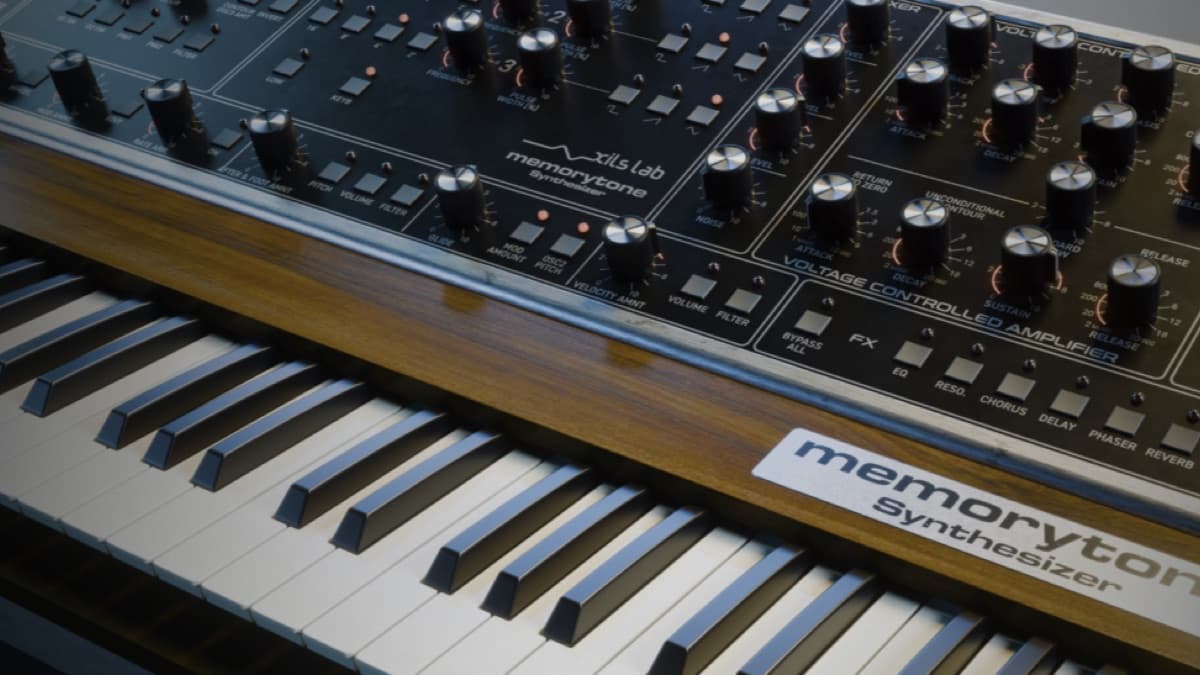
XILS-lab released MemoryTone on September 7, 2026. It is a software recreation of the Memorymoog, the sixteen-voice monster Moog built in 1982. The plugin rebuilds that instrument's core, three oscillators per voice feeding a 24 dB self-oscillating ladder filter, then bolts on the modern conveniences the hardware never had. It arrives in what has become a busy year for Memorymoog emulations.
At a glance: €79 introductory price, regular €199; VST2.4, VST3, AU and AAX on macOS and Windows; up to 16 voices with three oscillators each; six onboard effects; MPE support; iLok authorization with a 15-day license-free demo. It currently ships as version 1.0.0 beta.
What is the Memorymoog, and what is MemoryTone?
The Memorymoog was Moog's answer to the polyphonic synths of the early 1980s. Each voice carried three oscillators, which is why it sounded so enormous next to two-oscillator rivals. It also earned a reputation for being temperamental, with tuning stability that tested even patient owners.
MemoryTone recreates that architecture in software and drops the maintenance headaches. It runs sixteen voices, each built around three oscillators and a self-oscillating ladder filter, and it holds onto the raw, slightly wild character that made the original special. XILS-lab has spent years modeling classic analog and semi-modular instruments, so the plugin arrives with real pedigree behind it.
What MemoryTone does, feature by feature
MemoryTone follows the hardware's layout and then extends it. Here is what each section brings to a patch.
- Three oscillators per voice. Each voice runs three oscillators with pulse, sawtooth and triangle waves that combine freely. You get variable pulse width, oscillator hard sync, independent octave ranges, detuning on oscillators 2 and 3, and a low-frequency mode on oscillator 3. Three oscillators per note is the reason the Memorymoog sound is so thick, and it is preserved here.
- A self-oscillating ladder filter. The signal feeds a 24 dB per octave ladder filter with cutoff, emphasis that pushes into self-oscillation, keyboard tracking and its own ADSR envelope. Crucially, the mixer drive creates level-dependent saturation before the filter, so pushing the input dirties the tone the way the hardware did.
- Sixteen voices, three play modes. MemoryTone offers up to sixteen voices, with mono, circular polyphonic and unison modes, plus mono and polyphonic glide and a noise generator. Unison stacks those three-oscillator voices into a genuinely huge lead or bass.
- Two envelopes and a flexible LFO. You get two ADSR envelopes and an LFO running from 0.1 to 100 Hz with triangle, saw up, saw down, square and sample-and-hold shapes. Oscillator 3 can also act as a modulation source, which opens up cross-modulation tricks.
- Six assignable modulation slots. Beyond the fixed routings, six freely assignable slots let you send velocity, aftertouch, poly aftertouch, an expression pedal or MIDI Learn to the destinations you choose. Polyphonic voice modulation and voice detuning add per-note movement and analog drift.
- Full MPE support. MemoryTone reads MPE controllers, so per-note pitch, pressure and slide expression are available to players on modern controllers. That is something the 1982 hardware could never do.
- A deep arpeggiator and sequencer. The arpeggiator runs in mono and polyphonic modes with octave extension, broken-chord behavior, random patterns and adjustable gate and swing. A programmable sequencer sits alongside it for evolving rhythmic patterns.
- Six onboard effects. Chorus, phaser, delay, reverb, EQ and a three-band resonator can be routed flexibly, so you can finish a patch inside the plugin rather than reaching for a rack.
- A modern preset manager. Presets filter by bank, author, type, style, feeling and project, with favorites, hidden presets and A/B comparison. That kind of browsing keeps a large library usable.
XILS-lab kept the parts that make a Memorymoog sound like a Memorymoog, then layered on the modulation, expression and effects a 2026 producer expects. It is a faithful core with a generous modern shell.
XILS-lab MemoryTone specifications
| Spec | Detail |
|---|---|
| Type | Virtual analog polyphonic synthesizer (Memorymoog emulation) |
| Oscillators | 3 per voice, pulse/saw/triangle, hard sync, PWM, per-osc octave and detune |
| Polyphony | Up to 16 voices; mono, circular poly and unison modes |
| Filter | 24 dB per octave self-oscillating ladder, dedicated ADSR, key tracking |
| Envelopes | 2 ADSR |
| LFO | 1 LFO, 0.1 to 100 Hz, five waveforms including sample and hold |
| Modulation | 6 assignable slots, oscillator 3 as source, poly voice modulation, MPE |
| Expression | Velocity, aftertouch, poly aftertouch, expression pedal, MIDI Learn |
| Arpeggiator | Mono and poly, octave range, random, gate and swing, plus sequencer |
| Effects | Chorus, phaser, delay, reverb, EQ, three-band resonator (flexible routing) |
| macOS formats | VST2.4, VST3, AU, AAX (64-bit, Intel and Apple Silicon) |
| Windows formats | VST2.4, VST3, AAX (64-bit) |
| System | macOS 10.13 or later, Windows 7 to 11 |
| Authorization | iLok, with a license-free 15-day demo |
| Version | 1.0.0 (beta at launch) |
| Price | €79 intro, regular €199 |
MemoryTone vs Cherry Audio Memorymode 2
2026 has been the year of the Memorymoog. MemoryTone's closest rival is Cherry Audio's Memorymode 2. Both chase the same three-oscillator sound, but they price and structure it very differently.
| XILS-lab MemoryTone | Cherry Audio Memorymode 2 | |
|---|---|---|
| Approach | Single 16-voice engine, three oscillators per voice | Dual layer, 16 voices per layer, stack or split |
| Filter | 24 dB self-oscillating ladder | Rebuilt analog ladder model |
| Modulation | 6 assignable slots, oscillator 3 source, MPE | Motion, Touch Animator, MPE |
| Effects | Chorus, phaser, delay, reverb, EQ, resonator | Onboard effects per layer |
| Formats | VST2.4, VST3, AU, AAX | AU, VST, VST3, AAX, standalone |
| Authorization | iLok | No dongle |
| Price | €79 intro (regular €199) | $69 (upgrade $39) |
For most people right now, Memorymode 2 is the safer buy. It costs less, needs no dongle, gives you two full layers, and it ships as a finished release with a scored first look already on the site. MemoryTone answers with a single very deep engine, six assignable modulation slots, oscillator 3 as a modulation source and a strong arpeggiator. XILS-lab also has a long track record of capturing analog grit. If you want the widest, most modulation-rich take on the Memorymoog, and iLok and a 1.0 beta don't put you off, MemoryTone makes a real case. For a third option in the same family, our Arturia Memory V review covers Arturia's version. The GForce Prophet-5 piece is worth a look if you are shopping vintage-poly emulations more broadly.
Who MemoryTone is for
MemoryTone suits players who want the thick, three-oscillator poly-analog sound with room to modulate and perform. Huge unison basses, evolving pads, leads that bend under MPE: this is where it earns its keep. Producers who already trust XILS-lab's modeling, and who want a deep instrument rather than a quick preset machine, will get the most from it.
Hold off for now if you need a fully finished, thoroughly road-tested plugin today. It launched as a 1.0.0 beta, and some users have reported preset-system quirks in certain hosts. If a cheaper, dongle-free Memorymoog already covers your needs, there is no urgency to switch.
How much does MemoryTone cost?
MemoryTone runs €79 at its introductory price, down from a regular €199. That covers VST2.4, VST3, AU and AAX on macOS and Windows, authorized through iLok. A license-free 15-day demo is available on both platforms, so you can test it on your own patches before committing. Check the official XILS-lab store for current pricing at xils-lab.com. To weigh it against the cheaper rival, Memorymode 2 is on Plugin Boutique.
FAQ
Is XILS-lab MemoryTone worth buying?
If you want a deep, modulation-rich Memorymoog with MPE and a real arpeggiator, and the €79 intro price appeals, it is a strong option. Weigh it against the fact that it launched as a 1.0 beta with early preset quirks. For a finished release at a lower price, Cherry Audio Memorymode 2 is the pragmatic pick.
MemoryTone vs Cherry Audio Memorymode 2, which should I choose?
Memorymode 2 costs less, needs no dongle, gives you two layers and is a finished product. MemoryTone offers a single very deep engine with six assignable modulation slots, oscillator 3 as a source and a stronger arpeggiator, but it uses iLok and is still in beta. Choose on price and workflow.
What are the system requirements for MemoryTone?
MemoryTone runs on macOS 10.13 or later, natively on Intel and Apple Silicon, and on Windows 7 through 11, both 64-bit. Formats are VST2.4, VST3, AU and AAX, and authorization uses iLok.
Does MemoryTone support MPE?
Yes. MemoryTone supports MPE controllers, so per-note pitch, pressure and slide are available, along with velocity, aftertouch, poly aftertouch, an expression pedal and MIDI Learn.
Verdict
MemoryTone is a serious, characterful take on one of the most ambitious analog synths ever built. The three-oscillator voices, self-oscillating ladder filter and mixer saturation capture the big, slightly unruly Memorymoog tone. On top of that sit MPE, six effects, deep modulation and a proper arpeggiator, which push it well past museum-piece status. The caveats matter too. It ships as a 1.0.0 beta, it uses iLok, and Cherry Audio's Memorymode 2 delivers a similar sound for less money and no dongle. If none of that stops you, the intro price makes MemoryTone an easy demo to justify, and XILS-lab's pedigree suggests the beta rough edges will smooth out.