Arturia Memory V: Is the Memorymoog Worth It?
Arturia Memory V revives the 1982 Memorymoog as software with triple oscillators, a ladder filter, Multi-Arp, and modern modulation. Here's what's new.
Black Friday 2026Arturia Black Friday 2026: dates and deals →
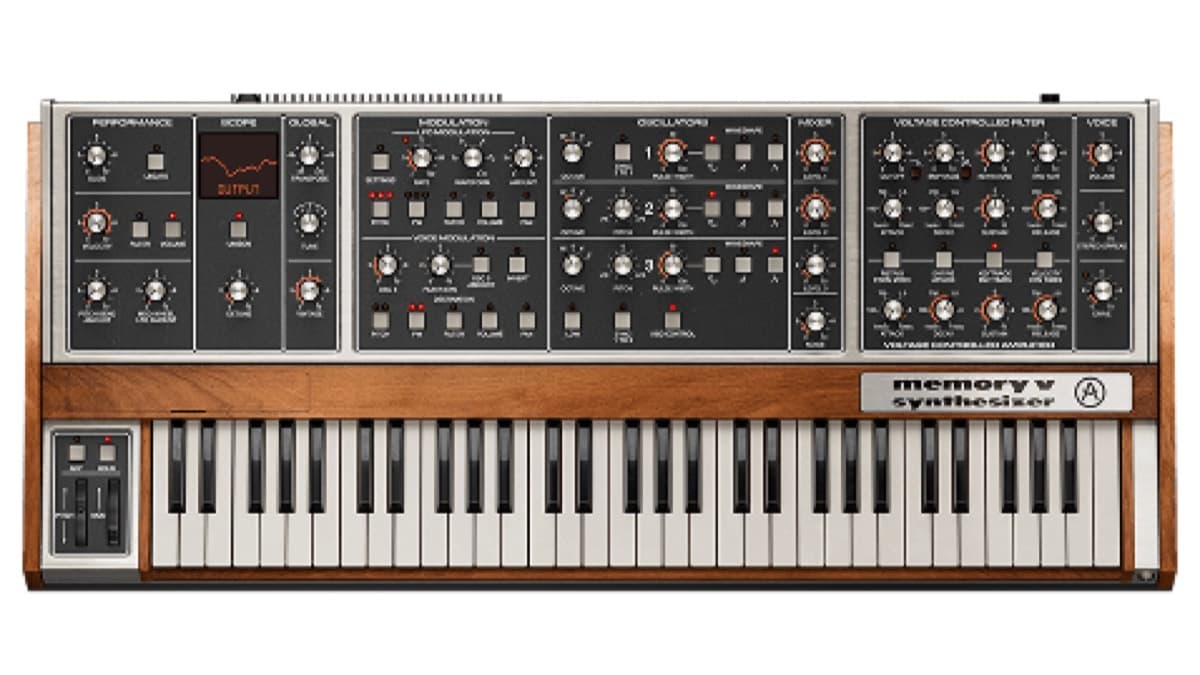
Arturia released Memory V on May 25, 2026. The software recreates the 1982 Memorymoog as a virtual instrument. It keeps the core sound and removes the upkeep that came with the original hardware.
Producers who need thick, stacked polysynth tones gain a practical choice. The hardware version stays rare and difficult to maintain. Memory V focuses on the sound itself and adds features that fit modern sessions.
What is the Memorymoog?
The Memorymoog packed three oscillators per voice into a six-voice analog polysynth. Each voice was essentially a Minimoog, stacked and tuned together. That architecture gave it a dense, layered tone.
The original was rare, heavy, and famously hard to keep in tune. Working units now sell for a premium.
Arturia rebuilds that voice structure in software using its TAE component-modeling engine. The goal is the same core character without the tuning drift.
What's new in Memory V?
Memory V is more than a faithful clone. Arturia added modern features the 1982 hardware never had:
- Triple-oscillator architecture with stackable waveforms per voice.
- 24 dB ladder filter with an optional 12 dB mode.
- Poly 6 and Poly 12 voicing modes for thicker stacks.
- Four-layer Multi-Arp for evolving, rhythmic patterns.
- A four-slot effects rack with more than 17 effects.
- Drag-and-drop modulation that maps sources to targets fast.
- MPE and microtuning support for expressive playing.
- Vintage and Dispersion controls to dial in analog instability on purpose.
It ships with over 300 presets. The Vintage and Dispersion knobs are the smart touch here. They let you add back the imperfection that made the original sound alive, then pull it out when you want a clean modern bass.
How does it sound?
Big. Three oscillators per voice plus the ladder filter give you wide unison pads, aggressive leads, and bass that fills a mix on its own. When you need to blend several analog-style filter models on audio you already printed, UB DSP Filter Blender is the effect for that job. The Memorymoog was always about scale, and Memory V delivers that scale without a service technician on speed dial.
If you already lean on Moog-style tone, Memory V slots in next to Arturia's other Moog emulations. For broader context, see our roundup of the best free synth VSTs of 2026 and our look at how virtual analog stacks up against u-he Zebra 3.
Is Memory V worth it?
Memory V works well for producers who want classic polysynth weight. It captures the important part of the original sound and adds modulation, effects, and arpeggiation that make it usable in a modern session. The Vintage and Dispersion controls keep it from feeling sterile.
If you already own several analog emulations, this is a focused addition rather than a must-have. But the Memorymoog tone is specific, and few plugins nail it. Players who want a much smaller filter instrument with per-note expression can look at the Tupos subtractive synth.
How much does Memory V cost?
Memory V launched at $149, with introductory discounts that ended in June 2026. You can check current Memory V pricing at Arturia.
Pair it with our guides to the best MIDI keyboards of 2026 to find a controller that does it justice, and our Omnisphere 3 review if you want a broader sound-design powerhouse alongside it.