Q Sahara for iPad: Pulsar Modular's AUv3 Compressor
Pulsar Modular's Q Sahara lands on iPad as a $19.99 AUv3 compressor with no threshold knob, adaptive timing and a sidechain filter. A first look at the port.
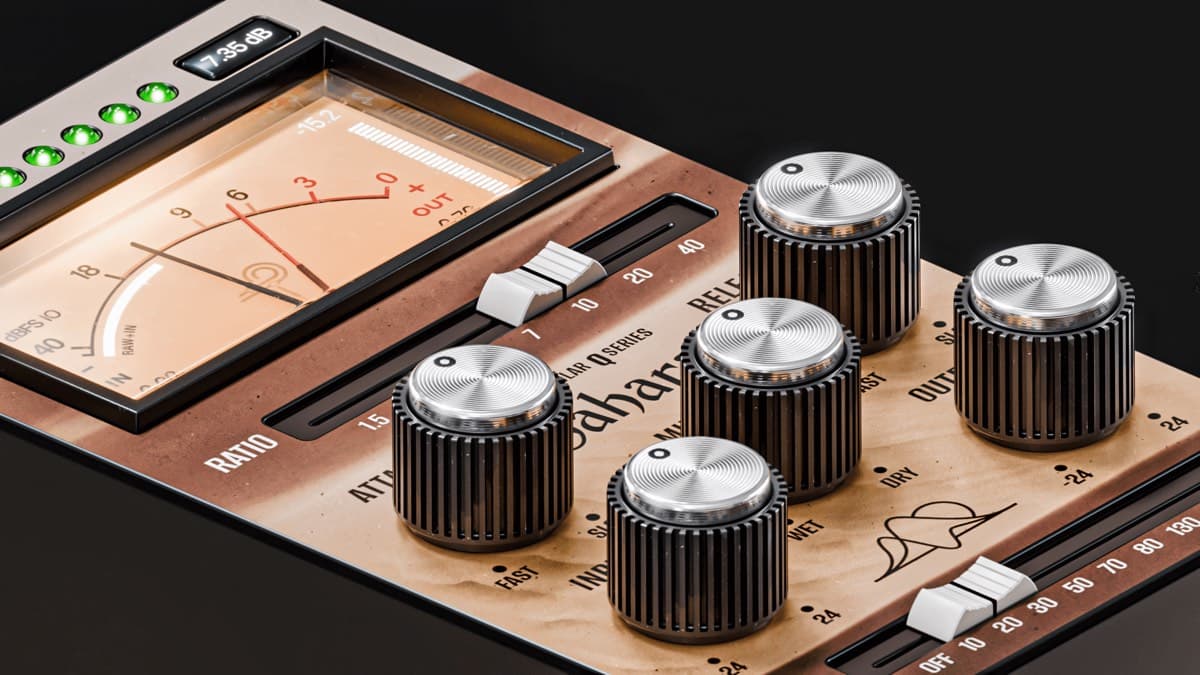
Pulsar Modular has moved another plugin from the desktop to iOS. Q Sahara arrived on the App Store this week as a $19.99 universal app for iPhone and iPad. It runs as an AUv3 plugin and as a standalone. It's the third Pulsar release to make the jump in 2026. P930 Lunar Lander and the P410 Joyride graphic EQ came first.
One clarification before anything else, because the naming trips people up. Sahara is a compressor, not an EQ. Pulsar's P440 Sweet Spot and P410 Joyride are the EQs in the catalog. Sahara belongs to the newer, cheaper Q-Series, and it was the first plugin in that line when the desktop version shipped in August 2025.
An input-driven compressor with no threshold
The design premise is unusual for a modern plugin, and it is the whole reason to care about this one. Q Sahara has no threshold control. The threshold is fixed internally, so you set the amount of compression by driving the input harder or softer. That is how a lot of classic analog hardware behaves, and it collapses two decisions into one gesture.
From there you pick a ratio and a knee shape, which moves the response from smooth to firm. Attack and release are program-dependent. There are no millisecond values to dial in — the circuit adapts to what you feed it. Pulsar calls the topology feed-forward, built around what it names a "Recoil" compressor circuit. The official product page and user guide both frame it as a speed-first tool, not a surgical one.
That framing matters for how you judge it. If you want to sculpt an exact attack time on a snare, this is not the compressor for that job. If you want to push a bus until it feels right and then move on, the control set is deliberately doing you a favor.
The trailer above covers the desktop release, since Pulsar has not published an iOS-specific video yet. The DSP and the control layout are the same, so it still shows you what the compressor does.
What the iOS version adds and drops
This is not a stripped tablet edition. According to the App Store listing, the mobile build keeps the desktop DSP. That includes zero samples of latency and the external sidechain input, which has its own dedicated high-pass filter. That filter is the detail worth flagging. Plenty of budget AUv3 compressors either skip external sidechain entirely or bolt it on without a way to keep low end out of the detector.
A few things are genuinely different on iOS:
- Oversampling modes are HD and Eco. The desktop version offers Vintage, Intel and HD. Eco is a mobile-side addition, presumably to protect battery and headroom on older iPads.
- Two interface themes, Sand Dune and Black Sand, replace the single 500-series-style desktop panel.
- Standalone mode ships alongside the AUv3, so you can open it outside a host.
- A/B compare and preset management are built in, with factory presets credited to Grammy-winning engineers.
Requirements are modest: iOS or iPadOS 14.0 and later, with visionOS 1.0 also listed. The download is 32.6 MB. Confirmed hosts include AUM, GarageBand, Logic Pro for iPad, Cubasis and Loopy Pro. If you already run a session in AUM, it should slot straight into your existing chain.
Where it fits in an iPad mix
The obvious placement is anywhere you would normally reach for a fast, characterful bus compressor. Producers using the desktop version consistently point to the same sweet spots: drum bus glue, individual drum inserts, bass, vocals and strings. The recurring description is set-and-forget, which lines up with a design that removes the two controls people fiddle with most.
CPU behavior is the other reason this port makes sense on a tablet. Low CPU use is one of the most repeated observations about the desktop plugin. Reports describe many instances running at high oversampling on modest machines. On iPad that headroom is not a nice-to-have. It decides whether you can put the same compressor on eight tracks or two.
Zero latency helps for the same reason. You can insert it on a tracking chain without pushing delay compensation around, which is exactly the situation where iPad rigs get awkward. If you are still assembling a mobile setup, our guide to building a mobile studio on a budget covers the surrounding hardware decisions.
How it compares to other iPad compressors
The iPad dynamics shelf is not empty. FabFilter's Pro-C line offers far deeper control — multiple compression styles, visible transfer curves, heavy oversampling — at a higher price. BLEASS Compressor is the usual budget pick with sidechain and light CPU use. Klevgrand and ToneBoosters both have dynamics tools with more conventional parameter sets.
Q Sahara is not competing on feature count, and it would lose that fight. It competes on workflow. No threshold, no attack, no release, adaptive timing, one gain stage that does the work. On a small screen that's either exactly what you want or a dealbreaker, and most people know which camp they're in before spending anything.
Against its own desktop sibling, the mobile version is the cheaper way into the same circuit. The desktop edition sells direct from Pulsar Modular in VST3, AU and AAX formats. Pricing there has shifted since the 2025 launch, so check the product page rather than trusting older figures. Pulsar does not sell through the usual plugin retailers, so the App Store is the only channel for the iOS build.
Open questions
A few things are not settled yet, and it is worth being straight about them.
The iOS version is days old, so there is very little real-world feedback specific to the mobile build. Early reaction centers on the AUv3 plus standalone combination, the sidechain high-pass and the factory presets rather than sustained mixing use. How Eco compares to HD in practice is unknown. Pulsar has also not posted a dedicated news item about the release, so the App Store listing is currently the primary official source.
There is one recurring criticism of Pulsar's iOS strategy that Q Sahara mostly sidesteps. Their mobile pricing has been called high relative to typical AUv3 norms, particularly on the EQ port. At $19.99 with no in-app purchases, this one sits in more familiar territory.
Worth a look?
If your iPad mixes lean on transparent, parameter-heavy compressors, Q Sahara will feel restrictive by design. If you like driving something until it sounds right, it removes friction that most plugins add. The sidechain high-pass, zero latency and low CPU draw make it credible as a workhorse, not a novelty. At $19.99, that's a low bar for finding out.
Our guide to parallel drum compression covers the theory behind the moves this compressor handles well. The same principles apply on a laptop or a tablet.