Some links on this page are affiliate links. If you buy through them, Dubspot may earn a commission at no extra cost to you. It never affects our scores or what we recommend — read our policy.
Cherry Audio Memorymode 2 Doubles the Memorymoog Tribute
Cherry Audio Memorymode 2 rebuilds the Memorymoog tribute as dual 16-voice layers with a new analog model. $69, $39 upgrade, full specs and comparisons.
M
Marcus Feld
August 26, 2026 · 10 min read
Black Friday 2026Cherry Audio Black Friday 2026: dates and deals →
Cherry Audio shipped Memorymode 2 on 25 August 2026. It is a ground-up rebuild of the 2021 Memorymode tribute to the 1982 Memorymoog, not a patch on the first plugin. Two complete 16-voice layers sit in one preset. The analog model is new. Version 1 stays on disk. This is a first look at the shipping feature set. We have not used it in a session.
At a glance: $69 new, $39 for Memorymode 1 owners. AU, VST, VST3, AAX, and standalone. macOS 10.13+ with native Apple Silicon. Windows 7+ 64-bit. 30-day demo. Buy it from Cherry Audio or Plugin Boutique.
What Memorymode 2 is
The 1982 Memorymoog was six Minimoog-style voices in one box: 18 VCOs and a 24 dB/octave ladder filter. Cherry Audio's first Memorymode, from 2021, modeled a vintage unit once owned by Chick Corea. Memorymode 2 keeps that brief and changes the engine: new oscillators, filter, and envelopes, then two full 16-voice synths in one instance.
It is still a Memorymoog-inspired analog poly, not a workstation. If you want a licensed 1980s digital hybrid from the same shop, our look at the Cherry Audio Ensoniq ESQ-1 covers that lane. Memorymode 2 is the fat analog stack. Sixteen voices per layer, unison up to 48 on a layer, and drift you set on purpose. Moog Music and inMusic have no affiliation with Cherry Audio.
What's new in Memorymode 2
Dual-layer architecture
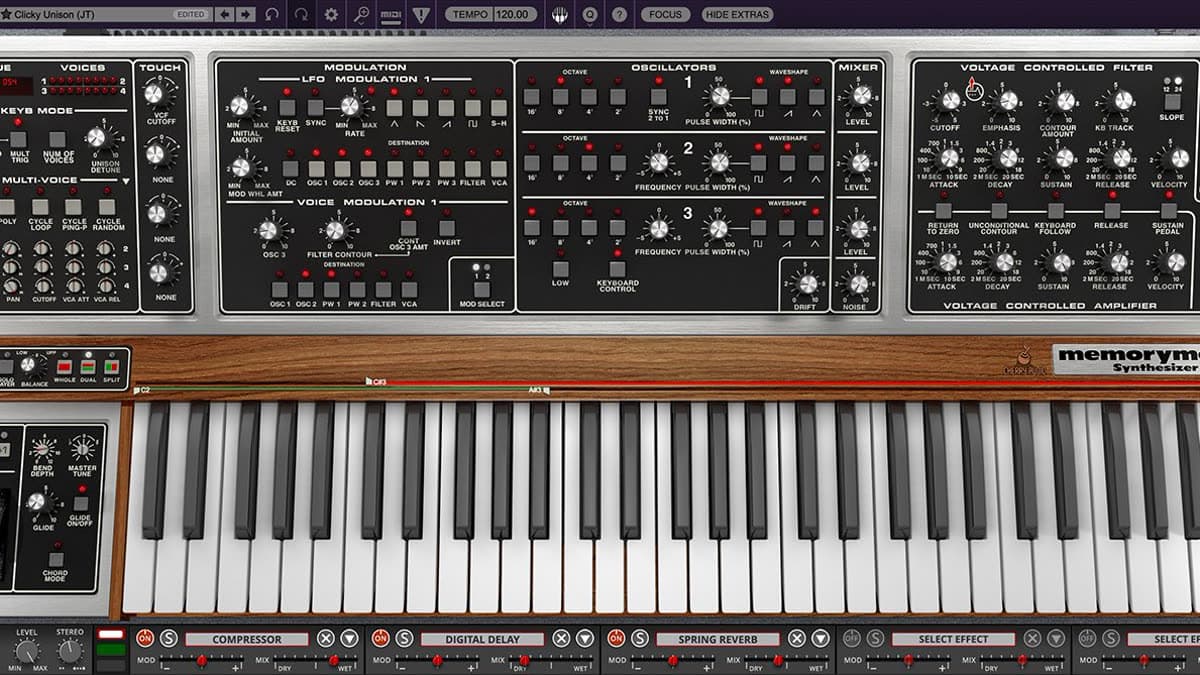
Each preset holds an Upper and a Lower layer. Stack them or split the keyboard. Every layer has its own oscillators, filter, envelopes, modulation, arpeggiator, 16x4 polyphonic sequencer, Touch Animator, and effects chain. That is two complete Memorymode synths, not a doubled oscillator. Utility panels copy, paste, swap, and move layers, effect chains, and sequencer data between presets, so a split does not become a filing job.
Cherry Audio calls the dual-layer engine newly optimized. Thirty-two analog voices still cost CPU. The 30-day demo is how you find out on your machine.
Rebuilt analog model
Version 2 remodeled the three-oscillator voice: ramp, triangle, variable-width pulse, noise, and oscillator sync. The ladder filter keeps the original 24 dB (4-pole) slope and adds 12 dB (2-pole). A Modern button fattens the lows and opens the highs. Emphasis Compensation holds level and low-end weight as you raise resonance, which is the usual ladder-filter volume drop, now optional.
Two ADSR envelopes per layer assign independently to filter, amp, and modulation, with velocity. Two tempo-syncable LFOs per layer offer seven waveforms and a reset. Two voice-modulation panels per layer use oscillator 3 and the filter envelope as sources, with up to six destinations at once. Analog drift is a dedicated control. Multi-voice mode adds per-note variation in pitch, pan, filter, and envelopes, from subtle to extreme. That is the organic-expression brief in one switch.
MPE, aftertouch, and the Touch matrix
Memorymode 2 takes velocity, channel aftertouch, polyphonic aftertouch, and MPE. The Touch modulation matrix has four slots, click-to-assign, and 52 destinations. Velocity, X, Y, and Z can map to those slots. If you play an Osmose or a Rise, this is the reason to prefer v2 over a static analog clone.
Motion: arp, sequencer, Touch Animator
Each layer has a syncable, transposable arpeggiator with Arp, Leap, Order, and Random modes, plus Swing, Chance, and Feel. Each layer also has a 16x4 polyphonic step sequencer with Start, Stop, Auto Start, and humanize, locked to the DAW clock.
Touch Animator is the new motion source. It is a 16-step by 4-pattern sequencer that scales the four Touch modulation slots over time. Hold a chord, let Animator ride cutoff, pulse width, and an effect send, and the patch moves without drawing automation. That is the feature that turns a Memorymoog pad into a performance instrument.
22 effects in three chains
Effects are a real rebuild. Each layer has its own chain. A third global chain sits on the summed output. The library is 22 processors, including Wide Phaser and Rotary Speaker new in version 2. Version 1 effect presets translate into the new system. A control tray gives each effect on/off, solo, a bipolar modulator slider, and dry/wet.
Presets, tape, and SysEx
The browser ships more than 800 presets, including the version 1 library and the 100 original Memorymoog factory patches, imported from cassette. Tape Data Import reads 100-program Memorymoog cassette backups as uncompressed WAV, any sample rate or bit depth. Lintronics Advanced Memorymoog SysEx banks drop onto the plugin. That exclusive hardware compatibility is a Cherry Audio claim, and it is the upgrade path for anyone sitting on a real Memorymoog tape.
The Foundation Preset Pack is a separate $9.99 library: 275 presets by James Dyson, Scott McAuley, and Ger Hughes, built around layers, splits, sequencers, Touch Animator, and the new effects. August 2026 proceeds go to the Bob Moog Foundation.
Version 2 installs beside version 1. User and third-party v1 presets stay put. Drag them into Memorymode 2 when you want the new model.
Memorymode 2 specifications
| Spec | Detail |
|---|---|
| Type | Dual-layer virtual analog poly, Memorymoog-inspired |
| Voices | 16 polyphonic voices per layer; unison up to 48 voices per layer |
| Oscillators | Three per voice: ramp, triangle, variable-width pulse, noise, sync |
| Filter | Ladder, 12 or 24 dB/octave; Modern; Emphasis Compensation |
| Modulation | Two ADSRs, two LFOs, two voice-mod panels, 4-slot Touch matrix (52 destinations), MPE |
| Motion | Per-layer arp + 16x4 poly sequencer + Touch Animator |
| Effects | 22 processors in three chains (Upper, Lower, Global) |
| Presets | 800+ including 100 factory Memorymoog patches; v1 library included |
| Import | Memorymoog cassette WAV; Lintronics SysEx |
| Formats | AU, VST, VST3, AAX, standalone |
| macOS | 10.13+, 64-bit, native Apple Silicon; 3.4 GHz quad-core or M1, 8 GB RAM recommended; 186 MB |
| Windows | Windows 7+, 64-bit; quad-core, 8 GB RAM recommended; 166 MB |
| Other | Oversampling control; MIDI learn; Focus zoom; activation needs internet |
| Price | $69; Memorymode 1 upgrade $39; Foundation pack $9.99; 30-day demo |
Memorymode 2 vs Arturia Memory V
The honest rival is Arturia Memory V, another 1982 Memorymoog recreation with modern extras. Cherry Audio's own GX-80 is the in-house dual-layer flagship if you want CS-80 weight instead of Memorymoog growl.
| Memorymode 2 | Arturia Memory V | Cherry Audio GX-80 | |
|---|---|---|---|
| Job | Dual-layer Memorymoog tribute | Single-engine Memorymoog recreation | Dual-layer GX-1 / CS-80 inspired poly |
| Voices | 16 per layer (two layers) | Poly 6 / Poly 12 | Dual-layer flagship voicing |
| Motion | Arp + 16x4 seq + Touch Animator per layer | Four-layer Multi-Arp | Deep dual-layer performance |
| Effects | 22, three chains | Four-slot rack, 17+ | Built-in Cherry Audio FX |
| Hardware import | Cassette WAV + Lintronics SysEx | Arturia library workflow | n/a |
| Formats | AU, VST, VST3, AAX, standalone | Arturia standard set | AU, VST, VST3, AAX |
| Street / list | $69 / $39 upgrade | $149 at launch | $59 on our GX-80 card |
Which to pick. Choose Memorymode 2 if you want two independent Memorymoog-style layers, hardware tape and SysEx import, and a $69 (or $39) ticket. Choose Memory V if you already live in Arturia's V Collection, want the Multi-Arp, and will pay for TAE. Choose GX-80 if the sound you want is Yamaha analog poly, not Moog ladder. A Prophet-style analog from another desk is Prophet-5 V; it will not replace a Memorymoog clone.
Who Memorymode 2 is for
Consider it if you want Memorymoog tone without a service tech, and you will use two layers or a split in one instance.
Consider it if you already own Memorymode 1. $39 keeps v1, imports the old bank, and puts the new model under the same patches.
Consider it if you play MPE or polyphonic aftertouch and want four Touch slots tied to a step animator.
Skip it if you already own Memory V and you are happy with one engine and Arturia's Multi-Arp. You do not need two Memorymoog plugins.
Skip it if you want a general-purpose synth, not a specific analog poly. Pigments 6 covers more engines for that job.
Skip it if 32 analog voices plus three effect chains will bury the CPU you actually have. Run the 30-day demo on a busy session first.
How much Memorymode 2 costs
$69 for a new license at Cherry Audio and at Plugin Boutique. Memorymode 1 owners upgrade for $39 in the Cherry Audio store after sign-in. The 30-day demo is the full instrument.
The Foundation pack is $9.99, sold only by Cherry Audio. August 2026 sales of that pack go to the Bob Moog Foundation.
Cherry Audio's Build Your Own Bundle is on sale through 7 September 2026: Pick 3 is $99 (usually $119) and Pick 6 is $149 (usually $169). Memorymode 2 can sit in either mix. That is the cheaper path if you were going to buy two or five more Cherry Audio instruments anyway.
Activation needs an internet connection. Buy it from Cherry Audio or Plugin Boutique.
The plugin card lives at /plugins/cherry-audio-memorymode-2.
FAQ
Does Memorymode 2 replace Memorymode 1?
No. It installs as a separate plugin and standalone app. Version 1 stays. Drag v1 presets into v2 when you want them on the new model.
Is Memorymode 2 a licensed Moog product?
No. MINIMOOG and MOOG are trademarks of Moog Music and inMusic. Cherry Audio states there is no association or endorsement. Memorymode is an inspired tribute with exclusive Memorymoog tape and SysEx import.
What are the system requirements?
macOS 10.13 or later, 64-bit, native Apple Silicon. Windows 7 or later, 64-bit. Cherry Audio recommends a 3.4 GHz quad-core or M1 and 8 GB of RAM. Disk use is 186 MB on Mac and 166 MB on Windows.
Memorymode 2 vs Arturia Memory V?
Memorymode 2 is cheaper, dual-layer, and reads Memorymoog cassette and SysEx. Memory V is Arturia's single-engine Memorymoog with Multi-Arp and TAE, launched at $149. Detail is in our Memory V first look.
Is there a demo?
Yes. Cherry Audio offers a free 30-day demo in AU, VST, VST3, AAX, and standalone.
The bottom line
Memorymode 2 is the 2021 tribute rebuilt: two 16-voice layers, a new analog model, MPE, Touch Animator, and 22 effects. $69 new. $39 if you already own v1. Foundation is $9.99 this month, with August proceeds to the Bob Moog Foundation. Pick 3 / Pick 6 stays on sale through 7 September.
This is a first look, not a scored review. We have not tracked a pad through both layers or leaned on Multi-voice in a mix. Run the 30-day demo, import a v1 bank if you have one, and decide whether the new model earns the second install. Live storefronts: cherryaudio.com/products/memorymode-v2 and Plugin Boutique.