Some links on this page are affiliate links. If you buy through them, Dubspot may earn a commission at no extra cost to you. It never affects our scores or what we recommend — read our policy.
Quadrant Modulator Draws Bézier Waves for Ring-Mod
Unusable Quadrant Modulator is a €29 four-quadrant ring-mod with a drawable oscillator, pitch follow, one-shot shaping, and an 8-slot sequencer. AU/VST3.
M
Marcus Feld
September 11, 2026 · 10 min read
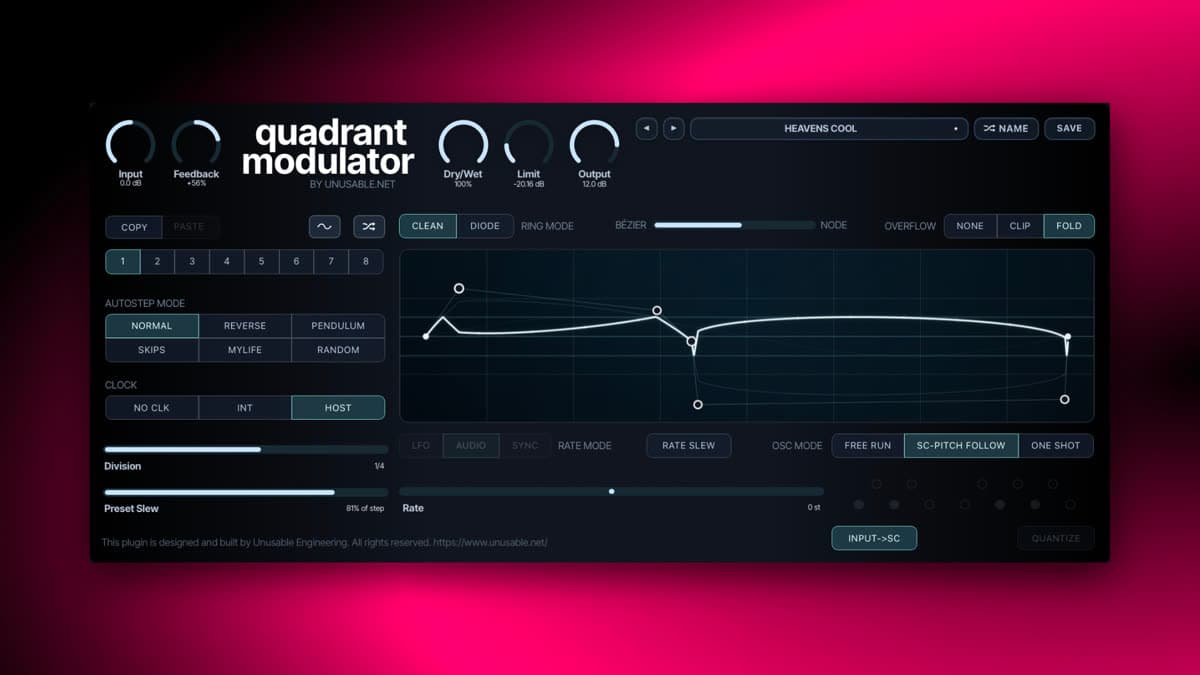
Unusable Engineering sells Quadrant Modulator as a four-quadrant multiplier built around the drawable oscillator from Curves & Membranes. Street price is €29.00 incl. 25% VAT. It ships as AU and VST3 on macOS 12+, and VST3 on Windows 10 and 11.
At a glance: €29.00 incl. VAT. Four-quadrant / ring-mod or amplitude modulation, depending on which side of the horizon you draw. Free Run, SC Pitch Follow, and One Shot. Sync, Quantize, and MTS-ESP. Eight-slot waveform sequencer. Clean and Diode modes. Wet feedback and a tube-style limiter. Buy it from unusable.net.
This is a first look at the shipping plugin and the official product page. We have not run Quadrant Modulator in a session yet.
What Quadrant Modulator is
Most ring-mod plugins hand you a sine and a frequency knob. Quadrant Modulator treats the modulator as a waveform you draw. Five linked points sit on a single-cycle display. Bézier mode keeps the edges soft. Node mode sharpens them. Anything between those two poles is a morph, not a mode switch.
The math is four-quadrant multiplication. Positive oscillator values change amplitude. Negative values also invert polarity, which is where the classic ring-mod sidebands come from. Keep the whole waveform above or below the horizon and you get amplitude modulation instead. That is the same oscillator, two jobs, decided by geometry.
It sits next to sequenced multi-FX we already cover, but the job is narrower. ShaperBox 3 is a rack of time-based shapers. Infiltrator 2 is a multi-effect you sequence as scenes. u-he Melt is a pitch and time smearing tool. Quadrant Modulator is one multiplier with a drawable carrier, three run modes, and eight stored states. You buy it when ring-mod is the point, not when you want a whole FX chain. For modulation spread across your own third-party plugins, the Stride Engine modulation host is a different tool again.
Unusable's lineup stays direct. No plugin manager. No call-home. The same shop sells Geometry Delay, Curves & Membranes, and the rest of the science-native set. Quadrant Modulator is also in the Scientist Suite and Full Suite v2.
Three oscillator modes
The drawn waveform can repeat, track, or fire once.
Free Run repeats at a fixed rate. That is the classic ring-mod / LFO path. Rate spans LFO (0.01 to 20 Hz) and audio (1 Hz to 14 kHz), or a host-synced division from a 1/32 triplet to 8 bars. Sync restarts the cycle as well as setting its length.
SC Pitch Follow uses a phase-locked loop on the side-chain. Simple monophonic sources track cleanly. Complex or noisy material gets less predictable, which is the official warning and also the interesting case. Rate becomes a pitch offset from −24 to +24 semitones, with magnetic positions on common intervals. Input→SC forces tracking onto the main input when the host will not mirror it without a side-chain bus.
One Shot plays a single cycle per slot or clock trigger, then returns to zero. At audio rates that is a click or a cut. At slower rates the waveform is a one-cycle amplitude envelope. A clock impulse retriggers it even when only one slot is enabled.
Quantize snaps free LFO or audio rates to a custom note set. You toggle octave-pattern dots to build the scale. MTS-ESP tuning applies automatically when a compatible source is present. Sync temporarily disables quantization. Slew between quantized notes stays continuous; Quantize only snaps the target.
Drawable geometry, Clean vs Diode
Five linked points define the cycle. The midpoint leans on its neighbors, and those handles lean on the outer points, so a broad change does not mean redrawing the whole shape. Sine resets the active slot. Random writes a new geometry. Overflow is None, Clip, or Fold. Fold gets more obvious as you move toward Node mode.
The official gestures matter if you actually edit on a running pattern. Drag writes into every slot the playhead passes. Shift-drag locks to one axis. Option/Alt-drag scales the whole slot around the horizon. Crossing zero inverts the waveform.
Clean is direct four-quadrant multiplication. Diode is a diode-inspired model with a less exact, more circuit-like ring-mod character. That pair is the tone split: Clean when you want the drawing to print, Diode when you want the multiplier to smear.
Input sets the level into the multiplier and the feedback path. Feedback returns the fully wet signal. Center is off; left is inverted feedback; right is non-inverted. Dry/Wet blends before the limiter. Limit is a tube-style soft limiter on the mix, so it can color a fully dry signal. Output is the last level.
That limiter-after-the-mix detail is the quiet trick. You can park Dry/Wet at zero and still drive the tube stage. The modulation can be bypassed. The color can stay.
Eight slots and the sequencer
Each slot stores waveform geometry, Bézier/Node position, overflow, free frequency, sync division, side-chain pitch offset, and Rate Slew. Global gain, mix, feedback, limiter, oscillator mode, ring model, quantizer, and sequencer settings sit outside the slots.
The sequencer walks enabled slots in Normal, Reverse, Pendulum, Skips, MyLife, or Random. MyLife advances one step, then moves two steps back. Clock is No Clk, Int, or Host. No Clk leaves slots for manual selection and DAW automation.
Preset Slew morphs between slot states from 0 ms to 8 seconds with No Clk. In Int and Host it becomes a percentage of the current step. Slew interpolates waveform, shape mode, and overflow. Oscillator rate follows only when Rate Slew is on for that slot. Leave it off for a hard pitch jump. Turn it on for a slide.
Double-click or shift-click disables a slot. At least one stays enabled. Cmd-click on macOS or Ctrl-click on Windows solos a slot and stops stepping and slew. Copy and paste move a complete slot state. Holding a stored control while the sequencer runs writes the current value into every slot it reaches, which is how you record an edit across a live pattern.
The official use list is specific: tuned ring-mod that follows a monophonic source, one-shot envelopes on slot or clock, clocked clicks and cuts, pitch sequences with per-slot slides, feedback tones, and distorted modulation textures.
Quadrant Modulator specifications
| Spec | Detail |
|---|---|
| Type | Four-quadrant multiplier / ring-mod and amplitude shaper |
| Oscillator | Drawable 5-point Bézier / Node cycle from Curves & Membranes |
| Modes | Free Run, SC Pitch Follow, One Shot |
| Rate | LFO 0.01–20 Hz, audio 1 Hz–14 kHz, sync 1/32T–8 bars |
| Tuning | Quantize, MTS-ESP, pitch-follow offset ±24 st |
| Sequencer | 8 slots, 6 patterns, Preset Slew, per-slot Rate Slew |
| Ring models | Clean, Diode |
| Extra | Wet feedback, dry/wet, tube-style limiter |
| Formats | macOS: AU, VST3. Windows: VST3 |
| System | macOS 12+, Windows 10/11 |
| Price | €29.00 incl. 25% VAT |
| Bundles | Scientist Suite €99 / €185. Full Suite v2 €179 / €438, both incl. VAT |
Quadrant Modulator vs ShaperBox 3 and Infiltrator 2
| Quadrant Modulator | ShaperBox 3 | Infiltrator 2 | |
|---|---|---|---|
| Job | Drawable four-quadrant / AM | Time-based shaper rack | Sequenced multi-FX |
| Waveform | 5-point Bézier / Node | Envelope drawings per module | Scene / FX graph |
| Pitch follow | PLL side-chain, ±2 octaves | No ring-mod tracker | No ring-mod tracker |
| Tuning | Quantize + MTS-ESP | Host sync | Host sync |
| Price | €29 incl. VAT | Cableguys list | Devious Machines list |
| Formats | AU, VST3 (Win VST3) | VST, VST3, AU, AAX | VST, VST3, AU, AAX |
Pick Quadrant Modulator when the sound you want is multiplication: sidebands, inverted polarity, a drawn cycle, or a one-shot click. Pick ShaperBox 3 when you want volume, filter, and crush on a shared timeline. Pick Infiltrator 2 when the patch is a chain of effects, not one multiplier. Melt is the other current Unusable-adjacent texture on this desk, and it smears pitch and time instead of multiplying.
A stock DAW ring-mod still has a job if you only need a sine at audio rate. You are paying for the drawing, the PLL, the one-shot, and the eight-slot morph.
Who Quadrant Modulator is for
It suits producers who already think in ring-mod and want the modulator to be a shape, not a hidden sine. It also suits anyone who wants pitch-aware modulation, microtonal offsets, or clocked clicks without building that from an LFO and a utility. The €29 incl. VAT street price is the reason to try it if four-quadrant work is a weekly habit.
Skip it if you wanted a general multi-FX. Skip it if you only need a sine-wave ring-mod and already have one in the DAW. Skip it if you need AAX. Windows is VST3 only.
Unusable says the science-native UIs are happier on recent CPUs when several instances run at once. Close windows you are not editing if the session gets heavy. Audio keeps running.
How much does Quadrant Modulator cost?
The product is €29.00 incl. 25% VAT on unusable.net. The homepage prints the same figure.
Scientist Suite is €99.00 against €185.00 incl. VAT and includes Quadrant Modulator with Curves & Membranes, Spectral Pressure Chamber, Cavitation Fractures, Grain Discharge, and Synaptic Resonance. Full Suite v2 is €179.00 against €438.00 incl. VAT.
Formats are AU and VST3 on macOS 12+, VST3 on Windows 10 and 11. No plugin manager. No call-home. Sold direct.
FAQ
What does Quadrant Modulator do?
It multiplies incoming audio by a drawable bipolar oscillator. Cross the horizon for four-quadrant / ring modulation. Stay on one side for amplitude modulation. Free Run, pitch follow, and one-shot are the three ways that oscillator moves.
How much does Quadrant Modulator cost?
€29.00 incl. 25% VAT from Unusable Engineering. Scientist Suite is €99 / €185. Full Suite v2 is €179 / €438, both incl. VAT.
Can it follow incoming pitch?
Yes. SC Pitch Follow uses a phase-locked loop on the side-chain or the main input. It is most stable on simple monophonic signals.
Does it support tempo sync and MTS-ESP?
Yes. Sync runs from 1/32 triplets to 8 bars. Free rates can be quantized. MTS-ESP applies when a compatible tuning source is available.
What formats does Quadrant Modulator support?
AU and VST3 on macOS 12+. VST3 on Windows 10 and 11.
Verdict
Quadrant Modulator is a ring-mod you draw, sequence, and tune. Three run modes, Clean and Diode, wet feedback, and a limiter that still works when the mix is dry. €29 incl. VAT, AU and VST3, sold direct. It will not replace a multi-FX rack. If the job is four-quadrant multiplication with a waveform you can see, this is the Unusable tool for that sentence.