u-he MELT Review: The First u-he You Can Touch
u-he MELT is the software maker's first analog Eurorack module: a 14HP cascade low-pass and band-pass filter with variable slope and a Core Temperature drive. Full specs, sound, and price.
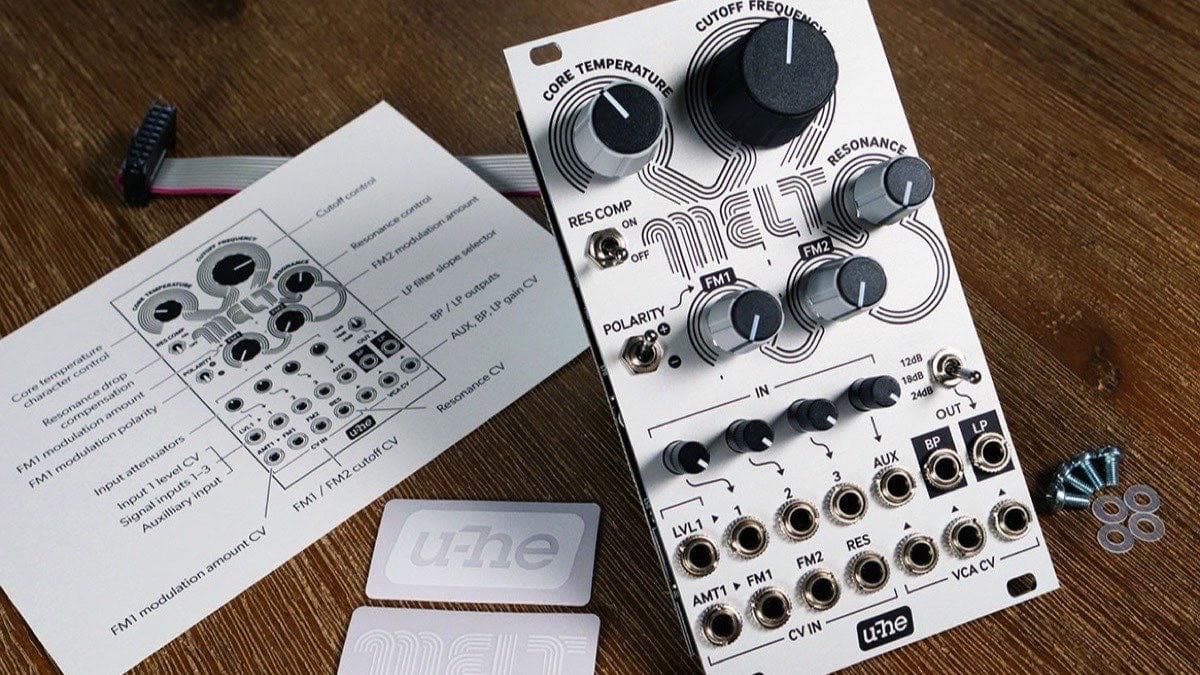
See full specs, price, and alternatives in the plugin database →
u-he released MELT, its first ever piece of hardware and its first fully analog instrument. After two decades of software synths like Diva, Zebra, and Repro, the Berlin developer has put a soldering iron to its own reputation and built a 14HP analog filter module for Eurorack. It shipped on August 27, 2026 at €299.
At a glance: €299 including VAT, 14HP wide, around 32mm deep with the bus cable attached. MELT is a four-pole analog cascade filter with a low-pass output whose slope switches between 12, 18, and 24 dB per octave, a simultaneous band-pass output, and a drive circuit called Core Temperature that runs from clean to wild. Power draw is 70mA on the +12V rail and 70mA on the -12V rail, with no +5V required.
What is u-he MELT?
MELT is an analog filter designed to be the final tone-shaping stage of a classic synth voice. In a subtractive patch the oscillators make the raw sound, the envelope shapes the amplitude, and the filter decides the character. MELT is built for that last job, and u-he has treated it as the most important one.
What makes it notable is who built it. u-he is a respected software house, and its virtual-analog filters in Diva and Repro are the reason many producers reach for those plugins. A physical analog filter puts that filter theory into real circuitry, where there is no oversampling to hide behind and every component colors the sound. The result leans on the same voicing philosophy the company is known for in software.
What MELT does, feature by feature
A cascade low-pass with three slopes
The core of MELT is a four-pole cascade low-pass filter. What sets it apart from a fixed ladder is the switchable slope: you can run it at 12, 18, or 24 dB per octave. A gentler 12 dB slope lets more harmonics through above the cutoff, which keeps a bassline bright and a pad airy. The steeper 24 dB slope clamps down hard for that classic dark, focused low-pass sound. Having all three on one switch means the filter can be surgical or soft without swapping modules.
A band-pass output at the same time
MELT gives you a band-pass output alongside the low-pass, and both are live at once. Each has its own dedicated VCA, so you can level them independently or send them to different places in a patch. That opens up parallel filtering: run the low-pass into your main output and the band-pass into a reverb send, and you get a body-plus-shimmer sound from a single module. There is also an auxiliary output that bypasses the filter entirely, useful for blending dry signal back in.
Core Temperature: the drive that names the module
Core Temperature is MELT's character control. Turned down, the filter stays clean and precise. Turned up, it pushes the circuit into saturation, from a gentle analog warmth to an aggressive, overdriven growl. This is the control that earns the module its name, and it is the reason MELT is more than a clean utility filter. It gives a plain sawtooth teeth, and it can turn a resonant sweep into something that screams.
Modulation that goes beyond a normal filter
MELT carries more voltage control than most filter modules bother with. There are two cutoff FM inputs, FM1 and FM2, each with an attenuator. FM1 adds an inverter switch and its own modulatable VCA, so you can modulate the amount of modulation, ducking or swelling how hard an envelope or LFO hits the cutoff. Resonance has its own CV input. On top of that, MELT includes a three-channel audio input mixer, with a modulatable VCA on the first channel and level knobs on the other two, plus an attenuated, VCA-controlled aux input. In practice MELT can act as a small mixer and a filter in the same 14HP, which is a generous use of the panel.
u-he MELT specifications
| Spec | Detail |
|---|---|
| Type | Analog cascade low-pass and band-pass filter |
| Format | Eurorack module |
| Width | 14HP |
| Depth | ~32mm with bus cable |
| Low-pass slopes | 12, 18, 24 dB per octave (switchable) |
| Outputs | Low-pass (with VCA), band-pass (with VCA), aux (filter bypass) |
| Drive | Core Temperature, clean to heavy saturation |
| Cutoff modulation | FM1 (attenuator, inverter, modulatable VCA), FM2 (attenuator) |
| Resonance modulation | Dedicated CV input |
| Audio inputs | 3-channel mixer (ch.1 modulatable VCA, ch.2 and ch.3 level), plus aux input with VCA |
| Power | 70mA @ +12V, 70mA @ -12V, no +5V |
| Price | €299 (incl. VAT), €251.26 net |
u-he MELT vs Make Noise QPAS
MELT is not the only character-focused analog filter in Eurorack. The best-known rival is Make Noise QPAS. They aim at different jobs, so the comparison is really about what you want a filter to do.
| u-he MELT | Make Noise QPAS | |
|---|---|---|
| Developer | u-he | Make Noise |
| Architecture | Mono cascade low-pass + band-pass | Stereo four-response multi-filter |
| Slope options | 12 / 18 / 24 dB per octave | Fixed multimode responses |
| Character control | Core Temperature drive | Radiate and Q control |
| Audio mixer | 3-channel input mixer built in | Two stereo inputs |
| Width | 14HP | 30HP |
| Price | €299 | ~$349 |
Which to pick. Choose MELT if you want a driven, voice-final low-pass with a switchable slope and a band-pass tap, all in a compact 14HP. It is the better fit for shaping a single monosynth voice and giving it grit. Choose QPAS if stereo movement and simultaneous multi-peak filtering are the point, and you have the 30HP and the budget to spare. MELT is the tighter, more focused tool; QPAS is the wider, more experimental one. For a ladder-style alternative at a lower price, the AJH MiniMod Transistor Ladder Filter is worth a look, though it trades MELT's band-pass output and built-in mixer for a purer Moog-style voice.
Who u-he MELT is for
Consider it if you build monosynth voices in Eurorack and want the filter to be the character, not just a tone control. The variable slope makes it flexible across bass, leads, and pads, and Core Temperature means you can dial in anything from a clean vintage low-pass to a saturated, unstable snarl. The built-in mixer and deep cutoff modulation reward patch programmers who like to route audio and control voltage in unusual ways.
It is also a natural buy for existing u-he software users who have wanted that Diva or Repro filter voicing in the real world. This is the closest thing to holding one of those plugins in your hands.
Skip it if you need stereo filtering, a huge menu of filter modes, or the absolute cheapest way to get a low-pass into a rack. MELT is a considered, characterful mono filter, and that focus is the whole point. If your patches live in stereo or you want morphing multimode responses, a wider module serves you better.
How much does u-he MELT cost?
MELT is €299 including 19 percent VAT, which works out to €251.26 net. It is sold through established modular retailers including SchneidersLaden, Perfect Circuit, Elevator Sound, Thomann, and Moogaudio. There is no software version and no cheaper tier: this is a single analog hardware product, and the price reflects a fully analog signal path in a compact panel.
FAQ
Is u-he MELT worth it?
For a Eurorack builder who wants a characterful, flexible analog filter, yes. The switchable slope, the simultaneous band-pass output, and the Core Temperature drive give it more range and more personality than a plain utility filter, and the built-in three-channel mixer adds real patching value inside 14HP. At €299 it sits in the mid range for a boutique analog filter and earns the price with features.
Is MELT u-he's first hardware product?
Yes. u-he built its reputation entirely on software synths and effects like Diva, Zebra, Hive, and Repro. MELT is the company's first physical product and its first fully analog instrument, which is why it drew so much attention when it shipped.
What does the Core Temperature control do?
Core Temperature is MELT's drive and character control. At low settings the filter is clean and precise. As you raise it, the circuit saturates, moving from subtle analog warmth to an aggressive, overdriven tone. It is the control that gives the module its name and its signature sound.
Does MELT have a stereo output?
No. MELT is a mono filter with a low-pass output, a simultaneous band-pass output, and an aux output, each mono. If you need stereo filtering, a module like Make Noise QPAS is designed for that instead.
The bottom line
MELT is a strong debut. u-he took the filter theory that made its software synths famous and committed it to an analog circuit, then gave it a switchable slope, a band-pass tap, a real drive stage, and more modulation than a filter usually gets. It is mono and it is focused, and both of those are deliberate. As the final analog stage of a synth voice, it does exactly what u-he clearly set out to do, and it does it with the character the company is known for. For anyone building voices in Eurorack, it is one of the more interesting filters of the year.