Some links on this page are affiliate links. If you buy through them, Dubspot may earn a commission at no extra cost to you. It never affects our scores or what we recommend — read our policy.
Universal Audio Volt Gen 2: Tone Shaping on USB-C
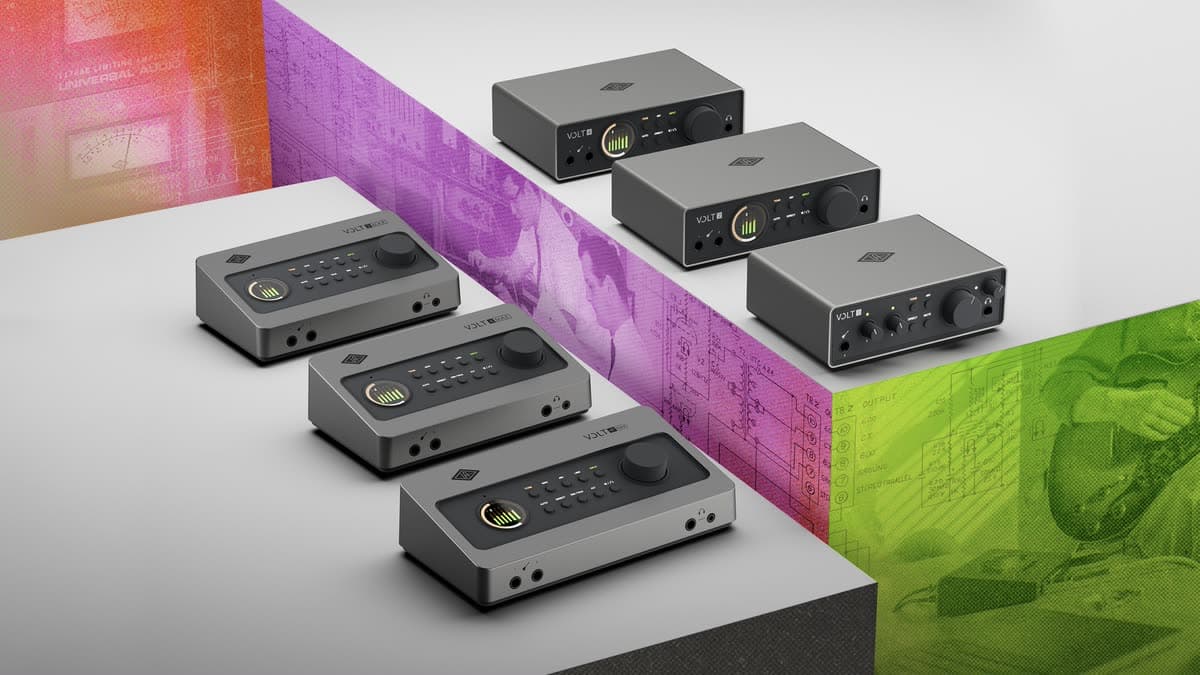
Universal Audio Volt Gen 2 and Volt Max are six USB-C audio interfaces from $149 up to $499, with 32-bit conversion and three-mode Tone Shaping preamps.
E
Elena Marsh
October 5, 2026 · 11 min read
Black Friday 2026Universal Audio Black Friday 2026: dates and deals →
Universal Audio put six new Volt interfaces on sale on 1 October 2026. Every model is a bus-powered USB-C box with 32-bit conversion at sample rates up to 192 kHz. US prices run from $149 for Volt 1 Gen 2 to $499 for Volt 4P Max. In the UK, Thomann lists the same six from £121 to £435, in stock.
At a glance: six USB-C interfaces, all bus-powered. Tone Shaping has three modes: Warmth, Focus, and Shine. Auto-Gain, Clip Protection, and the color Smart Display skip Volt 1 Gen 2. Max models add six dynamics presets drawn from UA's 1176, LA-2A, and VCA designs. LUNA and the UAD Volt Studio Bundle come in the box.
What each box is for
Volt is a desktop interface, not a mixer you can run without a computer. It needs a USB host. Mac and iOS are class-compliant. Windows needs the UA ASIO driver from UA Connect. The floor is macOS 12, Windows 10 64-bit, and iPadOS or iOS 16, on Intel, AMD, or Apple silicon. A 1 m USB-C cable is included. Lightning iPads need Apple's camera adapter. For a larger desktop hub with 18 inputs and 20 outputs, see our AudioFuse Studio Rev2 review.
A 15 W USB-C charger covers every model when the computer cannot feed it. The 3 A supply itself ships only with Volt 4 Max and Volt 4P Max.
Volt 1 Gen 2 ($149, £121) is the 2-in/2-out: one combo mic/line input and a front Hi-Z jack (1 megohm) that can run together, which the first Volt 1 could not do. One Tone Shaping preamp, 60 dB, phantom, monitors, one headphone, and loopback. No screen, Auto-Gain, Console, MIDI, ADAT, or hub.
Volt 2 Gen 2 ($219, £173) is 2-in/4-out, and it is where the Smart Display, Auto-Gain, Clip Protection, independent 48 V, and UAD Console start. Console is also where session recall and the two cue mixes live, the part of interface routing you will actually touch. No MIDI, ADAT, hub, or Max.
Volt 4 Gen 2 ($299, £243) is 12-in/6-out: two preamps, two extra line inputs, optical ADAT or S/PDIF, line outs 3-4, one headphone, Type A MIDI, and a 500 mA USB hub. Four analog channels convert in and six convert out. No Max, talkback, or speaker switch.
Volt 2 Max ($299, £261) is the other $299 choice, at 10-in/4-out. Two analog channels plus eight from ADAT, with Max, MIDI, the hub, talkback, and a second headphone. No line inputs 3-4, and no speaker switching.
Volt 4 Max ($399, £348) adds Max, talkback, two headphones, and speaker switching to the 12-in/6-out layout. Hold ALT for two seconds and outs 3-4 feed the alt monitors, with the same switch in Console. The 3 A supply is included, and bus power still works. To correct those monitors for your room, ARC Studio+ room correction can sit between an interface like this and your speakers.
Volt 4P Max ($499, £435) puts Tone Shaping on all four analog inputs, each with 60 dB and its own 48 V, plus two Hi-Z jacks, Max, speaker switching, talkback, and the hub. Typical draw is 6.0 W, which is why the supply is in the box.
Optical ADAT is eight channels at 44.1 or 48 kHz, four at 88.2 or 96, and two at 176.4 or 192. Clock can be internal, ADAT, or S/PDIF. Digital inputs skip Tone Shaping and Max. Extra line inputs are fixed gain on Gen 2 and adjustable up to 60 dB on Max.
Tone, compression, and what changed
The preamps match the Volt 876 family, and Tone Shaping is digital. Warmth comes from the UA 610 tube voice, for vocals and acoustic guitar that need body. Focus is an American solid-state console voice, aimed at rap vocals, electric guitar, and bass. Shine is British Class-A, for air on top. You can leave all three off and record the preamp flat.
Clip Protection is not one circuit. On Gen 2 it is gain staging plus a software limiter. On Max it is a hardware limiter in front of the converter. Either one can be turned off.
Max stores six presets: Great Vocal, Rap Vocal, Album Vocal, Electric Guitar, Jangly Acoustic, and Tight Bass. They draw on 1176, LA-2A, and VCA designs. With three tone modes, that is more than 18 combinations, and the display shows gain reduction. Auto-Gain sets the level and arms Clip Protection. Volt 1 Gen 2 leaves both jobs to you.
UAD Console runs every new Volt except Volt 1, plus Volt 876. There is no UAD-2 DSP in the chassis, so Native plug-ins run on the computer. You cannot pair these with an Apollo or with a second Gen 2 or Max. An ADAT model can sit beside a Volt 876.
The first Volt 4 was 24-bit, with 55 dB of gain, one Vintage switch, and 5-pin MIDI. Gen 2 is 32-bit, with 60 dB, three tone modes, and 3.5 mm Type A MIDI on the models that have it. Monitor outs are DC-coupled at 20.2 dBu, up from 15 dBu. The original Volt 1, 2, and 4 launched at $149, $199, and $259. Gen 2 holds $149 on the small box and lists the other two at $219 and $299.
Mic inputs measure 119 dB A-weighted. From Volt 2 up, monitors and line outs measure 126 dB with mic THD+N at -110 dB. Volt 1's monitors are 122 dB, and its mic THD+N is -108 dB. Headphones deliver 45 mW per channel into 32 ohms. Volt 4 Gen 2 is about 7.4 x 4.9 x 2 inches and 1.4 lb, and Volt 2 Max is about 7.5 x 4.5 x 2.1 inches and 1.3 lb.
Volt specifications
| Model | I/O | Preamps and extras | US price | Thomann |
|---|---|---|---|---|
| Volt 1 Gen 2 | 2-in/2-out | 1 preamp, Hi-Z. No screen, Auto-Gain, MIDI, or ADAT | $149 | £121 |
| Volt 2 Gen 2 | 2-in/4-out | 2 preamps, display, Auto-Gain, Console. No MIDI or ADAT | $219 | £173 |
| Volt 4 Gen 2 | 12-in/6-out | 2 preamps, line 3-4, ADAT, MIDI, hub. No Max or talkback | $299 | £243 |
| Volt 2 Max | 10-in/4-out | 2 preamps, Max, ADAT, MIDI, talkback, second headphone | $299 | £261 |
| Volt 4 Max | 12-in/6-out | Max, line 3-4, ADAT, MIDI, talkback, speaker switch, supply | $399 | £348 |
| Volt 4P Max | 12-in/6-out | 4 preamps, Max, ADAT, MIDI, talkback, speaker switch, supply | $499 | £435 |
Sample rates are 44.1, 48, 88.2, 96, 176.4, and 192 kHz on every model. Thomann links above are our affiliate route.
Volt next to Scarlett, SSL 2, and the iD14
The two-channel prices sit in a tight band. Focusrite's US store lists the Scarlett 2i2 4th Gen at $224.99. It is 2-in/2-out, with 120 dB dynamic range, Air Presence, Air Harmonic Drive, Auto Gain, and Clip Safe. No MIDI, and no ADAT. SSL's launch note prices the SSL 2 MKII at $229.99: 2-in/2-out, 32-bit / 192 kHz, 120 dB converters, two preamps, two instrument inputs, Legacy 4K, DC-coupled outs, and two headphones on one mix.
Audient's iD14 MKII is a 10-in/6-out with 32-bit conversion, two console preamps, a JFET instrument input, four line outs, two headphones, and ADAT. Thomann lists it at £185.
| Volt 2 Gen 2 | Scarlett 2i2 4th Gen | SSL 2 MKII | iD14 MKII | |
|---|---|---|---|---|
| Street price | $219 / £173 | $224.99 | $229.99 | £185 |
| Shape | 2-in/4-out | 2-in/2-out | 2-in/2-out, two HP | 10-in/6-out, ADAT |
| Color | Warmth, Focus, Shine | Two Air modes | Legacy 4K | Audient console preamps |
| Software | LUNA and Volt Studio Bundle | Hitmaker, Pro Tools Intro+, Live Lite, Cubase LE | SSL Production Pack | Audient's bundle |
Which one to pick
Volt 2 Gen 2 is the buy when you want the three tone modes and the LUNA bundle, and two inputs are enough. The Scarlett 2i2 is the buy when Air modes and the wider starter pack matter, at almost the same US price. The SSL 2 MKII is the buy when Legacy 4K and a second headphone on a compact 2x2 come first.
Inside Volt, the $299 split is the real decision. Volt 4 Gen 2 spends it on line inputs, line outs 3-4, and one headphone, with no onboard compressor. Volt 2 Max spends it on the six presets, talkback, a second headphone, ADAT, and MIDI, and gives up those line jacks. In the UK the Max is £18 more. Step to Volt 4 Max at $399 when you want Max and speaker switching in one chassis. Volt 4P Max is only for sessions that need four mic preamps here.
The iD14 MKII at £185 undercuts both $299 Volts in the UK and already has ADAT. Take it for Audient preamps and more I/O for less. Take a Volt when the tone modes, the Max presets, or the UA software are the point. A wider field is in our best audio interfaces for 2026.
Who it is for, and the software
Volt 1 is the one-mic-and-guitar buy. Volt 2 is the screen and Auto-Gain buy. Volt 4 Gen 2 is the line and ADAT buy when you will compress in the DAW, and a Max is the buy when those presets should print on the way in.
Skip the range if you need UAD-2 inserts, because that is still an Apollo, or if you wanted a mixer with no computer attached. Skip Volt 1 when the screen is the feature you came for. Skip the bundle as a reason to buy on iPad, Android, or Windows ARM: the plug-ins do not run there, while Tone Shaping and Max stay in the hardware.
The bundle is LUNA plus Topline Vocal Tune, the UA 610, Century Tube Channel Strip, LA-2A, 1176, Pure Plate, Galaxy Tape Echo, Oxide Tape, Vibe, PolyMAX, Anthem, Lion '68, and Showtime '64. Alongside that sit Melodyne Essential, Ampeg SVT-VR, UJAM Virtual Drummer DEEP, Virtual Bassist DANDY, Splice INSTRUMENT, UVI Prisma Producer Lab, three months of FL Studio Producer Edition, and Puremix. Contents can change, and the FL Studio months are a window, not a full licence.
FAQ
Do I need a driver?
On a Mac or an iPad, no. The interface is class-compliant. On Windows, install the UA ASIO driver through UA Connect. Volt 1 Gen 2 does not use UAD Console. Every other new Volt does.
Can Volt sit next to an Apollo?
No. Combining Gen 2 or Max with Apollo is not supported, and neither is pairing two of the new Volts. ADAT models can pair with Volt 876.
Which $299 Volt should I buy?
Volt 4 Gen 2 if you need line inputs and line outs 3-4. Volt 2 Max if you want the dynamics presets, talkback, a second headphone, and ADAT, and you can live without those extra line jacks.
Does Tone Shaping hit the ADAT input?
No. Tone Shaping and Max stay on the analog preamps. Optical inputs remain clean. Gen 2 line inputs are fixed gain. Max line inputs go up to 60 dB.
Does the plug-in bundle run on iPad?
No. It does not run on iOS, Android, or Windows ARM. You can still record, and the onboard tone and Max processing stay in the box.
Verdict
Gen 2 is easier to shop than the first Volt line. The $149 box takes a mic and a guitar together, the $219 box adds the screen and Auto-Gain, and the two $299 boxes split patchbay I/O against printed compression. Max is the right spend when you want those six presets on the way in, and it still does not replace an Apollo. Match the jacks to the sessions you actually run.