IK Multimedia ARC Studio+ Calibrates Rooms Without a Computer
IK Multimedia ARC Studio+ adds standalone calibration, automatic sub alignment and digital I/O to hardware room correction. Specs, prices and how it compares.
Black Friday 2026IK Multimedia Black Friday 2026: dates and deals →
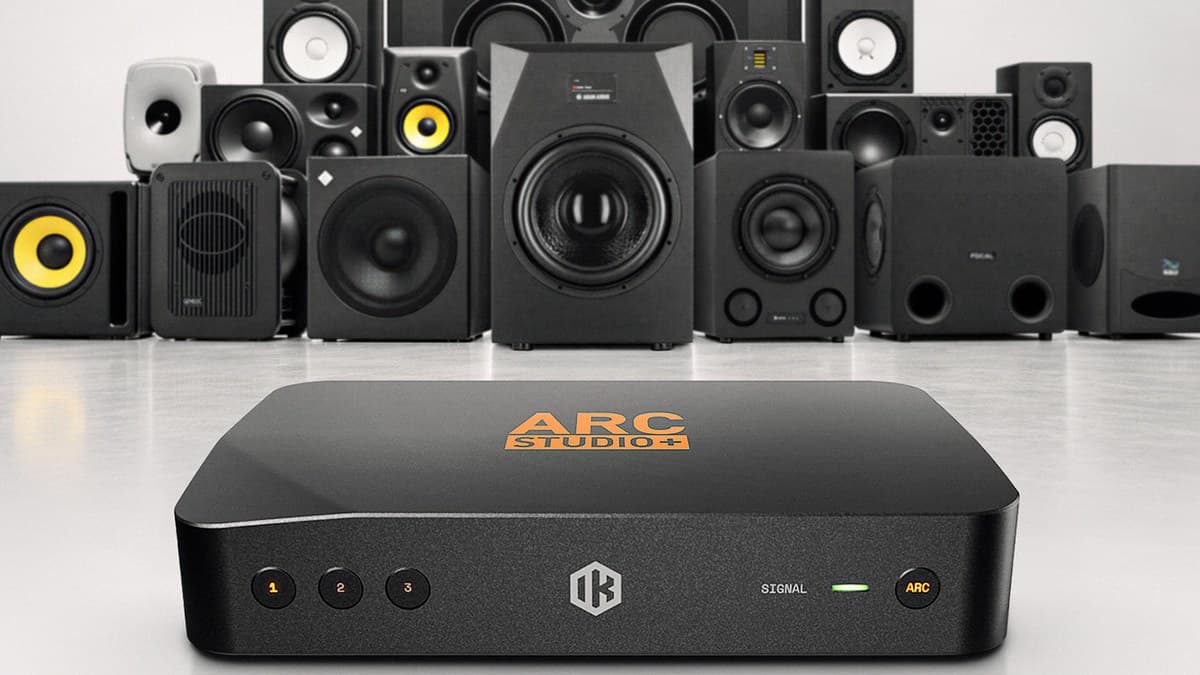
IK Multimedia released ARC Studio+ on October 15, 2026, and it's shipping now. It's a hardware room correction processor that can measure and calibrate your room from its own front panel, with no computer, DAW or interface involved. If you've put off room correction because the setup felt like a chore, this is the version that removes most of the excuses.
At a glance: ARC Studio+ costs $449.99 / €449.99 regular, with an intro price of $399.99 / €399.99 for a limited time (excluding tax). It includes the hardware, ARC X software, a power supply and the ARC measurement mic. Standalone 1-point and 3-point calibration runs from the front panel. ARC X adds 7-point and 21-point 3D measurement. There's a dedicated balanced sub output with automatic gain, crossover, phase and delay alignment, three Scene buttons, USB-C and optical S/PDIF digital I/O, and a relay-based hard bypass. Correction covers 20 Hz to 20 kHz. Thomann UK lists it at £399 including VAT, in stock.
What is ARC Studio+?
ARC Studio+ is a box that sits between your source (an audio interface or monitor controller) and your speakers. It measures how your room colors the sound at your listening position, then applies correction onboard so what reaches your ears is closer to what's on the recording. Because the processing lives in hardware, it keeps working whatever you're playing, whether that's a DAW session, a reference track in a streaming app, or a phone plugged into the inputs.
IK has been at this for a long time. The ARC System first appeared in 2007, and ARC Studio+ belongs to a line that spans nearly 20 years and five generations. The original ARC Studio, introduced in February 2024, moved correction into hardware but still needed the mic connected through an audio interface running software to take measurements. ARC Studio+ removes that dependency and adds subwoofer management and digital connections. The original stays in the lineup as the cheaper option.
If you're new to the idea of room correction and want the background on why rooms cause so many mix problems, our older explainer on finding the sweet spot of your home studio with room correction covers the basics.
Features, and what they do for you
Standalone calibration from the front panel
This is the headline. You plug the included ARC mic into the dedicated ARC MIC input (XLR) and run a 1-point or 3-point quick calibration straight from the unit. The correction is calculated and applied onboard. You don't need a computer, a DAW or an audio interface for any of it.
In practice, that means you can recalibrate after moving your desk or swapping monitors in a few minutes. It also makes the box easy to take to a different room, like a rehearsal space or a friend's studio, without packing a laptop and interface just to measure.
ARC X software for deeper measurement
Quick calibration is convenient, but more measurement points usually give a better picture of the listening area. ARC X, which is included, handles 7-point and 21-point 3D room measurement. It's also where you edit target curves and manage profiles.
Profiles are stored in the hardware, so once you've measured and saved, you can close ARC X and the correction keeps running. ARC X runs on Windows (Intel, AMD and Arm64) and macOS (Apple Silicon and Intel).
ARC X also includes X-Monitor, which lets you audition virtual versions of over 20 speaker models through your corrected system. It's a handy way to check how a mix might sound on other playback systems. The unit has to stay connected over USB-C for that feature.
Automatic subwoofer management
Adding a sub to a small studio is easy to get wrong. Set the crossover, phase or delay badly and you can end up with a hole in the low end that's worse than having no sub at all. ARC Studio+ has a dedicated balanced mono TRS sub output. It detects the sub automatically and aligns gain, crossover, phase and delay for you.
IK says this uses technology developed for its iLoud Sub, and that it works with any brand of monitors and sub. You can run it as stereo or 2.1, which is useful if you want to switch the sub off to check how a mix holds up on smaller systems.
Three Scene buttons
The front panel has three Scene buttons. Each one stores a calibration profile, speaker routing, sub on or off, and input selection. IK's examples are good ones: one Scene for your mix position, one for an artist sitting on the couch, and one with a translation check curve.
That's a real workflow improvement over digging through software menus mid-session. One press and the whole setup changes.
Analog and digital connectivity
You get two balanced XLR/TRS combo inputs, two balanced XLR outputs and the balanced sub output. On the digital side there's a USB-C digital audio input plus optical S/PDIF in and out. Digital paths skip extra AD/DA conversion stages, so if your source can send digital audio, you avoid converting to analog and back again before correction.
Relay-based hard bypass
The bypass is relay-based and power-safe. It protects your speakers from pops when the unit powers up or down, and it gives you a clean comparison between corrected and uncorrected sound. That A/B is worth doing regularly, since it's the quickest way to hear what the correction is doing in your room.
Two latency modes
Natural Phase mode runs at 1.4 ms of latency. Linear Phase mode runs at 42 ms. The low-latency mode is the one to use while tracking or playing along. Linear Phase is better kept for mixing and critical listening, where a little delay doesn't matter.
Specifications
| Spec | ARC Studio+ |
|---|---|
| Type | Hardware acoustic room correction processor |
| Correction range | 20 Hz to 20 kHz |
| Sample rates | 44.1 to 192 kHz |
| Conversion | 32-bit |
| Frequency response | 2 Hz to 87 kHz (-2 dB) |
| Dynamic range | 120 dB (A-weighted) |
| THD | 0.00011% |
| THD+N | 0.00023% |
| Crosstalk | -134 dB |
| Max input/output level | +18 dBu |
| Input impedance | 20 kOhm balanced |
| Output impedance | 50 Ohm |
| Latency | 1.4 ms (Natural Phase), 42 ms (Linear Phase) |
| Analog inputs | 2 x balanced XLR/TRS combo |
| Analog outputs | 2 x balanced XLR, 1 x balanced mono TRS sub out |
| Digital I/O | USB-C digital audio input, optical S/PDIF in and out |
| Mic input | Dedicated ARC MIC input (XLR) |
| Bypass | Relay-based hard bypass |
| Power | 5 V DC, 2.5 A |
| Dimensions | 19.7 x 12.2 x 4.4 cm |
| Weight | 625 g |
| In the box | ARC mic, mic clamp, pouch, USB cable, power supply |
| ARC X compatibility | Windows (Intel, AMD, Arm64), macOS (Apple Silicon, Intel) |
How it compares
| ARC Studio+ | IK ARC Studio | Sonarworks SoundID Reference (Speakers & Headphones + mic) | |
|---|---|---|---|
| Price | $449.99 ($399.99 intro) | $299.99 | $249 software + $99 mic |
| Where correction runs | Hardware | Hardware | Software on your computer |
| Standalone calibration | Yes, from the front panel | No, mic connects through an interface running software | No, needs a computer and interface |
| Computer needed during playback | No | No | Yes |
| Dedicated sub output | Yes, with automatic alignment | No | No |
The original ARC Studio is the closest alternative, and it's a solid one. Correction still lives in hardware, so once you've measured, your computer is out of the picture. What you give up is standalone calibration, the dedicated sub output and the digital I/O. If you have a stereo pair, no sub, and an interface already on your desk (something like the UA Volt Gen 2 range), ARC Studio does the core job for $100 to $150 less, depending on whether you catch the Studio+ intro price.
Sonarworks SoundID Reference is cheaper again at $348 with the mic, and it covers headphones too. The catch is that the correction runs on your computer, so it only works with audio that passes through it, and there's no offline use. The mic also needs 48V phantom power from your interface. If you work mostly in the box and want headphone correction as well, that's a reasonable trade.
Pick ARC Studio+ if you run a sub, move between rooms, recalibrate often, or want correction applied to everything without a computer in the chain. If none of that applies, save the money.
Who it's for
ARC Studio+ makes the most sense for producers running a 2.1 setup, since automatic sub alignment solves one of the hardest problems in small-room monitoring. It also suits anyone who works in more than one space, mobile engineers, and studios that host clients and would benefit from a "couch" Scene. Producers who want their streaming references, DJ sources and DAW all corrected the same way will like having the processing in hardware.
Skip it if you already own an ARC Studio and don't need a sub output or standalone measurement. The same goes if you mostly mix on headphones; our guide to the best studio headphones is a better place to spend time. And if your computer is always on and always the source, a software solution covers the basics for less.
Pricing and availability
ARC Studio+ is shipping now. All prices below exclude tax, and IK's intro offers save $50 / €50 for a limited time.
- ARC Studio+ (hardware, ARC X, power supply, ARC mic): $399.99 / €399.99 intro, $449.99 / €449.99 regular.
- Upgrade for ARC Microphone owners (no mic included): $349.99 intro, $399.99 regular.
- Upgrade for ARC Studio owners: $299.99 intro, $349.99 regular.
- Original ARC Studio: $299.99 (down from $349.99), with an upgrade price of $249.99.
In the UK, Thomann lists ARC Studio+ at £399 including VAT, in stock. The ARC Studio+ Upgrade is £343 and the original ARC Studio is £211. You can find full details on the official ARC Studio+ page. If you also use IK gear for guitar, our TONEX 2 Player first look covers the company's other October release.
FAQ
Do I need a computer to use ARC Studio+?
No. Plug the ARC mic into the dedicated ARC MIC input and run a 1-point or 3-point calibration from the front panel. You'll only need a computer for ARC X features like 7-point and 21-point measurement, target-curve editing and X-Monitor.
Will it work with my existing monitors and sub?
IK says the subwoofer management works with any brand of monitors and sub. The unit auto-detects the sub and aligns gain, crossover, phase and delay, and you can run stereo or 2.1.
I already own ARC Studio. Is the upgrade worth it?
The upgrade is $299.99 intro, $349.99 regular. It's worth it if you want standalone calibration, a sub output with automatic alignment, digital I/O or the Scene buttons. If your current setup is a stereo pair you rarely move, your ARC Studio already handles the main job.
What about latency while recording?
Natural Phase mode adds 1.4 ms, which is low enough for tracking. Linear Phase mode adds 42 ms, so save it for mixing and listening.
Does correction keep running when ARC X is closed?
Yes. Profiles are stored in the hardware and keep working after you close the software. The exception is X-Monitor speaker auditioning, which needs the unit connected over USB-C.
Verdict
ARC Studio+ fixes the main drawback of the original ARC Studio. Measurement no longer needs an interface and software, and it adds automatic sub alignment, digital I/O and Scene recall that small studios will use every day. At $399.99 intro it costs more than the alternatives, and stereo-only users who stay in one room can save money with the original. This is a first look based on IK's official materials, not a hands-on test. On paper, though, it's the most complete hardware room correction IK has offered so far.