TONE3000's Free Plugin Opens 700,000 Amp Captures
TONE3000 launched a free, open-source Neural Amp Modeler plugin and standalone app with 700,000+ amp and pedal captures. Formats, features, specs and how it compares.
See full specs, price, and alternatives in the plugin database →
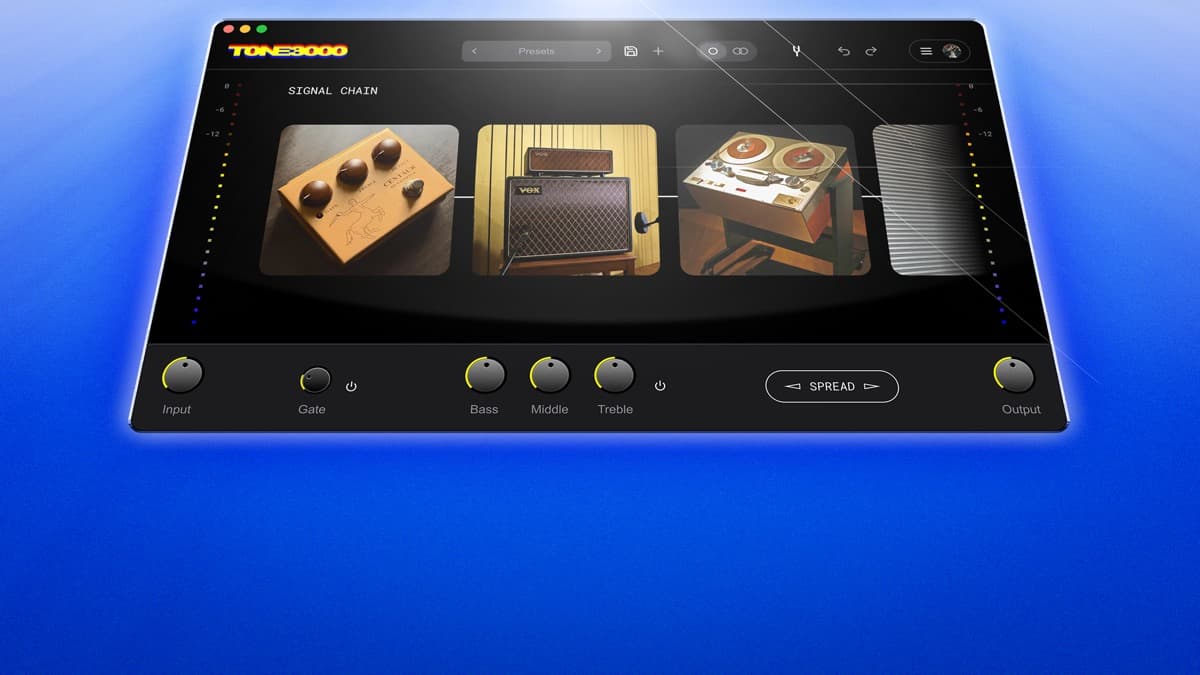
TONE3000 has released its own free plugin, and it changes how easy amp captures are to use. On September 1, 2026 the company behind the largest public library of Neural Amp Modeler captures launched a free, open-source plugin and standalone app. It runs on the new NAM A2 engine and puts more than 700,000 amp and pedal captures a click away inside any DAW. Nothing to buy, and no capture files to wrangle.
At a glance: Free and open-source. The TONE3000 plugin runs as VST3, AU, AAX, CLAP and LV2, plus a standalone app, on macOS, Windows and Linux. It browses and loads NAM captures and impulse responses directly from the TONE3000 library, and adds chains, parallel dual chains, stereo processing and EQ around them.
What is the TONE3000 plugin?
Neural Amp Modeler, or NAM, is an open-source technology that captures the sound of a real amp or pedal into a small neural model. Anyone can make a capture. Over the last few years a community has uploaded hundreds of thousands of them to TONE3000. The catch, until now, was logistics. You downloaded individual capture files, sorted them into folders and loaded them into a third-party NAM host. Powerful, but fiddly.
The TONE3000 plugin removes that friction. It is the official player for the library, so instead of managing files you browse tones inside the plugin and load them straight onto your track. The company reports that the library has more than doubled in three months, from 300,000 to over 700,000 captures and impulse responses, and that the platform has passed 600,000 monthly active users and 9 million downloads. Scale is the whole argument here. No single amp-sim developer can model as many rigs as a community this size can capture.
Under the hood sits NAM A2, the second-generation model architecture that first appeared in June 2026. TONE3000 says a blind listening test with more than 1,000 participants rated NAM A2 above capture and modelling technologies from Neural DSP, IK Multimedia and Line 6. That is the developer's own test, so take the ranking with a grain of salt. The broader trend is hard to argue with, though: capture accuracy has caught up to the paid competition, and on TONE3000's numbers it has edged ahead.
What the TONE3000 plugin does, feature by feature
Built-in browsing is the core convenience. You search the TONE3000 library from inside the plugin and audition captures on your own DI signal, with no downloading, unzipping or folder-sorting. That alone changes how usable the NAM ecosystem is for a working session.
Chains let you stack an unlimited number of NAM A2 captures and impulse responses in series, so you can put an amp capture into a cab IR into a room IR the way a real signal path works. Dual Chain runs two parallel chains with branching and independent panning, which is how you build big stereo rhythm tones or blend a clean and a dirty amp. Stereo processing is multi-core with auto-align and auto-balance to keep parallel paths phase-coherent and level-matched, and Spread adds stereo widening to a mono chain.
On the tone-shaping side, there is pre- and post-block parametric EQ plus a global EQ, so you can carve the signal before and after the amp capture without loading a separate plugin. Calibration matches the plugin's input to your audio interface level. That step matters more than it sounds, because a NAM model expects the same signal level the capture was made at. Get it right and the captures behave the way their authors intended. Get it wrong and even a great capture can sound thin or overdriven.
TONE3000 plugin specifications
| Spec | Detail |
|---|---|
| Price | Free, open-source (plugin, engine and library) |
| Plugin formats | VST3, AU, AAX, CLAP, LV2 |
| Standalone | Yes |
| Operating systems | macOS (Apple Silicon and Intel), Windows, Linux |
| Engine | NAM A2 (Neural Amp Modeler, Architecture 2) |
| Library access | 700,000+ NAM captures and impulse responses |
| Signal routing | Unlimited chains, dual parallel chains, stereo, spread |
| EQ | Pre-block, post-block and global parametric EQ |
| Level matching | Interface input calibration |
How TONE3000 compares to a paid amp sim
The natural comparison is against a modelled amp suite such as Line 6 Helix Native, where you tweak virtual amp and cab controls, rather than load a fixed capture.
| TONE3000 Plugin | Helix Native | |
|---|---|---|
| Price | Free | Paid licence |
| Approach | Plays community NAM captures | Editable modelled amps and effects |
| Tone count | 700,000+ captures and IRs | Fixed roster of modelled amps, cabs, effects |
| Editable amp controls | Limited (EQ and routing) | Full gain, EQ and tone-stack per amp |
| Formats | VST3, AU, AAX, CLAP, LV2, standalone | VST3, AU, AAX |
| Best for | Grabbing a specific real-rig tone fast, free | Designing and tweaking a tone from scratch |
Pick TONE3000 when you want the exact sound of a specific real amp or pedal and you want it for nothing. Pick a modelled suite like Helix Native, or IK Multimedia's ToneX capture platform, when you want to dial amp controls yourself rather than lean on how someone else set up a capture. Plenty of players run both, using a paid suite for tone design and TONE3000 for its sheer breadth. If you are building a no-cost rig, it earns a place in any list of the best free VST plugins.
Who the TONE3000 plugin is for
It is for anyone who records guitar or bass into a DAW and wants convincing amp tone without buying a suite. It is ideal for producers who occasionally need a real-sounding guitar and do not want to learn a deep amp-modelling interface, and for guitarists who already live in the NAM world and want the library without the file admin. Because it is open-source and on Linux, it also suits engineers who avoid closed ecosystems.
Who should skip it: players who want to sculpt an amp from the front panel, turning gain, bass, mid and treble knobs on a modelled circuit, will find a capture player limiting by design. And if you never track guitar or bass, this is not a tool you need.
How much does the TONE3000 plugin cost?
Nothing. The plugin, the NAM A2 modelling technology and the capture library are all free, and the project is open-source. You can download the TONE3000 plugin and the standalone app and load captures without paying. Optional paid tiers on the TONE3000 platform exist for creators who want extra upload and hosting features, but playing tones costs nothing.
FAQ
Is the TONE3000 plugin really free?
Yes. The plugin, the NAM A2 engine and access to the capture library are free, and the code is open-source. There is no licence to buy to load and play tones.
What formats and operating systems does it support?
It ships as VST3, AU, AAX, CLAP and LV2, plus a standalone app, and runs on macOS (Apple Silicon and Intel), Windows and Linux.
TONE3000 vs ToneX or Neural DSP, which is more accurate?
TONE3000 published a blind listening test of more than 1,000 people that rated its NAM A2 engine above competing capture and modelling technologies. That is the developer's own test, so treat it as a signal rather than a verdict and audition captures on your own guitar. In practice, capture-based accuracy is now very high across the board.
Do I need to download capture files separately?
No. The whole point of the plugin is that you browse and load captures from the TONE3000 library inside the plugin, with no manual file downloading or folder management.