Snorkel Disto Disco Turns Distortion Into Movement
Snorkel Audio Disto Disco is a €59 distortion effect with 28 modes and a 16-step modulator on every dial. Specs, official price, and who should buy it.
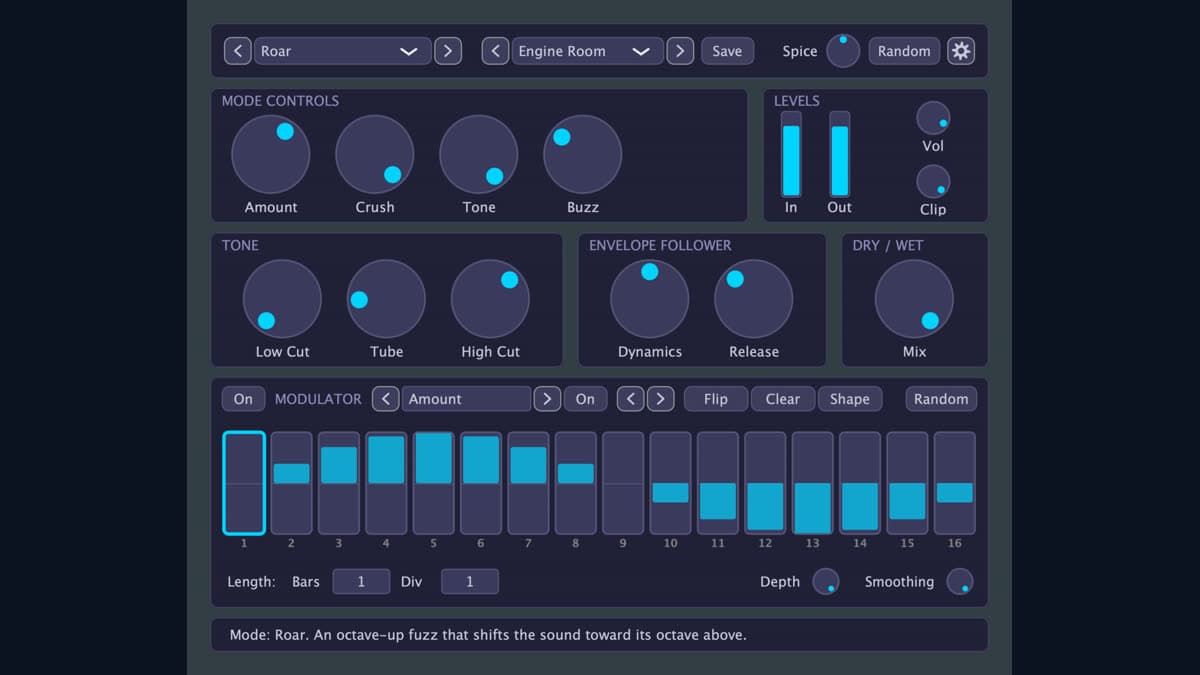
Snorkel Audio released Disto Disco in September 2026. It starts as a distortion plugin and then walks into stranger territory: degrading echoes, vocoders, spectral gates, raw math, and granular clouds. Every dial has its own rhythmic modulator, so the patch can move with the beat instead of sitting still. Street price is €59, direct from the Snorkel shop.
At a glance: €59. 28 modes across five families. A 16-step modulator on every dial. Random with a Spice control. macOS VST3 and AU; Windows VST3. Free demo. Buy it from Snorkel Audio.
This is a first look at the shipping effect and the specs Snorkel publishes. We have not run a session through it yet.
What Disto Disco is
Most distortion plugins pick a circuit and stay there. You set drive, tone, and mix, then you automate if you want motion. Disto Disco treats motion as part of the effect. Each mode brings its own dials. Each dial can run a 16-step modulator locked to the host. One control can swing hard while another glides across a bar. The result is distortion that grooves, talks, or falls apart on purpose.
Snorkel is a Berlin studio that already ships Wave Collider, Snorkel, and a set of smaller tools. Disto Disco is the new distortion-as-movement plugin in that catalogue. It is an effect, not an instrument. You put it on a track you already have.
That is a different bet from Saturn 2, which spends its depth on multiband styles and a modulation matrix, and from Thermal, which stacks two routable distortion stages with a large modulation system. Disto Disco spends its depth on 28 distinct modes and a modulator on every knob.
28 modes across five families
Switching modes changes the controls. The interface does not stay a wall of knobs that mean something else in every algorithm. Each family has a job.
Drive (7): Soft, Growl, Fold, Fuzz, Roar, Lead, and Crush. This is the familiar lane, from gentle warmth through wavefolding and fuzz to high gain and bit crushing. Roar is the octave-up fuzz on the official GUI: it shifts the sound toward the octave above.
Spectral (7): Lowpass, Bandpass, Vowel, Vocoder, Distorted Vocoder, Spectral Gate, and Phase Swap. These reshape frequency content. Filter, morph, vocode, or keep the tone while pulling the timing apart.
Math (7): Max, Subtract, Absolute Difference, Divide, Squared, Sign Multiply, and XOR. Two versions of the input meet through simple operations. The textures are raw and often harsh. This is the family you reach for when a circuit model still sounds too polite.
Time (4): Delay, Helix, Resonator, and Scrub. Recent sound comes back as echoes, loops, and resonances, then gets bent, pitch-shifted, or scrubbed as the input changes. Delay is the one Snorkel highlights for bending timing and driving the feedback loop with every control in motion.
Granular (3): Rain, Hail, and Cloud. Recent sound is cut into grains and scattered, from isolated drops and rhythmic repeats to a continuous shifting layer.
A tone stage sits after every mode: Low Cut, Tube, and High Cut. An envelope follower makes the distortion react to the input. A soft-clip ceiling sits on the output. Everything is automatable from the host.
Every dial can dance
The modulator is the product, not a bonus page. Each dial gets its own 16-step pattern, synced to the host transport. Draw a pattern, pick a shape, or let the modulator roll its own. Depth and smoothing sit on that row, so a step sequence can be a hard gate or a slow wave.
That is how a static Crush setting becomes a rhythmic crush, and how a Delay time can walk without drawing automation in the DAW. One dial can do the obvious pump. Another can take four bars to drift. The patch starts to feel performed.
Random rebuilds the whole patch: mode, dials, and how those dials move. Spice sets how far that jump goes, from a gentle nudge with little or no modulation to a full reshuffle. Every randomized value stays visible and editable. Keep the part that works, pull the rest into shape, and save it.
Dark and light themes are on the official screenshot set. A full manual documents every mode and dial.
Disto Disco specifications
| Spec | Detail |
|---|---|
| Type | Distortion and rhythmic multi-effect |
| Modes | 28, in five families (Drive 7, Spectral 7, Math 7, Time 4, Granular 3) |
| Modulation | 16-step modulator per dial, host-synced |
| Random | Random + Spice; all values remain editable |
| Tone stage | Low Cut, Tube, High Cut after every mode |
| Dynamics | Envelope follower; soft-clip output ceiling |
| Automation | Fully automatable from the host |
| Formats | macOS VST3 and AU; Windows VST3 |
| Demo | Free download from the product page |
| Price | €59, direct |
Disto Disco vs Thermal and Saturn 2
| Disto Disco | Output Thermal | FabFilter Saturn 2 | |
|---|---|---|---|
| Approach | 28 modes, five families | Two routable distortion stages, 30+ algorithms | Up to 6 bands, 28 styles |
| Motion | 16-step modulator on every dial | LFOs, envelopes, macros | 50-slot modulation matrix |
| Extra territory | Time, spectral, math, granular | Filtering and staged FX | Multiband and linear-phase crossovers |
| Formats | VST3, AU (macOS); VST3 (Windows) | VST, VST3, AU, AAX | VST, VST3, AU, AAX, CLAP |
| Price | €59 | Premium Output street | Premium FabFilter street |
Pick Disto Disco when you want distortion that is already a sequencer, and you are happy to buy direct at €59. Pick Thermal when you want two staged engines and a deep modulation graph, and you need AAX. Pick Saturn 2 when the job is multiband saturation you can trust on a mix bus. Trash 2 ($99) and Decapitator stay the simpler circuit-style drives if you do not want 28 modes or a step modulator.
Disto Disco has no AAX and no Linux build. Pro Tools users and Linux sessions are out. That is a real filter, not a footnote.
Who Disto Disco is for
Disto Disco suits producers who treat distortion as movement: electronic tracks that need a crush that pumps, vocals that should talk, synths that should degrade on the repeat. Sound designers who like math operators and granular showers in the same menu as fuzz will get through the 28 modes without getting bored. The free demo is the right first step.
Skip it if you need AAX, or if you want one great tube drive and nothing else. Skip it if Saturn's multiband control is the actual job. And skip it if you already live in Thermal and do not want a second modulation-heavy distortion. This is a mode-hopper with a sequencer on every knob, not a single analog model.
How much does Disto Disco cost?
Disto Disco is €59, direct from Snorkel Audio. Checkout runs through Lemon Squeezy on the official buy block. Formats are VST3 and AU on macOS, and VST3 on Windows. A free demo is on the same page. You will not find it on Plugin Boutique, Thomann, or Best Service.
FAQ
What is Disto Disco?
Disto Disco is a Snorkel Audio effect with 28 processing modes across Drive, Spectral, Math, Time, and Granular families. Each dial has a 16-step modulator, and Random plus Spice can rebuild the patch.
How much does Disto Disco cost?
€59 one-time from Snorkel Audio, with a free demo.
Does Disto Disco work in Pro Tools?
Snorkel lists VST3 and AU on macOS, and VST3 on Windows. AAX is not on the spec sheet, so Pro Tools is not a native host.
Disto Disco vs Saturn 2?
Saturn 2 is a multiband saturator with a deep modulation matrix. Disto Disco is a single-band mode-hopper whose motion comes from a 16-step modulator on every dial, plus time, spectral, math, and granular modes Saturn does not try to be.
What are the Disto Disco system requirements?
Windows and macOS. Plugin formats are VST3 on both, plus AU on macOS.
Verdict
Disto Disco is distortion with a sequencer glued to every control. The 28 modes earn the price when you actually leave Drive and use Time, Math, or Granular as the effect, then let Random plus Spice throw a starting point you can edit. At €59 with a free demo, that is a cheap way to find out whether this is your motion plugin. It will not replace Saturn on a mix bus, and the missing AAX will send Pro Tools sessions elsewhere. Browse our distortion coverage to see where a €59 mode-hopper sits next to Thermal, Saturn, and the simpler drives.