Some links on this page are affiliate links. If you buy through them, Dubspot may earn a commission at no extra cost to you. It never affects our scores or what we recommend — read our policy.
Rast Sound Redwood Stacks Tape, Passive EQ, and Tube Comp
Rast Sound Redwood is a three-stage analog color rack: magnetic tape, vintage passive EQ, and tube compression. Intro €79 against €129. AU, VST3, AAX.
E
Elena Marsh
September 14, 2026 · 9 min read
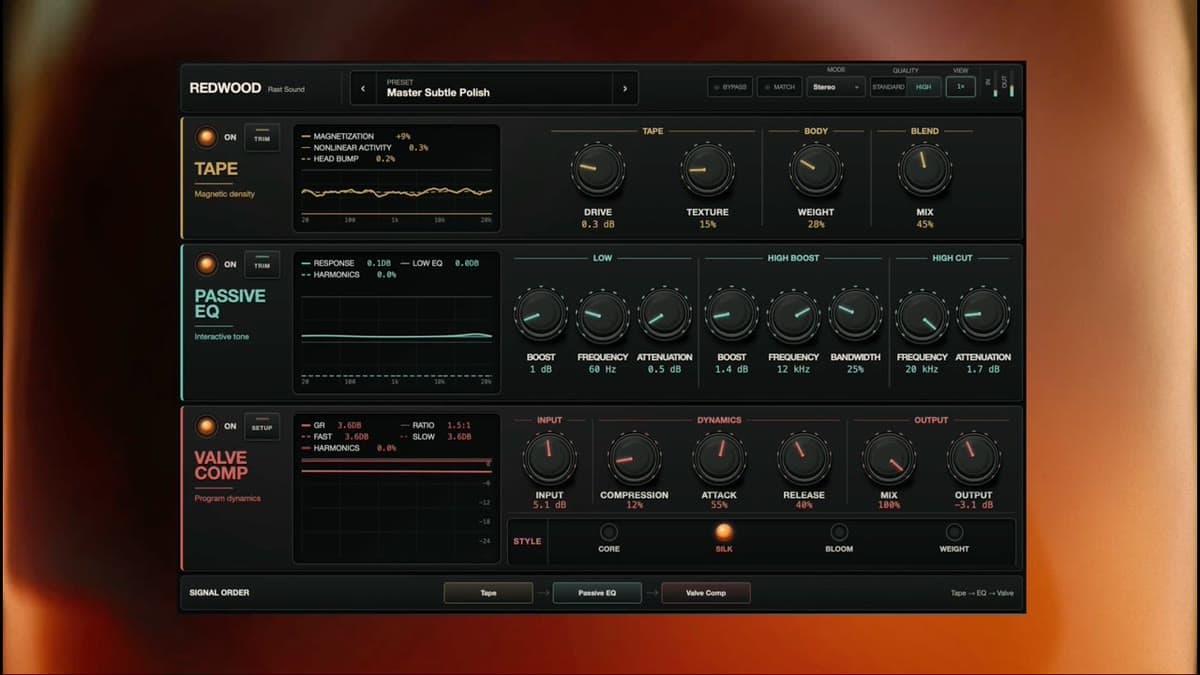
Rast Sound is selling Redwood as a three-stage analog color rack: magnetic tape, vintage passive EQ, and variable tube compression. The intro is €79 against a €129 list. Formats are AU, VST3, and AAX on macOS 12+ (Apple Silicon and Intel) and Windows 10+.
At a glance: €79 intro / €129 list. Three reorderable stages. Four compressor characters: Core, Silk, Bloom, Weight. Mid, Side, or M/S. RMS Match. Forty-five presets. Standard and High quality. Sold direct from rastsound.com.
This is a first look at the shipping plugin and the official product page. We have not run Redwood in a session yet.
What Redwood is
Redwood is one rack with three analog-style processors and a drag handle that changes the order. Rast Sound's line is the character of classic hardware in one plugin. The job is warmth, weight, and movement, not a full channel strip with gates and de-essers.
That sits next to tape and saturation we already cover, with a narrower brief than a distortion flagship. Satin is a dedicated tape machine. Decapitator is analog saturation with five hardware flavors. Saturn 2 is multiband distortion with a deep matrix. Redwood is tape plus passive EQ plus tube compression, and you decide which stage hears the others.
Each stage has its own Mix and can be switched off. You do not have to run the whole rack. One stage is a finishing touch. Three stages is a new character. The official instruction is to start with one, then combine.
Magnetic tape modeling
The first named stage is tape. Rast Sound's copy is magnetic density and harmonic color. Texture and Weight are the two shape controls. Mix blends from a restrained touch to a driven finish. How hard you hit the stage changes the model. That is tape behavior, not a static saturator.
Use it to add body to a vocal, weight to a bass, or a finishing layer that ties a mix together. Official examples are a vocal, a bass, and a full mix. The tape stage is also happy as the last processor in the rack, after EQ and compression have already decided the shape.
It is not a tape delay and it is not a wow-and-flutter toy. The official job is warmth, body, and character.
Vintage passive EQ
The EQ is inspired by classic passive hardware. The curves are broad and musical. The official move on the low end is boost and attenuate together: add weight, then cut the mud so the boost stays defined. High boost and high cut are independent, so you can lift air and then soften the edge.
That is a Pultec-style habit without Rast Sound naming a clone. Give bass more authority. Give a vocal more air. Do not let thickness or a sharp top take over. The graphs on the official GUI show a low shelf region and a high region, not a surgical 8-band EQ.
If you needed a clean, linear surgical EQ, this is the wrong plugin. If you needed tone that already sounds like hardware before the compressor, this is the stage.
Valve compression: Core, Silk, Bloom, Weight
The compressor is variable tube compression inspired by classic hardware. It is program-dependent. You choose a style, then shape attack and recovery, then blend. The official promise is glue, density, and life without losing the first hit.
Four characters are printed on the page:
Core is balanced control for tracks and buses.
Silk is smooth glue with a lighter touch of color.
Bloom is expressive breathing and movement for drums and buses. The official drum demo on the product page runs Bloom.
Weight is rich tube density with a slow, smooth recovery, aimed at vocals and sustained sounds.
Groove in Rast Sound's language is dynamic movement and recovery. It is not tempo-synced processing. The compressor does not move notes and it does not lock release to the DAW grid. If you wanted a sidechain pump locked to 1/8 notes, this is not that plugin.
Attack, release, compression, mix, and input/output sit on the valve page. Style is the character switch. The rest is a conventional compressor once you have picked a tube.
Drag-reorder, Mid/Side, and RMS Match
The rack order is not fixed. Drag the stages and the signal path follows. Each processor changes what the next one receives. Rast Sound prints three starting shapes:
Shape, then move, then finish. EQ into compression, tape last.
Feel first, tone after. Compression first, then EQ lift and tape.
Start with character. Tape first, then shape, then control the combined result.
That is the reason Redwood is a rack and not three separate plugins. The same settings become a different record when tape hits the compressor instead of the other way around.
Imaging is one shared rack, not two. Mid mode focuses the processing on the center. Side mode colors the edges. M/S processes both through the same controls. You are not building a dual mid/side tree. You are pointing one rack at part of the image.
RMS Match is a listening aid. It eases the processed average level toward the input so bypass is a fair comparison. Rast Sound is explicit: it is not a limiter and it is not a loudness target. Let it settle, then hit Bypass to hear what the rack added besides volume.
Quality is Standard or High. Standard is the everyday recording and mixing mode. High is the final-sound mode when the session has headroom. The analog modeling is the CPU cost. The interface scales at 1× or 1.3×.
Redwood specifications
| Spec | Detail |
|---|---|
| Type | Three-stage analog color rack |
| Stages | Magnetic tape, vintage passive EQ, variable tube compression |
| Compressor styles | Core, Silk, Bloom, Weight |
| Routing | Drag-reorderable stages, per-stage Mix and enable |
| Imaging | Mid, Side, or M/S on one shared rack |
| Listening | RMS Match (not a limiter) |
| Presets | 45, six categories |
| Quality | Standard / High |
| UI scale | 1× / 1.3× |
| Formats | macOS: AU, VST3, AAX. Windows: VST3, AAX |
| System | macOS 12+, Windows 10+, Apple Silicon and Intel |
| Demo | Coming soon |
| Price | €79 intro / €129 list |
Redwood vs Satin, Decapitator, and Saturn 2
| Redwood | Satin | Decapitator | Saturn 2 | |
|---|---|---|---|---|
| Job | Tape + passive EQ + tube comp | Tape machine | Analog saturation | Multiband saturation / distortion |
| EQ | Vintage passive tone | Tape EQ / head bump | Tone control | Per-band |
| Compression | Four tube characters | Tape dynamics | None | None as a dedicated compressor |
| Order | Drag-reorder | Tape path | One stage | Up to 6 bands |
| Price | €79 intro / €129 | €129 | $199 | FabFilter street |
| Formats | AU, VST3, AAX | VST3, AU, CLAP, AAX | VST, AU, AAX | VST, VST3, AU, CLAP, AAX |
Pick Redwood when you want tape, a passive EQ, and a tube compressor in one reorderable rack. Pick Satin when tape is the whole instrument: heads, delay, and wow. Pick Decapitator when you want one saturation flavor fast and you already have EQ and compression elsewhere. Pick Saturn 2 when the job is surgical multiband distortion, not analog color.
€79 is the intro reason to try the rack instead of buying three dedicated plugins. €129 is the list price.
Who Redwood is for
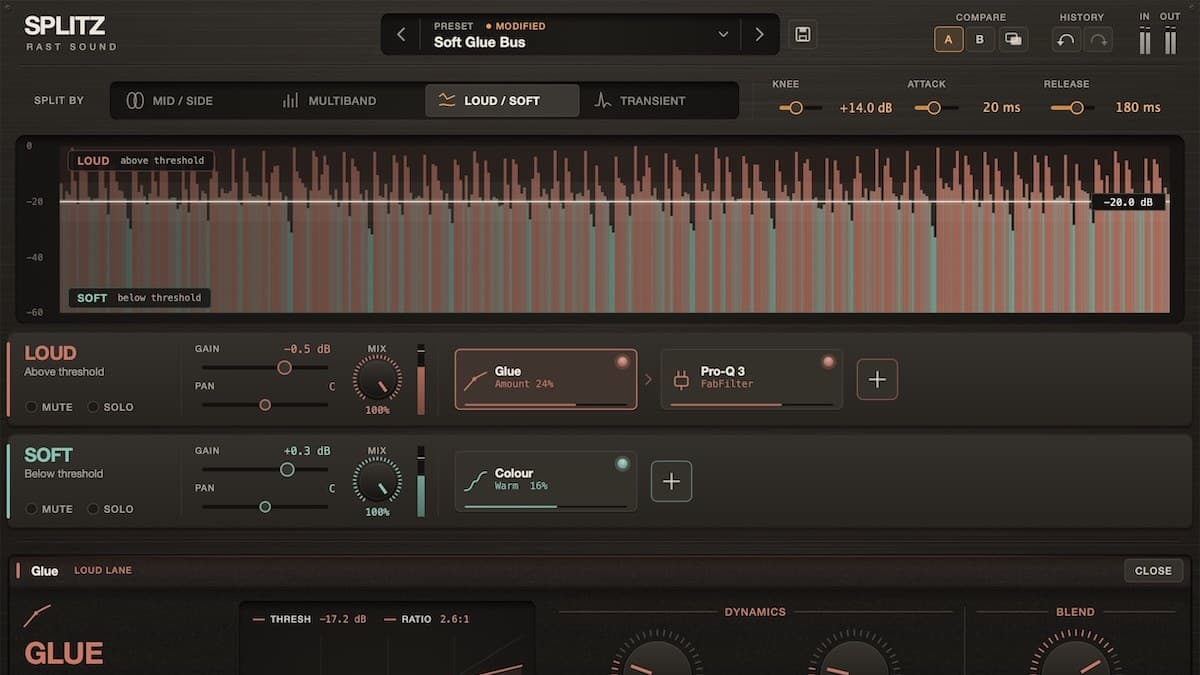
Redwood suits mixers who want analog color as a rack, not as three separate decisions. Drums through Bloom, vocals through Weight, a bus through Core or Silk, then tape as the last coat. It also suits anyone who wants Mid/Side color without building a dual-mono tree. For parallel chains instead of a serial rack, the same developer's Splitz split effects rack processes hits, tails, bands or sides separately.
Skip it if you needed a tape delay or a wow/flutter instrument. Skip it if you needed surgical EQ. Skip it if you needed a tempo-synced pump. Skip it if you needed a demo today: Rast Sound says the demo is coming soon.
Forty-five presets across six categories are the fast start: Mix & Master, Drums, Vocals, Instruments, Color, and the rest of the factory set. Groove, Tone & Tape and Drum Bus Bloom Punch are the named starting points on the official page.
How much does Redwood cost?
The intro is €79. The list price is €129. Both figures are on the Rast Sound Redwood page.
Formats are AU, VST3, and AAX on Mac, VST3 and AAX on Windows. macOS 12+, Windows 10+, Apple Silicon and Intel. A PDF manual is on the product page. Rast Sound lists a demo as coming soon.
Sold direct from Rast Sound.
FAQ
What is Rast Sound Redwood?
A three-stage analog color rack: magnetic tape modeling, vintage passive EQ, and variable tube compression. You can enable one stage or drag all three into a new order.
How much does Redwood cost?
€79 intro against a €129 list, sold direct from Rast Sound.
Do I have to use all three stages?
No. Each stage has its own enable and Mix. Start with one.
Does Redwood sync to tempo?
No. The compressor's movement is program-dependent recovery, not a host-synced release.
What formats does Redwood support?
AU, VST3, and AAX on macOS 12+. VST3 and AAX on Windows 10+. Apple Silicon and Intel.
Verdict
Redwood is a small analog rack with a real order problem: tape, passive EQ, and a four-character tube compressor you can drag. €79 intro against €129. AU / VST3 / AAX. It will not replace Satin as a tape machine or Saturn 2 as a distortion studio. If the job is warmth, weight, and movement from one plugin, this is the Rast Sound rack for that sentence.