Pulsar P252 MDN Diode Models a 1968 Neve 2252
Pulsar Modular P252 MDN Diode is a $165 germanium diode-bridge compressor modeled on a 1968 Neve 2252 from Wessex Studios. Specs, controls, and who it is for.
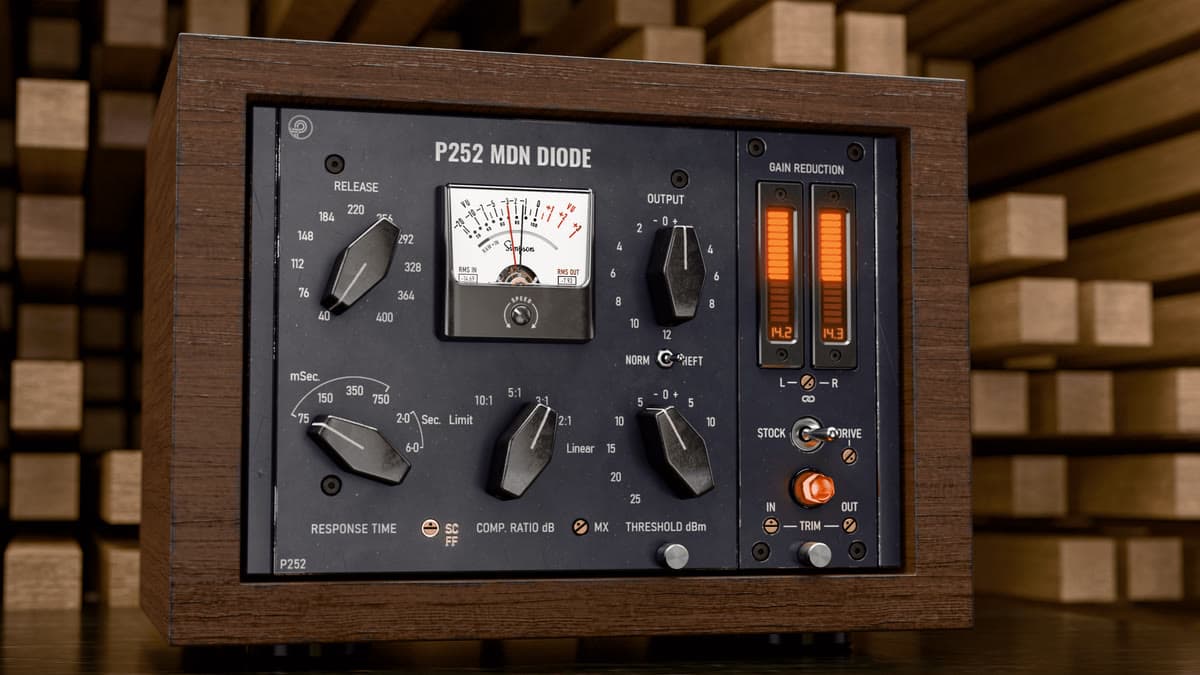
Pulsar Modular and Marc Daniel Nelson have released P252 MDN Diode, a $165 one-time plugin. It models a rare 1968 Neve 2252 germanium diode-bridge compressor that lived at Wessex Studios in London. The current installer is v1.0.12. This is a first look based on the official product page and published specs. We have not run it on a mix.
At a glance: $165 from Pulsar Modular. 15-day demo. AU, VST3, AAX. macOS 10.14+, Windows 10+. Challenge/response license, two machines.
What P252 is, and what it is not
The hardware story is the whole product. Nelson bought a 2252 from a former Wessex technician. Pulsar's page says Wessex purchased Rupert Neve's third console in 1968, and two 2252 modules arrived with it. The console eventually left. The compressors stayed racked and kept working as the studio's main tracking chain through the punk years.
Pulsar and Nelson present the 2252 as one of Neve's earliest compressor designs, and as a short-lived germanium diode-bridge circuit that later gave way to silicon. The more famous siblings — 2254, 33609 — are the names most mixers already know. P252 is not those plugins. It is the earlier, less predictable, more aggressive box.
Official copy is blunt about the original reputation. Early on, engineers called it unusable. Nelson's stated use cases now are bass guitar, rock vocals, drums that need attitude, and piano that needs a firm grip. The plugin exists because that personality is the point.
This is the third MDN collaboration after P455 MDN Sidecar and P821 MDN Tape. Q Sahara on iPad is Pulsar's cheaper input-driven compressor. P252 is the full 1968-module model.
Pulsar's own channel walks through the story:
How the circuit is supposed to behave
Pulsar says a static curve or an impulse response cannot capture this unit. The 2252 is a moving system: signal, feedback path, detector, diode stage, output level, and timing all react to each other. The model is algorithmic and tuned by ear. That is the developer's claim, not our measurement.
The original had no release control and no useful metering. P252 adds both, then keeps the rest of the panel close to hardware logic.
Gain staging comes first
Trim In exists because the 2252 was built for 1968 line level. A hot modern track will grip and thicken before you ask for any compression. Trim In is preparation, not a volume fader.
Threshold does not sweep a detector across a modern range. The detection point stays put. Threshold changes how hard you drive into it, much like a preamp feeding a compressor. Toward −25 you get compression, density, and saturation. Toward +10 it may not trigger at all.
That is the same mental model as Sahara — drive the box — with more numbers attached.
Ratio, response, and the release they added
Ratios are Linear, 2:1, 3:1, 5:1, 10:1, and Limit. Pulsar says the feedback path softens every slope, so these read as musical positions rather than arithmetic. Linear leaves the path running with no curve applied.
Response Time splits into two families. The 75, 150, 350, and 750 ms settings track the music at different speeds. The 2 s and 6 s settings hold: they arm after roughly two seconds of sustained level and keep that grab through the gaps. That is a bus and bass move, not a snare-transient move.
Release is the modern addition. The hardware used a fixed 40 ms stage. Here it runs from 40 ms to 400 ms. Fast for punch, slower for thicker sustain.
Output is not makeup gain
Output feeds the detector when the sidechain runs in feedback mode. It colors and compresses at the same time. In feedforward it sits downstream and moves level and transformer tone. Trim Out is the clean level control.
That distinction punishes anyone who treats Output like a modern makeup knob. Read the official control notes before you push it.
Sidechain, Drive, Heft, Noise
The SC control switches feedforward or feedback. Default is FF. A detector-only high-pass reaches 200 Hz and never filters the audio itself. EXT keys the unit from the host sidechain input, delay-aligned and oversampling-aware.
STOCK is the unit as modeled. DRIVE brings out grit on a 0–100% screw. The two modes are level-matched, so an A/B compares character rather than loudness.
NORM is the standard low end. HEFT adds weight underneath it. NOISE adds the hardware floor at a lower, more musical level than the original, and it ships switched off.
A Simpson-style VU shows raw input, processed output, and how hard the modeled unit is being driven. Mix and Link run 0–100%. Oversampling is Off, 1, 2, or 3, with zero latency when OS is off.
The official deep dive walks the panel knob by knob:
P252 MDN Diode specifications
| Spec | Official detail |
|---|---|
| Product | P252 MDN Diode |
| Developer | Pulsar Modular with Marc Daniel Nelson |
| Models | 1968 Neve 2252 germanium diode-bridge (Wessex Studios unit) |
| Price | $165 one-time |
| Demo | 15 days, fully functional, two computers |
| Formats | AU, VST3, AAX |
| Channels | Mono, stereo |
| Precision | 64-bit floating point throughout the DSP path |
| Threshold | −25 to +10 dB, 5 dB steps |
| Ratio | Linear, 2:1, 3:1, 5:1, 10:1, Limit |
| Response | 75 ms, 150 ms, 350 ms, 750 ms, 2 s, 6 s |
| Release | 40 ms to 400 ms |
| Output | −12 to +8 dB, 2 dB steps |
| Trim In / Out | −24 to +12 dB |
| Sidechain | HPF 0–200 Hz (detector only); FF or FB (default FF); EXT key |
| Mix / Link | 0–100% |
| Oversampling | Off, 1, 2, 3 |
| macOS | 10.14+, Apple Silicon and Intel, Universal 2 |
| Windows | 10+, x64 |
| Display | 1440 × 900 or 1280 × 960 minimum, 2 GB RAM |
| License | One-time challenge/response, up to 2 machines |
| Current version | v1.0.12 (meter artwork and user guides) |
Version 1.0.10 addressed Drive's low-level character, saturation tracking, and a discontinuity on quiet fades. Version 1.0.3 fixed a 1-sample latency report. The official release build was v1.0.1.
P252 vs an 1176-class FET and a bus compressor
Do not shop this as a 2254 clone or a general-purpose mix-bus glue box. Pulsar is selling a rare germanium diode-bridge with extra Drive and Heft. Compare it to other character compressors we already catalog, then decide whether you need this flavor.
| P252 MDN Diode | UAD 1176 Collection | SSL Native Bus Compressor 2 | |
|---|---|---|---|
| Job | Tracking and character; bass, rock vocal, drums | FET limiting; vocals, drums, parallel smash | Mix-bus glue |
| Topology (as sold) | 1968 germanium diode-bridge | FET, three hardware eras | SSL bus compressor |
| Price | $165 at Pulsar | See the current UA page | $299 typical at SSL |
| Demo | 15 days | 14-day UAD native demo | Confirm on SSL's site |
| Formats | AU, VST3, AAX | AU, VST3, AAX | AU, VST3, AAX |
| Character switches | Drive, Heft, Noise, FF/FB | All-Button, Mix, Headroom | Official SSL bus feature set |
| Reach for it when | You want attitude and density on a source | You want a fast FET grab or All-Button drums | You want stereo bus cohesion |
An 1176-class FET is the closest familiar reference for in-your-face compression, and Pulsar's own copy uses that comparison at high ratios with fast release. Treat it as a usage hint, not a claim that P252 is an 1176. CLA-76 and Analog Obsession FETISH cover that FET lane if you already own one.
The Glue and SSL Bus Compressor 2 do the opposite job: even stereo glue rather than germanium grit. If you want parallel drum smash, our parallel compression guide remains the technique page. P252's Mix knob is the official way to blend that grit instead of printing it at 100%.
Q Sahara is still Pulsar's cheaper, simpler compressor: no threshold, adaptive timing, $19.99 on iPad. Different product, same developer habit — drive the input, do not micromanage milliseconds.
Who P252 is for
Consider it if you want a character compressor for bass, rock vocals, and drums, and you are willing to learn the gain staging. The 15-day demo is the honest filter. Official starting points in the user guide cover drums, vocals, bass, and mix bus.
Skip it if you want invisible level control, a mastering limiter, or a drop-in 1176 or 2254 substitute with a familiar panel. Skip it if you will not read the signal flow. A common first-insert complaint is that the plugin sounds broken or overcooked, and the usual cause is leaving Trim In untouched on a hot modern track. That is a workflow warning, not a verdict.
The plugin database entry is a spec card, not a scored review.
How much P252 costs
$165, one time, from Pulsar Modular. The demo runs fifteen days, checkout at $0, authorization by email, two computers. The license is challenge/response for up to two machines.
Plugin Boutique and Best Service carry Pulsar Audio products, which are a different company. Do not confuse Poseidon or Pulsar 1178 with this plugin.
The plugin card lives at /plugins/pulsar-p252-mdn-diode.
FAQ
Is P252 a 2254 or 33609 emulator?
No. Pulsar models a 1968 2252 germanium diode-bridge. The 2254 and 33609 came later and used different diode choices. Official copy says the 2252 helped lay the foundation for those designs. It does not claim to be them.
What are the system requirements?
macOS 10.14 or later, Universal 2. Windows 10 or later, x64. AU, VST3, and AAX. Minimum display of 1440 × 900 or 1280 × 960, and 2 GB RAM. The license covers two machines.
Does it need iLok?
No. Pulsar uses its own one-time challenge/response authorization.
How does P252 compare to Q Sahara?
Sahara is an input-driven Q-Series compressor with no threshold knob, and the iPad version is $19.99. P252 is a $165 model of a specific Wessex 2252, with threshold, six ratios, Drive, Heft, and FF/FB switching. Same developer, different job.
Where do I buy it?
Direct from Pulsar Modular. As of August 20, 2026, that storefront is the official purchase route.
The bottom line
P252 is a $165 character compressor with a narrow, well-told hardware story. The 1968 germanium 2252 is the reason it exists. The added Release, Drive, Heft, and Mix controls are why the plugin should be more usable than the original panel ever was.
This is not an invisible compressor, and this is not a scored review. Run the 15-day demo on a bass DI and a rock vocal. If the gain staging clicks, the official page is the store. If you actually wanted a familiar 1176, stay with the UAD collection you already know.
P252 MDN Diode is $165 from Pulsar Modular.