Some links on this page are affiliate links. If you buy through them, Dubspot may earn a commission at no extra cost to you. It never affects our scores or what we recommend — read our policy.
Warpfield: Parish Audio's Six-Mode Time Manipulator
Parish Audio Warpfield is a $34.97 intro time-manipulation effect with six modes that turn any audio into new melodies and rhythms. Specs, pricing, FAQ.
P
Priya Raman
October 5, 2026 · 8 min read
Black Friday 2026Parish Audio Black Friday 2026: dates and deals →
Parish Audio has released Warpfield, a creative time-manipulation effect that takes audio you already have and makes it behave differently in time. It isn't a one-trick box. Six distinct modes stretch from subtle rhythmic variation to whole new melodic phrases pulled out of the original performance. The intro price is $34.97, down from a $69.95 regular price. This is a first look drawn from the live Parish Audio shop and the developer's demo, not a hands-on review.
At a glance: Warpfield reshapes any audio with six processing modes, Stretch, Reverse, Stop, Stutter, Repeat and Warp, running continuously or triggered on demand, synced to the host or free in milliseconds. It is a VST3 plugin for macOS and Windows at $34.97 intro against $69.95 regular, and it is also covered by Parish Audio's $9.95 a month all-access subscription with a 7-day free trial. Buy it from Parish Audio.
What Warpfield is
Warpfield is an effect, but it often behaves like an instrument. The idea is simple. It captures the audio passing through it and plays that audio back differently in time, so a part you already recorded turns into something new without touching the source. Drop it on a synth line, a drum loop, a vocal or a full musical phrase, and it generates melodies, countermelodies, rhythms and textures that still carry a clear connection to the original.
This is the second release this autumn from Parish Audio, the developer behind the granular transform Aethon. It carries the same theme of reshaping existing audio rather than synthesizing from scratch. Where Aethon breaks a signal into grains, Warpfield works with musical windows of time, which gives it a more rhythmic, more composerly character.
The six modes, and what each one does
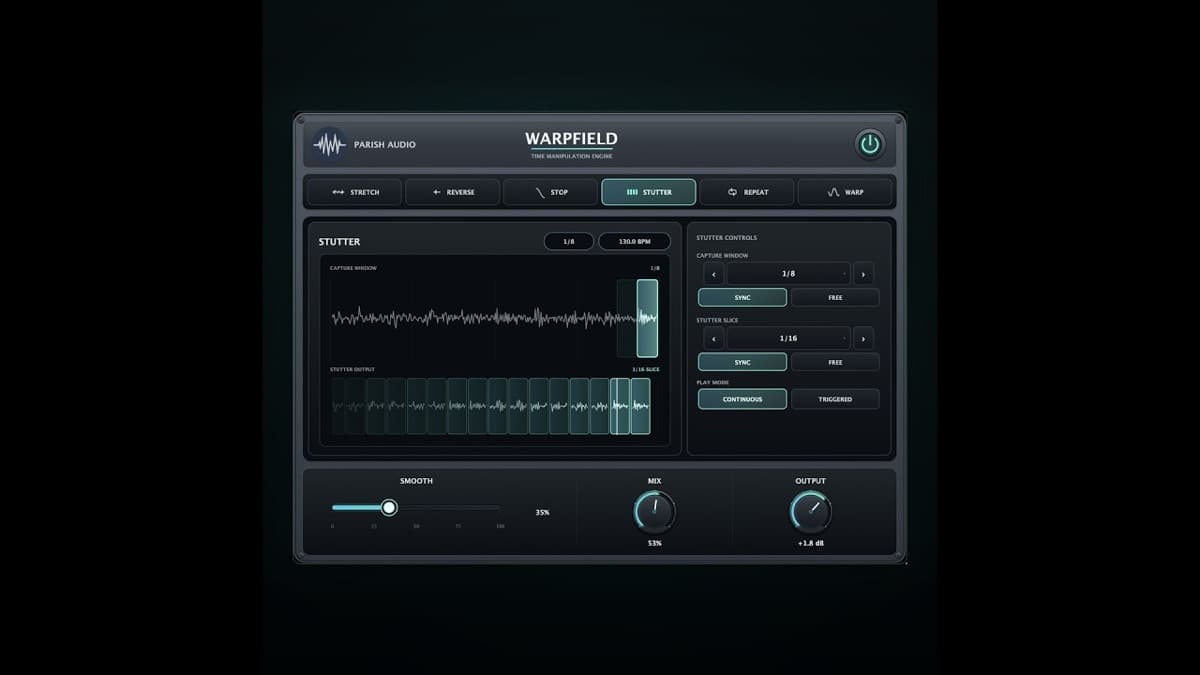
The heart of Warpfield is its six modes, each a different way of reshaping the incoming signal.
Stretch is the composition tool. Warpfield captures a musical window and plays it back slower, which changes how the captured notes relate to the track around them. A synth line can produce a new melody underneath itself, and a chord progression can reveal a countermelody. Because the processing stays tied to musical windows, the results feel intentional rather than random. Change the window size and playback speed and you uncover different melodic patterns from the same source.
Stutter and Repeat handle rhythm. They capture short sections and reorganize the sense of pulse inside each processing window, and their loop lengths either follow the host tempo or run freely in milliseconds. That split is the clever part. A synced capture window can hold an uneven, free-running repeat, building internal rhythms that do not divide neatly into the beat, then resetting cleanly at the next window. The payoff is complex, syncopated grooves that never drift away from the song.
Reverse turns captured sections around while keeping the surrounding timing intact, which suits reversed phrases, transitions and alternate takes on a part. Stop creates tape-style slowdowns and accelerations. Long settings give you familiar tape-stop transitions, while very short synced windows produce aggressive scratching, pitch dives and rhythmic movement. Warp keeps moving the playback speed above and below normal, so you get drifting pitch and timing that runs from subtle instability to obvious transformation. For a single-purpose alternative, the TimeStop tape-stop plugin maps the slowdown to one automatable Pitch control.
Every mode runs continuously or in Triggered mode, where it only engages when you want it. That makes Warpfield as handy for one-off performance moments as for always-on processing. A global Smooth control softens loop edges and transitions. The Mix control matters more than it looks. Partial settings let newly generated melodic or rhythmic material sit alongside the source instead of replacing it, so Warpfield can layer rather than overwrite.
Warpfield specifications
| Spec | Detail |
|---|---|
| Type | Creative time-manipulation effect |
| Developer | Parish Audio |
| Modes | Stretch, Reverse, Stop, Stutter, Repeat, Warp |
| Controls | 17, including Mode, Capture Window, Playback Speed, Slice and Loop Length, Warp Depth, Drift Rate, Smooth, Mix and Output |
| Timing | Capture window and loop lengths sync to host or set freely in milliseconds |
| Operation | Continuous or Triggered, with an Engage control |
| Formats | VST3 |
| Platforms | macOS and Windows |
| Price | $34.97 intro, $69.95 regular |
| Subscription | $9.95 a month all-access, 7-day free trial |
Warpfield vs Output Portal
The best-known creative time and texture effect is Output Portal, a granular processor that hides a lot of complexity behind a single playable macro and a big preset library. Both plugins can wreck and rebuild a sound, but they come at it differently. Portal is a granular engine aimed at clouds, textures and transitions. Warpfield is a time-window manipulator built to pull new melodies and rhythms from material you already have.
| Parish Audio Warpfield | Output Portal | |
|---|---|---|
| Core engine | Time-window capture and playback | Granular processing |
| Approach | Six discrete modes, manual control | One playable macro, preset-driven |
| Best at | New melodies, syncopation, tape effects | Texture, motion, transitions |
| Timing | Synced or free, synced plus free-running loops | Tempo-synced granular motion |
| Formats | VST3 | VST, VST3, AU |
| Price | $34.97 intro, $69.95 | $149 |
Pick Portal if you want finished textures fast and like working from presets with one expressive control. Pick Warpfield if you want to dig in by hand, generate melodic and rhythmic ideas from your own parts, and pay a good deal less. If you would rather stay in the grain domain entirely, Parish Audio's own Aethon is the sibling to look at, and our Aethon first look covers how that one works.
Who Warpfield is for
Three kinds of producer will get the most from it. Electronic musicians who build from synths, arpeggios and programmed drums and want new parts teased out of old ones. Sound designers chasing transitions and tape effects. And writers who work by reacting to happy accidents. Stretch mode in particular is a quiet composition aid. Feed it a line you like and it often hands you a countermelody you would not have written. Because the modes cover both pitch and rhythm, it is as comfortable generating a melodic hook as it is chopping a drum loop into a new groove.
Skip it if you only need clean, transparent time-stretching for tempo correction. That is not the job here. Warpfield is built for creative transformation, and it is happiest when you let it change the source rather than preserve it.
How much Warpfield costs
Warpfield is $34.97 at its intro price, down from a $69.95 regular price, as a one-time purchase you own permanently. Parish Audio also sells it through an all-access subscription at $9.95 a month that unlocks the whole catalogue. A 7-day free trial you can cancel any time makes that a low-risk way to try Warpfield alongside the rest of the lineup. It installs as a VST3 plugin on macOS and Windows, with installers for both on the product page. Specs also live on the Warpfield plugin page. For more creative processors, our guide to the best free VST plugins of 2026 makes a good companion.
FAQ
What makes Warpfield different from a normal time-stretcher?
A normal time-stretcher is built to change tempo or length cleanly. Warpfield is built to transform audio creatively, with six modes that generate new melodies, countermelodies, rhythms and tape-style effects from the material you feed it.
Can Warpfield create new melodies?
Yes. Its Stretch mode captures musical windows and plays them back slower, which changes how the captured notes relate to the rest of the track and can reveal melodies and countermelodies hidden inside the original performance.
What formats and systems does Warpfield support?
Warpfield is a VST3 plugin for macOS and Windows. Parish Audio provides installers for both on the product page, and the plugin unlocks after you sign in with your account.
How much does Warpfield cost?
Warpfield is $34.97 at its intro price, down from $69.95 as a one-time purchase. It is also included in Parish Audio's $9.95 a month all-access subscription, which has a 7-day free trial.