Overtonium: A Free Additive Synth Built Like a Mixer
Overtonium is a free, open-source 32-partial additive synth laid out like a mixer, with per-harmonic control and continuous microtuning, for Mac, Windows and Linux.
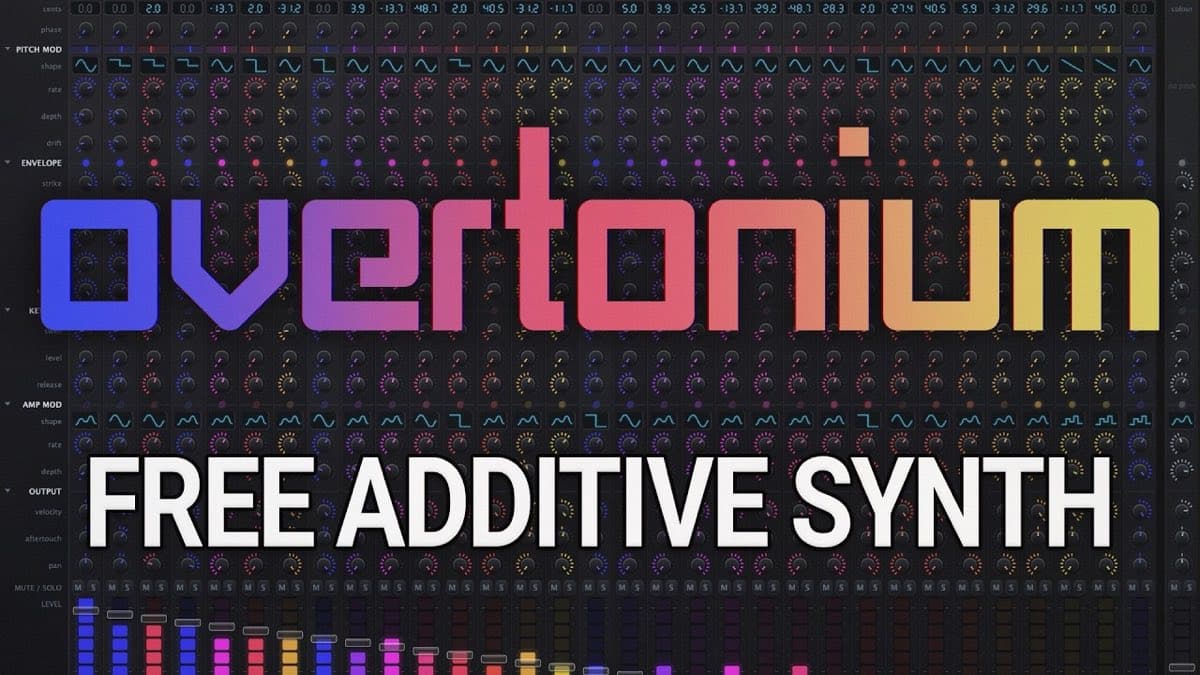
Benjamin Dehli has released Overtonium, a free, open-source additive synthesizer that treats sound the way a mixing desk treats tracks. It arrived in late September 2026 for macOS, Windows and Linux, it's free under the AGPLv3 license, and it approaches additive synthesis from an angle most synths never touch: continuous microtuning of every harmonic. This is a first look based on the official project page and source repository, not a hands-on review.
At a glance: Overtonium is a 32-partial additive synth laid out like a 32-channel mixer, where each channel is a sine oscillator locked to a harmonic of the note you play. Every partial gets its own tuning, envelope, modulation, stereo position and level, and a single TUNE control sweeps the whole set between equal temperament and pure just intonation. It's free and open source, and it runs as VST3, AU, LV2 and standalone. There's nothing to buy and no account to create.
What is Overtonium?
Additive synthesis builds sound by stacking sine waves. It's one of the oldest ideas in synthesis and also one of the least used, because managing dozens of individual partials is fiddly and most plugins hide the process behind presets. Overtonium takes the opposite path. It puts all 32 partials in front of you as channel strips, so the instrument reads like a mixer rather than a black box, and each strip controls one harmonic of the played note.
That layout is the whole point. Instead of drawing a spectrum or morphing between wavetables, you build a timbre by deciding, harmonic by harmonic, how loud each one is, how it moves over time, where it sits in the stereo field and how it is tuned. A separate noise channel adds unpitched material for breath, air and texture. The result is a synth that rewards understanding what a sound is actually made of, and it makes the abstract idea of a harmonic series tangible. For a stranger take on the harmonic series, the COLAPSO additive synthesizer draws its partials from the periodic table.
What Overtonium gives you
Thirty-two harmonics, each with its own channel strip. The core of Overtonium is 32 sine oscillators, each locked to a harmonic of the note. The project describes 23 controls per channel strip, which is what turns a stack of sines into a real instrument: level, tuning, envelope, modulation and stereo placement all live on the strip. You sculpt the sound the way an engineer balances a mix.
The TUNE control, the reason to try it first. A single TUNE knob sweeps every partial continuously between equal temperament and just intonation. At the equal end the harmonics snap to the nearest semitones, which is how most digital sound behaves. At the just end they sit at exact whole-number ratios, the way a real vibrating string does, which is why the timbre suddenly locks into a purer, more resonant character. Being able to slide continuously between the two is unusual, and it's the feature that gives Overtonium its identity.
Six historical temperaments for the keyboard. Overtonium separates the tuning of the partials from the tuning of the keyboard. That second system offers six temperaments, applied on any root: equal, just, Pythagorean, quarter-comma meantone, Werckmeister III and Young. If you write early or non-Western music, or you just want your chords to beat differently, this is a level of tuning control that costs money in most plugins and is free here.
Inharmonic stretch and keyboard tracking. Beyond the temperament systems, an inharmonic stretch bends the partials away from perfect ratios, which is how you get bell, metal and piano-like tones where the overtones are deliberately not whole numbers. Keyboard tracking keeps the behavior consistent as you move up and down the range.
Movement: DRIFT, WOBBLE and a dual tape echo. Static additive tones can sound sterile, so Overtonium adds motion. DRIFT applies a random warble to each partial individually, while WOBBLE applies a slower warble across the whole instrument, and together they keep a sound alive. A built-in tape echo with dual paths adds space and repeats without leaving the plugin.
Full MPE, and it's free and open. Overtonium supports MPE, with per-note pitch bend and pressure, so an expressive controller can shape individual notes. And because it's released under the AGPLv3 license, the whole thing is open source. You can read the code, build it yourself and use it in any project without cost.
Overtonium specifications
| Spec | Detail |
|---|---|
| Type | Additive synthesizer (32 partials plus noise) |
| Developer | Benjamin Dehli (Dehli Musikk) |
| Sound source | 32 sine oscillators locked to harmonics, plus a noise channel |
| Per-partial control | Around 23 controls per channel strip |
| Tuning | Continuous equal-to-just TUNE sweep, inharmonic stretch |
| Keyboard temperaments | Equal, just, Pythagorean, quarter-comma meantone, Werckmeister III, Young |
| Modulation | Per-partial envelope and modulation, DRIFT, WOBBLE |
| Effects | Tape echo with dual paths |
| Expression | MPE, per-note pitch bend and pressure |
| Formats | VST3, AU (macOS), LV2 (Linux), standalone |
| System | macOS (universal), Windows, Linux |
| License / price | AGPLv3, free and open source |
Overtonium vs Vital
The natural free reference point is Vital, the spectral wavetable synth that a huge number of producers already use at no cost. They're both approachable and both free, but they synthesize sound in opposite ways, so the comparison is really about method.
| Overtonium | Vital | |
|---|---|---|
| Synthesis | Additive, 32 individual harmonics | Spectral wavetable |
| Interface | Mixer-style channel strips | Wavetable editor and macros |
| Tuning | Continuous equal-to-just, six temperaments | Standard, with micro-tuning support |
| Strength | Precise control of the harmonic series | Fast, modern, huge sound range |
| Price | Free, open source (AGPLv3) | Free tier, paid upgrades |
| Reach for it when | You want to design a timbre from its overtones | You want a versatile everyday synth |
Which to pick. For general production, Vital is the more flexible everyday workhorse and will cover far more ground. Reach for Overtonium when you want to understand or precisely control the harmonic content of a sound, or when microtuning and just intonation are central to what you're writing. Since both are free, most producers can keep both installed.
Who Overtonium is for
Grab it if you're curious about additive synthesis, microtuning or just intonation, and you learn by doing. The mixer layout makes the harmonic series legible in a way that few instruments manage, and the price removes any reason not to explore it.
It suits you if you make ambient, drone, experimental or modern-classical music where tuning and evolving timbre matter more than presets, or if you teach synthesis and want a clear, hands-on tool.
Skip it, or pair it with something else, if you need a fast, preset-driven synth for conventional tracks. Additive design takes patience, and a wavetable synth like Vital will get you to a usable sound quicker.
How much does Overtonium cost?
Overtonium is completely free and open source under the AGPLv3 license, with the source code and downloads on the developer's official project page and its GitHub repository. There is no paid tier, no account and no time limit.
If you are collecting free instruments, our roundups of the best free synth VSTs of 2026 and the best free VST plugins of 2026 point to more no-cost options, and Vital is the obvious free wavetable companion for everyday work.
FAQ
Is Overtonium really free?
Yes. Overtonium is free and open source under the AGPLv3 license. You can download it, build it from source and use it in your music at no cost, with no account required.
What makes Overtonium different from other synths?
It's an additive synth laid out like a 32-channel mixer, giving you direct control over each of 32 harmonics, and it can sweep every partial continuously between equal temperament and just intonation. That combination of per-harmonic control and continuous microtuning is unusual.
What formats and systems does Overtonium support?
It runs as VST3, AU (macOS), LV2 (Linux) and standalone, on macOS (universal), Windows and Linux. It also supports MPE for per-note expression.
Can Overtonium do microtonal and just-intonation music?
Yes. Its TUNE control moves the partials between equal temperament and pure just intonation, and a separate keyboard system offers six historical temperaments, including Pythagorean, quarter-comma meantone, Werckmeister III and Young, on any root.