Northstar: One Mastering Window, With Linux
Northstar is a one-window mastering console with three EQ banks, FET, VCA, and Vari-Mu, plus a true-peak limiter. Launch price is $59 through 4 October.
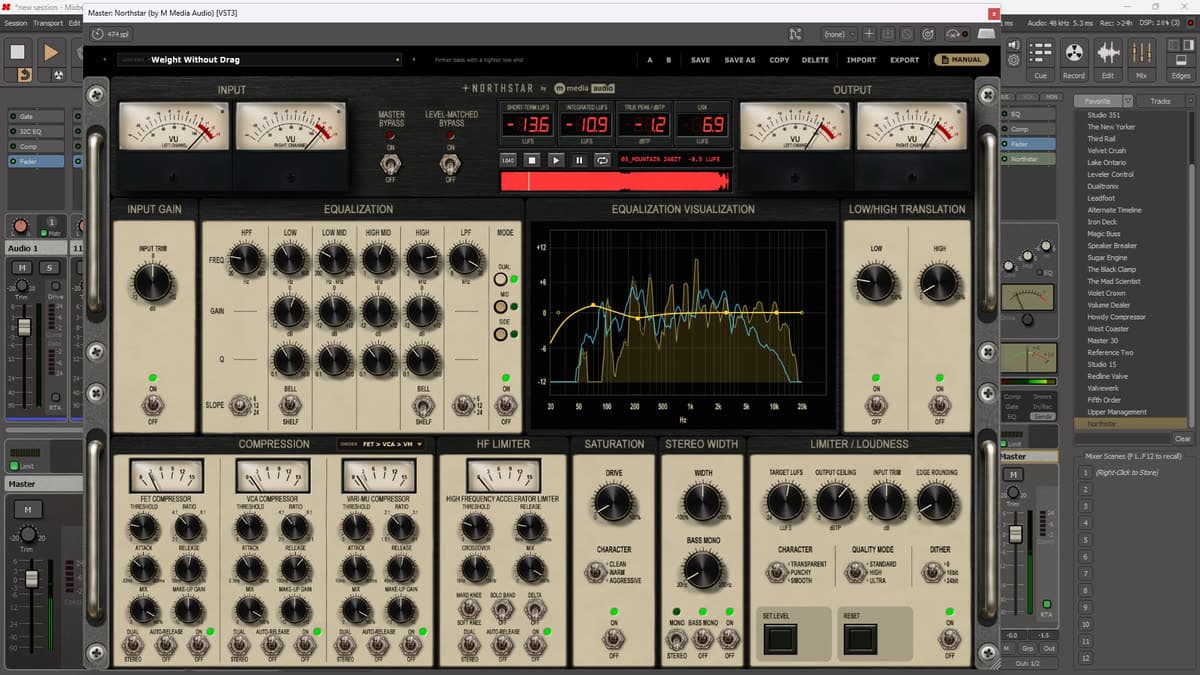
M Media Audio has released Northstar, a mastering console that keeps EQ, dynamics, color, stereo, and loudness in one window. The perpetual licence is $59 through 4 October 2026, then $99. Version 1.0.0 is the September 2026 release. It runs as VST3 on Windows, macOS, and Linux, and as AU on macOS. There is no subscription.
At a glance: $59 launch / $99 regular, through 4 October 2026. Pay once. Three activations. VST3 on Windows 10/11, macOS 11 or later, and Linux. AU on macOS. No AAX listed. Nine sections. About 474 samples of latency with the limiter on, 3 samples with it off.
What Northstar is
Northstar is built as the last insert on a stereo master. M Media Audio describes nine processing sections from input to output, with the EQ curve, a reference player, and loudness meters in the same window as the controls. Every section has its own power switch. The plugin starts neutral. The suggested gain staging on the page is simple: put it last, feed peaks around −6 dBFS, and bring in the section the music asks for.
That layout is the product. You hear the EQ move against the compressors, the saturation, and the limiter without paging between plugins to guess which one changed the chorus. Level-matched bypass keeps a louder master from winning the comparison by itself.
The licence is perpetual. Three machines at once. Moving an activation is an email to the developer, at info@mmediaaudio.com. Activation is encrypted over HTTPS. The page says no telemetry, and that no data leaves the machine during use. The manual opens from a button in the preset bar, inside the plugin. The window scales from 1000×680 up to 2000×1360 and remembers the size.
Three EQ banks that can all run
The equalizer is three banks, and all three can run together. Dual shapes left and right as a pair. Mid works on the center. Side works on the difference between the channels. Each bank keeps its own settings. Activity lights show which banks are working, including while you are looking at another bank.
Each bank has six bands: a high-pass, four parametric bands, and a low-pass. The filters cover 20 to 400 Hz and 8 to 20 kHz, at 6, 12, or 24 dB per octave, and they can sit fully off at the ends of their ranges. The four bands are Low, Low-Mid, High-Mid, and High. Each has frequency, ±12 dB of gain, and Q from 0.1 to 10. Low and High switch between shelf and bell.
The display draws the curve against live PRE and POST spectra, before and after the equalizer, so a +3 dB boost shows POST 3 dB above PRE. Select the Side view and the display follows that bank. A reference track can show its average spectrum on the same display, aligned for comparison. The reference player jumps to a passage and plays it at matched loudness. M Media Audio's instruction is to use the picture to find something worth hearing, then decide whether the record should follow it.
Three compressors, six orders
FET, VCA, and Vari-Mu sit in one console, and you choose the order the signal meets them. Six orders, because three compressors can be arranged six ways. Use one, blend it in parallel, or run all three. The panels stay put while the route changes, and the order can switch during playback without a click.
The knees match the topologies. FET is a hard knee. VCA is a 6 dB soft knee. Vari-Mu is a 12 dB soft knee. Threshold, ratio, attack, and release for each topology are in the spec table below. FET's attack starts at 20 microseconds, which is how you catch a peak before Vari-Mu, whose attack starts at 10 ms, shapes the body. VCA sits between them.
Each compressor has a mix control for parallel compression, ±12 dB of make-up, Dual or Stereo operation, and Auto-Release. Each has its own gain-reduction needle, up to 15 dB. The order selector decides whether the fast stage sees the raw master or the already-leveled one.
Translation, color, and the limiter
Low Translation and High Translation watch several bands at each end of the spectrum and pull down the ones that get too prominent as the music moves. The low side is for sub, kick, and bass trading places. The high side is for brightness that only shows up in the chorus. A separate HF Limiter handles top-end peaks, with Solo Band and Delta so you can hear what it caught and what it removed.
Saturation is three characters, level-compensated, so density doesn't arrive as a loudness trick. Stereo is Width, Bass Mono, and a Mono Check, each on its own control.
Set Level is the loudness move. Pick a target, and the control adjusts gain toward that target using the loudness measured at Northstar's output, including what the limiter is doing. It settles within 0.25 LU of the target, then stops. Targets run from −24 to −5 LUFS. The page is explicit that the control can chase a number and cannot decide how hard the master should be pushed.
Inside the loudness stage is a lookahead limiter, a soft clipper, and a second, smaller limiter that holds the ceiling. Peaks are found with oversampled true-peak detection. Edge Rounding, from 0 to 10, softens the highest peaks before they hit the ceiling. Characters are Transparent, Punchy, and Smooth. Quality mode is Standard, High, or Ultra, with 4× or 8× oversampled detection. The output ceiling runs from −3 to 0 dBTP, and the default is −1. Dither is off, 16-bit, or 24-bit.
Meters read Short-Term LUFS, Integrated LUFS, True Peak, and LRA, plus VU. Level-Matched Bypass plays the dry signal at the processed loudness. It measures both continuously and corrects the difference over about two seconds, up to ±20 dB. Master Bypass is delay-matched, with a 5 ms fade so it doesn't click.
Presets, latency, and the platforms
Twenty-eight factory presets cover tone, dynamics, color, stereo, and loudness. Named examples include True North, Weight Without Drag, and Print It Before We Ruin It. A and B hold two full states. Presets import and export as small files. Loading one leaves the bypass switches and the Input Trim alone, so a comparison doesn't undo the gain staging.
Latency is published. With the limiter on, Northstar reports about 474 samples, which is 10.7 ms at 44.1 kHz. With the limiter off, it reports 3 samples. The figure is reported to the host for compensation. Saturation runs at 2× oversampling, and true-peak detection runs at 4× or 8×. The path is stereo in and stereo out.
Linux gets a full build: VST3 on Ubuntu 22.04 or equivalent. The page says it was tested on Ubuntu 22.04 and 24.04, Debian 12, and Fedora 40, and confirmed in REAPER and Bitwig. Licence checks need libsodium: libsodium23 on Ubuntu and Debian, libsodium on Fedora and RHEL, libsodium via pacman on Arch. macOS is 11 Big Sur or later, Apple Silicon and Intel, VST3 and AU. Windows is 10 or 11, VST3. Hosts named for VST3 include Reaper, Cubase, Studio One, Ableton Live, FL Studio, Bitwig Studio, and Nuendo. AU covers Logic Pro, GarageBand, and MainStage.
AAX isn't in the format list, so Pro Tools users don't get a build on this release.
Northstar specifications
| Spec | Detail |
|---|---|
| Price | $59 through 4 October 2026, then $99 |
| Licence | Perpetual. Three activations. No subscription |
| Version | 1.0.0, September 2026 |
| Sections | Nine, each with its own power switch. Starts neutral |
| EQ | Three banks, Dual, Mid, and Side, able to run together |
| Bands | High-pass, four parametric, low-pass, per bank |
| Filter slopes | 6, 12, or 24 dB/octave. Ranges 20 to 400 Hz and 8 to 20 kHz |
| Parametric | ±12 dB, Q 0.1 to 10. Shelf or bell on Low and High |
| Compressors | FET, VCA, Vari-Mu, in any of six orders |
| Ratios | 2:1 to 12:1 FET and VCA. 1.5:1 to 6:1 Vari-Mu |
| Translation | Low and High, plus an HF Limiter with Solo Band and Delta |
| Color | Three level-compensated saturation characters. 2× oversampling |
| Stereo | Width, Bass Mono, Mono Check |
| Loudness | Set Level to within 0.25 LU. Targets −24 to −5 LUFS |
| Ceiling | −3 to 0 dBTP, default −1. Edge Rounding 0 to 10 |
| Limiter quality | Standard, High, Ultra. 4× or 8× true-peak detection |
| Dither | Off, 16-bit, 24-bit |
| Meters | Short-Term LUFS, Integrated LUFS, True Peak, LRA, VU |
| Bypass | Level-matched, up to ±20 dB. Master bypass delay-matched, 5 ms fade |
| Reference | WAV, AIFF, FLAC, MP3. Loop and click-to-seek |
| Presets | 28 factory. A/B. Import and export. Preset load leaves bypass and Input Trim alone |
| Latency | About 474 samples limiter on (10.7 ms at 44.1 kHz). 3 samples limiter off |
| Windows | 10 or 11. VST3, 64-bit |
| macOS | 11 or later, Apple Silicon and Intel. VST3 and AU, 64-bit |
| Linux | Ubuntu 22.04 or equivalent. VST3. Tested on Ubuntu 22.04/24.04, Debian 12, Fedora 40. REAPER and Bitwig confirmed. Needs libsodium |
| Not listed | AAX |
| Support | Email to info@mmediaaudio.com. Manual opens inside the plugin |
| Buy | Northstar at M Media Audio |
Northstar vs Ozone 12 Advanced vs Pro-L 2
The price gap is the first fact. Northstar is a $59 launch console. Ozone 12 Advanced is a 20-module suite listed at €549 on its card. FabFilter Pro-L 2 is a true-peak limiter at $199. They answer different questions.
| Northstar | Ozone 12 Advanced | FabFilter Pro-L 2 | |
|---|---|---|---|
| Price | $59 until 4 Oct, then $99 | €549 on the Ozone card | $199 |
| Job | One-window master: EQ, three compressors, translation, saturation, limiter | Mastering suite with 20 modules, including Stem EQ and a maximizer | True-peak limiter and loudness metering |
| EQ on the master | Three banks, Dual / Mid / Side, all able to run | Stem EQ and the rest of the suite | None. It limits |
| Dynamics | FET, VCA, Vari-Mu, six orders, parallel mix | A suite of dynamics modules | Eight limiting algorithms |
| Linux | VST3, tested on Ubuntu, Debian, and Fedora | The card lists macOS and Windows | Not a Linux product on the card |
| AAX | Not listed | Yes | Yes, including AudioSuite |
| Latency | ~474 samples with the limiter, 3 samples without | Depends on the modules you enable | A limiter, so lookahead is part of the design |
| Reach for it when | You want the master decisions in one window, including on Linux | You want a full suite and stem-level rescue | You already have EQ and compression and need the limiter |
Which to pick. Choose Northstar when the session is a stereo bounce and you want to EQ the mid and the sides, pick a compressor order, check translation, and set a LUFS target without building a chain. The $59 intro is the reason to try that workflow before the price goes to $99 on 4 October. Choose Ozone 12 Advanced when you need the module count, Stem EQ, and a maximizer workflow, and you are on the macOS or Windows line the card lists, at €549. Choose Pro-L 2 when the EQ and compression are already done and the remaining job is a transparent ceiling with serious metering, at $199, in hosts that want AAX. Northstar's limiter is one stage inside the console, with 4× or 8× true-peak detection and a ceiling default of −1 dBTP. If limiting is the only job, a dedicated limiter is still the better buy, and Softube Limit Pro is the three-method option at a $99 intro.
bx_masterdesk is the other one-window desk in the database, listed at $299 on its card. Northstar is the lower-priced console, and it is the one whose current page documents a Linux VST3 build.
Who Northstar is for
Use it if you master or finish your own records and you want EQ, compression order, stereo, and loudness in one view. The three banks running together, with activity lights, are the part a single stereo EQ doesn't give you.
Use it if you work on Linux. The VST3 build, the tested distros, and the libsodium install line are all on the product page, which is rare in this price band.
Use it if you want a number without handing the master to an assistant. Set Level moves gain to a LUFS target and stops within 0.25 LU. You still choose the ceiling, the edge, and the compressor order.
Skip it if you rely on Pro Tools. AAX is not listed. AU and VST3 are the formats.
Skip it if you need stem separation, restoration, or a dozen specialist modules. Ozone's card is the suite. Northstar is one stereo path.
Skip it if the master has to stay at a few samples of latency with the limiter engaged. Limiter on is about 474 samples. The 3-sample figure only applies with the limiter off.
How much Northstar costs
$59 through 4 October 2026. $99 after that. One purchase, no renewal. Three activations, and a licence move is an email. Buy it from M Media Audio. The page doesn't list a retailer SKU.
The short spec is the Northstar plugin card. If something fails to activate, the page points to info@mmediaaudio.com.
FAQ
How much does Northstar cost after 4 October?
The launch price is $59 through 4 October 2026. The regular price on the product page is $99. The licence stays perpetual either way: one payment, three activations, no subscription.
Does Northstar run on Linux?
Yes. VST3 on Ubuntu 22.04 or equivalent, tested on Ubuntu 22.04 and 24.04, Debian 12, and Fedora 40, confirmed in REAPER and Bitwig. Install libsodium for the licence check. There is no AU build on Linux, and AAX is not listed on any platform.
Can the three EQ banks run at the same time?
Yes. Dual, Mid, and Side each keep their own high-pass, four parametric bands, and low-pass. Activity lights show which banks are on while you edit another one. Shelves are available on the Low and High bands. Gain is ±12 dB. Q runs from 0.1 to 10.
What does Set Level do?
It picks a LUFS target between −24 and −5 and adjusts output gain until the measured loudness is within 0.25 LU, then it stops. The measurement includes the limiter. The ceiling, Edge Rounding, and the Transparent, Punchy, or Smooth character are still your settings.
What is the latency?
About 474 samples with the limiter on, 10.7 ms at 44.1 kHz. Three samples with the limiter off. The plugin reports latency to the host. Saturation is 2× oversampled. True-peak detection is 4× or 8×, depending on the Standard, High, or Ultra quality mode.