Softube Limit Pro: Three Peak Limiters for $99
Softube Limit Pro puts Standard, Adaptive, and Fast peak suppression in one limiter. Limit Go is included, and the intro price is $99 through 7 November.
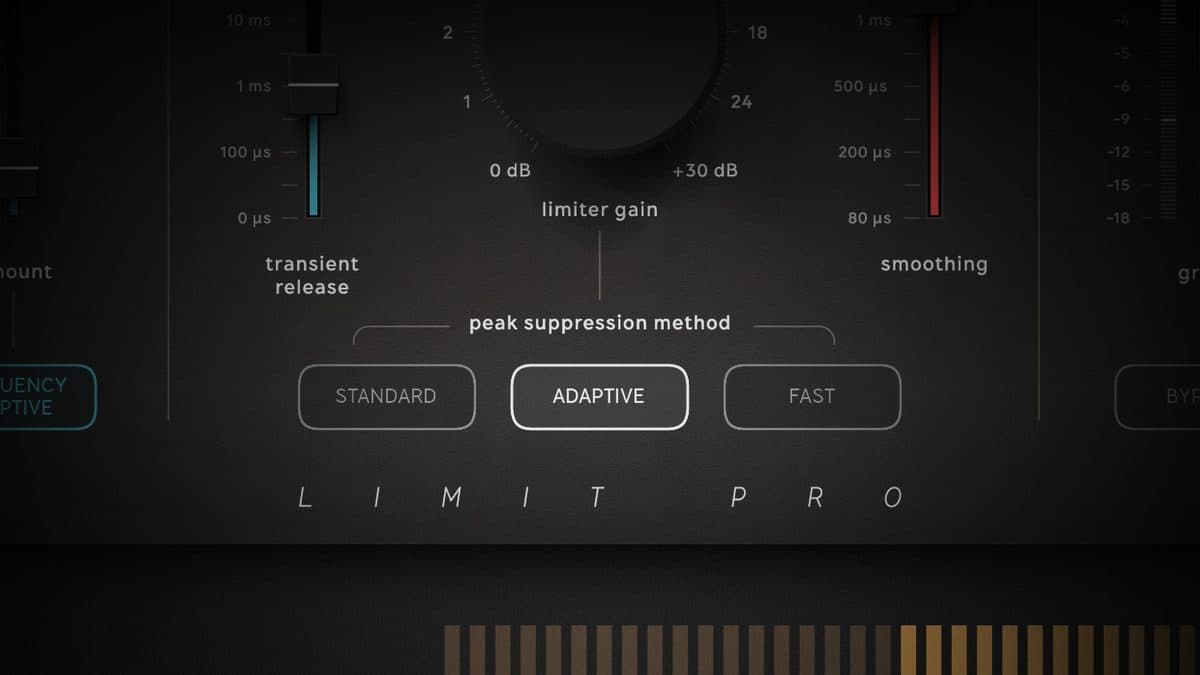
Softube has released Limit Pro, a limiter with three peak-suppression methods, frequency-aware release, and a metering set that includes true peak, LUFS, and a distortion display. The intro price is $99, down from $149, through 7 November 2026. Limit Go, the simpler sibling, is included with Pro and also sold on its own. This is a first look based on the official Softube product page, not a hands-on review.
At a glance: Limit Pro is a true-peak limiter for masters, mixes, and single tracks. Peak suppression is Standard, Adaptive, or Fast. Release is either the usual Transient Release or Adaptive Release, and it can follow frequency. Low Frequency Protection takes the sub-bass out of the limiter's way. Gain Match and delta monitoring are built in. Metering covers true peak, peak, LUFS, loudness loss, distortion, a distogram, and a real-time peak suppression view. Oversampling uses linear-phase filters. Latency and CPU are both described as low. Formats are AU, VST, VST3, and AAX. It is Console 1 and Flow Studio ready, and it is included with Flow Mastering and the Complete Suite.
What the three methods are for
Softube's argument is that one peak-suppression method cannot cover every record. A setting that suits a dense, bright mix will distort a dynamic rock track. Limit Pro ships three methods instead of asking you to swap plug-ins.
Fast behaves almost like clipping, without clipping the signal. It is the loud option.
Adaptive tries to stay as fast as it can, then slows down to keep low-frequency distortion in check.
Standard is the predictive workhorse. Softube describes it as reliable, and as the one that may not buy you that extra decibel of loudness.
Release is a separate decision. Transient Release is the control most limiters already have, close to an extension of the peak suppression itself. Adaptive Release lets go faster on transients than on sustained sound, so a longer release does not sit on the whole mix. It can also be made frequency dependent.
Frequency-adaptive release assigns different release times to different frequencies without changing the tone of the audio. Low-frequency distortion from the limiter is the thing it is trying to reduce. Adaptive Release is the timing. Frequency Adaptive is how that timing follows the spectrum.
Bass, meters, and the delta button
Low Frequency Protection is the other half of the bass story. Frequency-adaptive release is one path. Low Frequency Protection is the other: it takes over limiting for sub-bass so an 808, or any low transient, does not turn into distortion. Softube's own diagram shows a low kick with a longer release than a high snare, and marks the region where that protection is working.
Metering is the reason the interface is busy. You get true peak, peak, LUFS, loudness loss, and a distortion meter aimed at transparency. The distogram plots how the distortion sits against the incoming sound. A peak at the top of that graph means harmonics far above the source, which reads as bright or fizzy. A peak at the bottom means harmonics close to the source, which reads as natural or growly. A real-time peak suppression view shows the limiting as it happens.
Gain Match holds the level comparison honest, so louder does not win the A/B. Delta monitoring plays the difference between input and output, which is the practical way to hear what the limiter is adding when the meters look calm.
Oversampling uses linear-phase filters. Softube also lists low latency and low CPU, Console 1 and Flow Studio support, and inclusion in Flow Mastering and the Complete Suite subscription.
Limit Pro or Limit Go
Buy Pro or buy Go on its own. Make that choice before you pay.
Buy Limit Pro if you master, or if you finish mixes and you want to choose the peak-suppression method, shape release by frequency, protect the low end, and see distortion rather than guess at it. Pro is the full meter and the full control set. At $99 (from $149) through 7 November, it also includes Limit Go, so you are not choosing one and losing the other.
Buy Limit Go alone if you want the same core and you do not want the control surface. Softube describes Go as three styles, loosely tied to production jobs, with low latency, low CPU, and true-peak processing. Raw is for dense electronic mixes, where some high-frequency distortion is acceptable, and with Smoothing and Release at zero it sits near a clipper. Clean is the all-rounder for pop, rock, and other recorded music: less distortion, less loud than Raw, and the safer bet on sparse, bass-heavy arrangements. Safe is aimed at acoustic music, when you want the song's frequency balance left alone. Go is $89, down from $99, through the same 7 November date. If you already plan to buy Pro, do not buy Go separately.
Skip both if you already have a limiter you trust and you are not missing a second or third peak-suppression method. A sale is not a reason to replace a ceiling that is already transparent on your masters.
Limit Pro specifications
| Spec | Detail |
|---|---|
| Peak suppression | Standard, Adaptive, Fast |
| Release | Transient Release and Adaptive Release, with frequency-adaptive timing |
| Low end | Low Frequency Protection for sub-bass |
| Monitoring | Gain Match, delta |
| Meters | True peak, peak, LUFS, loudness loss, distortion, distogram, real-time peak suppression |
| Oversampling | Linear-phase filters |
| Included | Limit Go (Raw, Clean, Safe) |
| Formats | AU, VST, VST3, AAX |
| Systems | macOS Sonoma 14, Sequoia 15, Tahoe 26; Windows 10 64-bit and Windows 11 |
| Licence | Softube account and iLok; three activations |
| Trial and returns | 20-day trial; 14-day returns |
| Also in | Console 1, Flow Studio, Flow Mastering, Complete Suite |
| Intro price | Limit Pro $99 (from $149); Limit Go alone $89 (from $99); both through 7 November 2026 |
How it sits next to Pro-L 2 and Elevate
Two limiters already in the Dubspot database cover the obvious alternatives. FabFilter Pro-L 2 is the transparent brickwall with eight algorithms, true-peak limiting, oversampling up to 32x, and loudness metering against EBU R128, ITU-R BS.1770-4, and ATSC A/85. It also supports immersive formats up to Dolby Atmos 9.1.6. The card price is $199. Newfangled Elevate is the adaptive one: 26 bands on the Mel scale, with per-band speed, at the same $199, and the Mastering Bundle at that price adds Saturate, EQuivocate, and Punctuate.
| Limit Pro | Pro-L 2 | Elevate | |
|---|---|---|---|
| Idea | Three peak-suppression methods, plus frequency-aware release | Eight algorithms, from transparent to aggressive | 26-band adaptive limiter |
| Low end | Low Frequency Protection | Handled inside the style you pick | Per-band speed and adaptive analysis |
| Meters | True peak, LUFS, loudness loss, distogram | Loudness history and standard targets | Adaptive loudness, less manual |
| Immersive | Stereo mastering and mixing tool | Up to Atmos 9.1.6 | Stereo mastering limiter |
| Extra | Limit Go included | Specialist, one job | Bundle adds three more plug-ins |
| Price | $99 intro, from $149 | $199 | $199 |
Choose Pro-L 2 when the master is already EQ'd and compressed and you want a known ceiling with deep loudness history, including surround. Choose Elevate when you want the limiter to make per-band decisions and you are pushing modern loudness. Choose Limit Pro when you want to pick the suppression method yourself, protect sub-bass explicitly, and hear the distortion in a graph, at the lower intro price. Our mixing and mastering notes still start from a simple idea: put a limiter on the master early, and do not slam it. Limit Pro is a current plug-in for that slot. The card is Limit Pro in the plugin database.
Store links, both on the same sale through 7 November: Limit Pro at Plugin Boutique and Limit Go. The official page is softube.com/us/plug-ins/limit-pro.
FAQ
Does Limit Pro include Limit Go?
Yes. Softube includes Limit Go with Limit Pro. Go is also sold alone, at $89 from $99 through 7 November 2026, for sessions that only need Raw, Clean, and Safe.
What is the difference between the three peak-suppression methods?
Fast is the near-clip, high-loudness option. Adaptive stays fast and slows down to limit low-frequency distortion. Standard is the predictive, reliable setting, and it may give up a little loudness to get there.
What does Low Frequency Protection do?
It takes over limiting in the sub-bass so low transients, such as an 808, do not distort. Frequency-adaptive release is the related control: different release times per frequency range, without an EQ move.
Which formats and systems are supported?
AU, VST, VST3, and AAX, in a host that loads them. Softube lists macOS Sonoma 14, Sequoia 15, and Tahoe 26, plus Windows 10 64-bit and Windows 11. You need a Softube account and an iLok account. There are three activations, a 20-day trial, and 14-day returns.
Is this a replacement for Pro-L 2?
Not automatically. Pro-L 2 remains the specialist with eight styles, heavier metering history, and Atmos support, at $199. Limit Pro is the lower-priced option with three suppression methods, explicit bass protection, and Limit Go in the same purchase.