Audiority Studio Reverb 2026: Cinematic Reverb for $39
Audiority Studio Reverb is a cinematic algorithmic reverb with five early-reflection algorithms, ER Contour and 3-band damping. $39 intro to 7 Dec, from $69. VST3, AU, AAX, CLAP.
Dubspot's best Black Friday dealsDubspot Tracker Pro: $15, was $24.99 ↗Drum Programming and Groove Production Course: $19, was $99 ↗
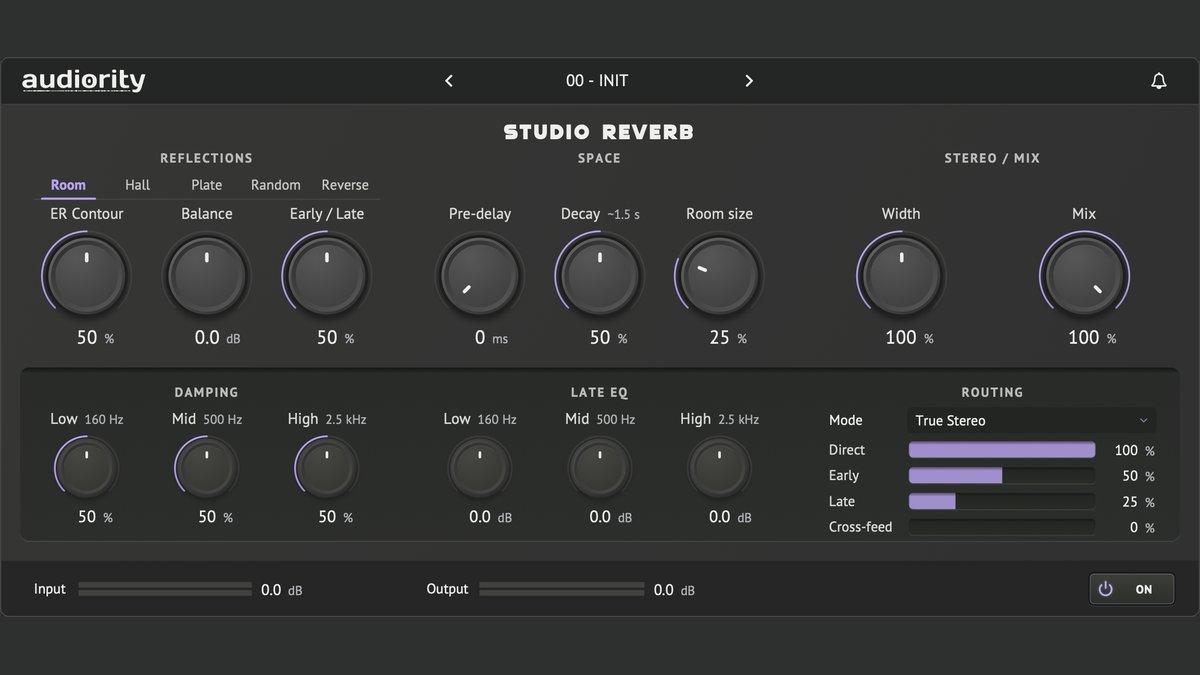
Studio Reverb is Audiority's new algorithmic reverb, released in November 2026 for Windows and macOS in VST3, AU, AAX and CLAP formats. It splits the sound into early reflections and a late tail and gives each its own controls, so you can set a space's character and its size independently. Five early-reflection algorithms, an ER Contour control for reflection timing and envelope, pre-delay to 500 ms, 3-band damping and a 3-band late-reverb EQ cover rooms, halls, plates and stranger spaces. The introductory price is $39 (€39) until 7 December 2026, down from $69 (€69).
At a glance: stereo algorithmic reverb; 5 early-reflection algorithms (Room, Hall, Plate, Random, Reverse); ER Contour; pre-delay up to 500 ms; room size and decay controls with an estimated decay-time display; independent early/late blend; 3-band damping and 3-band late EQ; true stereo, stereo and mono-sum routing; preset browser with banks, categories and search; parameter locking; MIDI mapping. $39 intro until 7 Dec, $69 regular, demo available. A modern reverb built to place sounds rather than drown them.
What is Audiority Studio Reverb?
Audiority makes effects such as Spatial D320, Chief Flanger, NeonVerb MV2 and Big Swarma, and Studio Reverb adds a mix-ready algorithmic reverb to that range. The pitch is a "natural-sounding reverb, from tiny ambiences to expansive soundscapes" with independent control over tone and balance of the early reflections and late tail. That structure is how studio reverbs have long been used: a short, tight set of reflections tells the ear how big a room is, and the tail decides how long it lingers.
Studio Reverb puts that on the front panel. You choose an early-reflection algorithm, shape its contour, balance it against the late reverb and then set decay, size and damping for the tail. The estimated decay-time display saves guesswork when you need a reverb that ends before the next snare.
Studio Reverb's features, explained
Five early-reflection algorithms
Room, Hall, Plate, Random and Reverse set the pattern of the first reflections. Room, Hall and Plate cover the usual mixing choices, while Random scatters the reflection pattern and Reverse flips it for swelling, cinematic builds. ER Contour adjusts the timing and envelope of the reflections, which changes how forward or recessed a sound feels in the mix.
Early and late, balanced separately
Independent Early/Late blend, Early Reflection Balance and stereo width let you tune the front of the reverb separately from the tail. The routing panel goes further, with separate Direct, Early and Late level controls and a Late Reverb cross-feed, so you can place a vocal with strong early reflections and a very low tail, or flip it for a distant effect.
Space, damping and EQ
Pre-delay reaches 500 ms. Room size and decay control the physical scale of the space, and 3-band damping (low at 160 Hz, mid at 500 Hz, high at 2.5 kHz) tames how each region decays. A separate 3-band late-reverb EQ then shapes the tail's tone. True stereo, stereo and mono-sum routing handle different sources, and input and output gain plus a Mix control finish the signal path.
Workflow
A preset browser with banks, categories and search filters, parameter locking so you can audition presets without changing the controls you have dialled in, MIDI mapping and a resizable interface round out the workflow.
Studio Reverb specifications
| Spec | Detail |
|---|---|
| Type | Stereo algorithmic reverb |
| Early reflections | 5 algorithms: Room, Hall, Plate, Random, Reverse; ER Contour |
| Pre-delay | Up to 500 ms |
| Controls | Room size, decay, estimated decay-time display, early/late blend, ER balance, stereo width |
| Tone | 3-band damping, 3-band late reverb EQ |
| Routing | True stereo, stereo, mono sum; direct, early and late levels; late cross-feed |
| Workflow | Preset browser (banks, categories, search), parameter locking, MIDI mapping, resizable interface |
| Formats | CLAP, VST3, AU, AAX (64-bit) |
| Windows | Windows 7 64-bit or later; Intel i7 or higher; 2 GB RAM |
| Intel Mac | macOS 10.13 or later; Intel i7 or higher; 2 GB RAM |
| Apple Silicon | macOS 11.0 or later; M1 or higher; 2 GB RAM |
| Demo | Fully functional, outputs 3 seconds of silence every minute |
Studio Reverb vs Valhalla Room, VintageVerb and Pro-R 2
| Studio Reverb | Valhalla Room | Valhalla VintageVerb | FabFilter Pro-R 2 | |
|---|---|---|---|---|
| Price | $39 intro to 7 Dec ($69 regular) | $50 | $50 | $199 |
| Approach | Early/late split with ER Contour and Reverse | 12 original modes for rooms, halls and dark spaces | Classic hardware-inspired modes | Decay-rate EQ and detailed spatial control |
| Pre-delay | Up to 500 ms | Yes | Yes | Yes |
| Pick it if | You want to place sounds with separate early and late controls | You want believable rooms and halls at a modest price | You want vintage plate, chamber and hall colours | You want surgical decay shaping |
Which to pick: Valhalla Room and VintageVerb are the established $50 benchmarks, and our best reverb plugins guide places them among the field. Pro-R 2 costs about five times as much and rewards that with precise decay control. Studio Reverb's case is its front-panel logic: early reflections and late tail are two separate instruments, with ER Contour and a Reverse early-reflection mode on the front panel. At $39 during the intro window it is the cheapest of the four, and the decision is mostly about whether you like how that early/late workflow sounds on your material.
Who Studio Reverb is for
Buy it if you mix with reverb as a placement tool and want to dial early reflections separately from the tail; if you score or produce cinematic material and want a Reverse mode and a Random mode on tap; or if you want a modern reverb with parameter locking and a searchable preset browser for under $40.
Skip it if you want a convolution engine with impulse responses, a hardware-modelled plate or a spring tank. Studio Reverb is a modern algorithmic design, and the hardware-inspired colours of Valhalla VintageVerb or the Lexicon 480L recreation Relab LX480 are a different flavour. Skip it too if your machine is older than the requirement list: Intel Macs need an i7 or better and Apple Silicon Macs need an M1 or later.
How much does Studio Reverb cost?
- $39 / €39 introductory price until 7 December 2026, down from $69 / €69.
- Existing Audiority customers can check their User Area for loyalty pricing.
- A demo for Windows and Mac is available and outputs three seconds of silence every minute.
Buy or demo it on the Audiority Studio Reverb page.
Price-timing note: the intro price runs to 7 December, so it runs through Black Friday and Cyber Monday. Demo it now and decide before 7 December.
FAQ
What is Audiority Studio Reverb?
Studio Reverb is a cinematic algorithmic reverb from Audiority for Windows and macOS. It has five early-reflection algorithms, ER Contour, independent early/late controls, 3-band damping and a 3-band late EQ.
How much does Studio Reverb cost?
$39 (€39) until 7 December 2026, from a regular $69 (€69). Existing Audiority customers may have loyalty pricing in their User Area.
What formats does Studio Reverb support?
CLAP, VST3, AU and AAX, 64-bit, on Windows 7 or later and macOS 10.13 or later (Apple Silicon needs macOS 11 and an M1 or newer).
Is there a Studio Reverb demo?
Yes. Demos for Windows and Mac output three seconds of silence every minute.
Studio Reverb vs Valhalla Room: which is better?
Valhalla Room ($50) has 12 original modes for believable rooms, halls and dark spaces. Studio Reverb ($39 intro) separates early reflections and late tail with ER Contour, Reverse and Random modes. Choose Valhalla for a proven benchmark and Studio Reverb for placement control and cinematic builds.
Verdict
Studio Reverb is a thoughtful modern reverb. Instead of copying one hardware unit, Audiority built a design around how engineers use reverb: separate early and late sections, a contour control for the reflections, three-band damping and a late EQ, plus a preset system that stays out of the way. The Reverse and Random reflection modes add cinematic range. It has no convolution or hardware-modelled voicing, and it asks for a reasonably modern CPU. At $39 until 7 December, it is a low-cost way to add a more controllable space to a mix. Our Studio Reverb plugin page keeps the price current after the intro offer.