PSP ClassicQlite: A Free Neve-Voiced Console EQ
PSP ClassicQlite is a free British console EQ voiced after early Neve designs, with musical shelves, a bell band, a high-pass and PSP saturation. Specs and how it compares.
Dubspot's best Black Friday dealsDubspot Tracker Pro: $15, was $24.99 ↗Drum Programming and Groove Production Course: $19, was $99 ↗
Black Friday 2026PSP Audioware Black Friday 2026: dates and deals →
PSP Audioware released ClassicQlite in November 2026, a free equalizer voiced after classic British console EQs. It's a stripped-down member of the ClassicQ family, built around a few musical bands and PSP's own saturation stage rather than a long parameter list. The pitch is simple. Load it, grab a shelf, and the track sounds more like it ran through a desk.
At a glance: ClassicQlite is a free British-console EQ for macOS and Windows. It ships in VST, VST3, AU and AAX, pairs low and high shelves with a midrange bell and a high-pass filter, and adds PSP's second-generation SAT saturation. The download is free with no trial clock, and it authorizes through a free iLok account across three machines.
What is PSP ClassicQlite?
ClassicQlite is PSP Audioware's free take on a vintage console equalizer. PSP describes it as inspired by legendary console EQ designs, including early Neve equalizers. Those desks earned their reputation on broad, musical curves that flatter a source instead of carving it, and ClassicQlite aims at the same feel rather than at surgical precision.
It sits at the entry point of PSP's ClassicQ line. The paid ClassicQ and ClassicQex add class A preamp and output transformer emulations for more drive and color, and ClassicQex adds an extra low-midrange band. ClassicQlite keeps the core tone shaping and gives it away, which makes it a natural first stop before you decide whether the paid versions earn their price.
PSP Audioware has built audio plug-ins since 2000, and its catalog leans on analog-style warmth and character. ClassicQlite follows that house style. It aims to sound like a desk channel, not a clinical digital EQ.
What ClassicQlite gives you
The control set is small on purpose, and each band is built to be used fast.
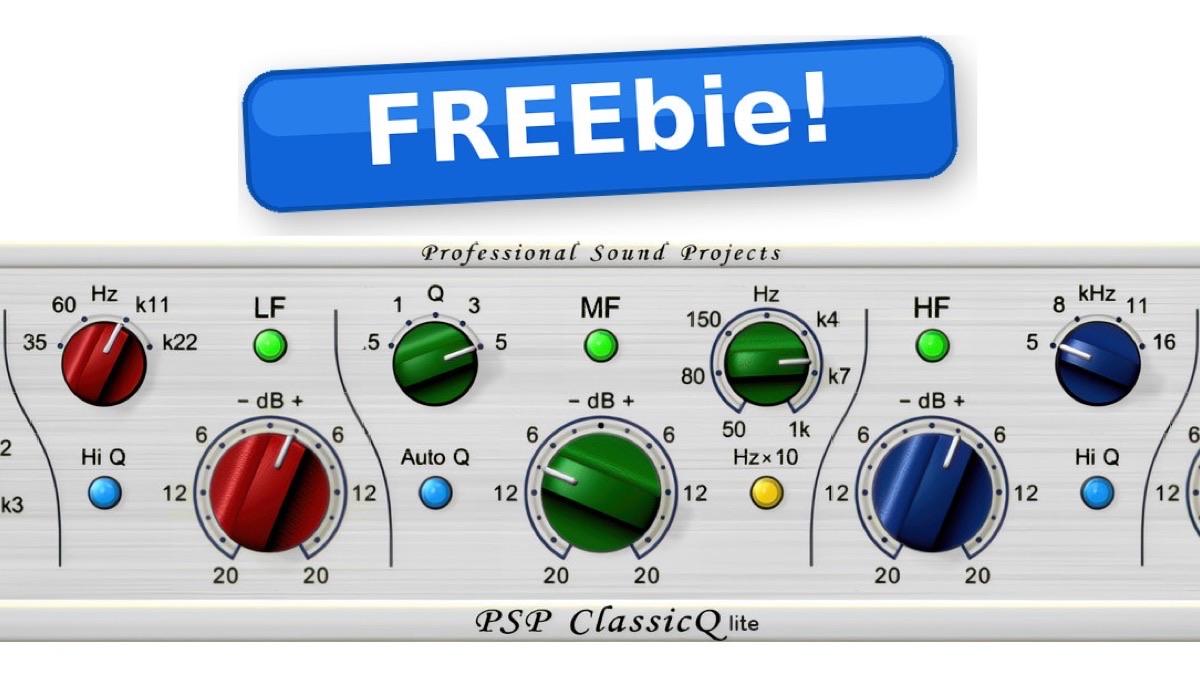
Low and high shelving filters. Both shelves are voiced to be musical, with a switchable Q that moves between smooth and punchy shapes. The smooth setting is the broad, gentle lift you want on a mix bus or a dull vocal. The punchy setting tightens the curve so a boost reads as a more focused bump, useful when you want low-end weight or air without washing the whole band.
A midrange bell. The mid band is a sweepable bell with a selectable Q and an Auto Q option. Auto Q widens the band at small gains and narrows it as you push harder, the behavior many classic EQs used to keep boosts from turning harsh. So you can reach for a big midrange move and still land somewhere musical.
A high-pass filter. The high-pass sweeps from 20 to 400 Hz, which covers everything from a gentle sub-rumble clean-up to a firm cut that pulls a guitar or a backing vocal out of the low end. Pairing a high-pass with a broad low shelf is one of the oldest desk tricks, and ClassicQlite puts both in easy reach.
PSP SAT saturation. The EQ runs through PSP's second-generation SAT algorithm, a saturation stage that adds smooth analog-style overdrive and helps guard against harsh digital clipping. It's subtle rather than a distortion unit, and it's a big part of why a free EQ like this can sound finished instead of sterile.
On top of the bands, ClassicQlite includes preset management, A/B comparison and a resizable interface. It behaves like a modern plugin even though the sound is built around a vintage idea.
PSP ClassicQlite specifications
| Spec | PSP ClassicQlite |
|---|---|
| Type | British console equalizer (early Neve voiced) |
| Price | Free |
| EQ bands | Low shelf, high shelf, midrange bell, high-pass filter |
| Shelf Q | Switchable, smooth or punchy |
| Mid band | Selectable Q with an Auto Q option |
| High-pass range | 20 Hz to 400 Hz |
| Saturation | PSP second-generation SAT stage |
| Extras | Preset manager, A/B, resizable interface |
| Formats (Windows) | VST, VST3, AAX (64-bit) |
| Formats (macOS) | AU, VST, VST3, AAX (64-bit), Intel and Apple Silicon |
| Operating systems | Windows 10 to 11, macOS 10.14 to macOS 27 |
| Authorization | Free iLok account, three activations, no hardware dongle required |
ClassicQlite vs TDR VOS SlickEQ
The obvious comparison is TDR VOS SlickEQ from Tokyo Dawn Labs, the other free, console-flavored mixing EQ that most producers already know. Both chase the same goal, a musical desk-style EQ you can spread across a session without a license fee, and both add gentle saturation. They differ in flavor and in depth.
| PSP ClassicQlite | TDR VOS SlickEQ | |
|---|---|---|
| Price | Free | Free |
| Voicing | Early Neve British console | Four models: American, British, German, Soviet |
| Bands | Low shelf, high shelf, mid bell, high-pass | Low, mid, high plus high-pass |
| Saturation | PSP second-generation SAT | Non-linear and output stages |
| Auto gain | No | Yes |
| Formats | VST, VST3, AU, AAX | VST2, VST3, AU, AAX |
| Authorization | Free iLok account | No iLok, serial download |
SlickEQ spreads wider, with four regional EQ models and auto-gain that keeps perceived loudness steady while you work. ClassicQlite is more focused. It commits to one Neve-leaning voice and a saturation stage tuned to match, and it skips the iLok-free convenience that SlickEQ offers. If you want options and auto-gain, SlickEQ is the broader free kit. If you want one confident console color and PSP's saturation, ClassicQlite is the quicker character choice. Many mixers will keep both, since neither costs anything. For surgical, visual work, a paid tool like FabFilter Pro-Q 4 stays the different lane, and a hardware-modeled option like the Maag EQ4 brings its own air band.
Who ClassicQlite is for
ClassicQlite fits the producer who wants tracks to sit together without thinking hard about frequencies. Reach for it on a vocal that needs air and a little weight, on a drum bus that wants glue, or on a guitar that needs to step back out of the low mids. The small control set is the point. There are fewer decisions, so you move faster and trust your ears.
It's a weaker fit if you need dynamic EQ, mid-side processing, or tight notch surgery to kill a resonance. Those jobs call for a full parametric EQ with a spectrum display. ClassicQlite is a tone-shaping tool, not a problem-solving scalpel. It's also tied to an iLok account, so if you avoid iLok on principle, a serial-based free EQ will suit you better.
How much does PSP ClassicQlite cost?
ClassicQlite is free. You download it from a free PSP User Area account, and it authorizes through a free iLok user ID across three machines, with no hardware dongle required. There's no time limit and no feature lock, so the free version is the full plugin.
If you grow into it and want more drive and color, the paid ClassicQ and ClassicQex add class A preamp and output transformer emulations, and ClassicQex adds an extra low-midrange band. You can audition the whole family and explore more free and paid options in the plugin database.
FAQ
Is PSP ClassicQlite really free?
Yes. ClassicQlite is a free download from PSP Audioware. It needs a free User Area account and a free iLok account to authorize, and it installs on up to three machines. There's no trial period, so the free version is the complete plugin.
What formats and systems does ClassicQlite support?
On Windows it ships as VST, VST3 and AAX. On macOS it ships as AU, VST, VST3 and AAX, on both Intel and Apple Silicon. It runs on Windows 10 to 11 and macOS 10.14 through macOS 27.
ClassicQlite vs the paid ClassicQ, what is the difference?
ClassicQlite gives you the core console EQ bands and PSP's saturation for free. The paid ClassicQ and ClassicQex add class A preamp and output transformer emulations for more drive and color, and ClassicQex adds an extra low-midrange EQ band.
ClassicQlite vs TDR VOS SlickEQ, which should I pick?
Pick ClassicQlite for one focused Neve-leaning console voice with PSP saturation. Pick SlickEQ for four regional EQ models, auto-gain, and no iLok requirement. Both are free, so many mixers keep both on hand.
The verdict
This is a first look based on PSP's official materials, not a full hands-on mix test. On paper, ClassicQlite reads as one of the easier free EQs to recommend. The band set is small but well chosen, the Auto Q behavior on the mid band is the kind of detail that keeps boosts musical, and PSP's SAT stage is the ingredient that lets a free console EQ sound finished rather than flat. It won't replace a surgical parametric for corrective work, and the iLok requirement is a small hurdle. As a fast, musical tone shaper that costs nothing, it earns a slot on the channel strip, and it doubles as a no-risk way into PSP's paid ClassicQ line.