KaitoSato IMFMSynth: Free-Routing FM Plus Wavetables
KaitoSato IMFMSynth is an 8-operator FM and wavetable synth. Official beta is ¥3,000 ($19), list ¥7,400 ($49). Specs, DX7 import, and who should buy it.
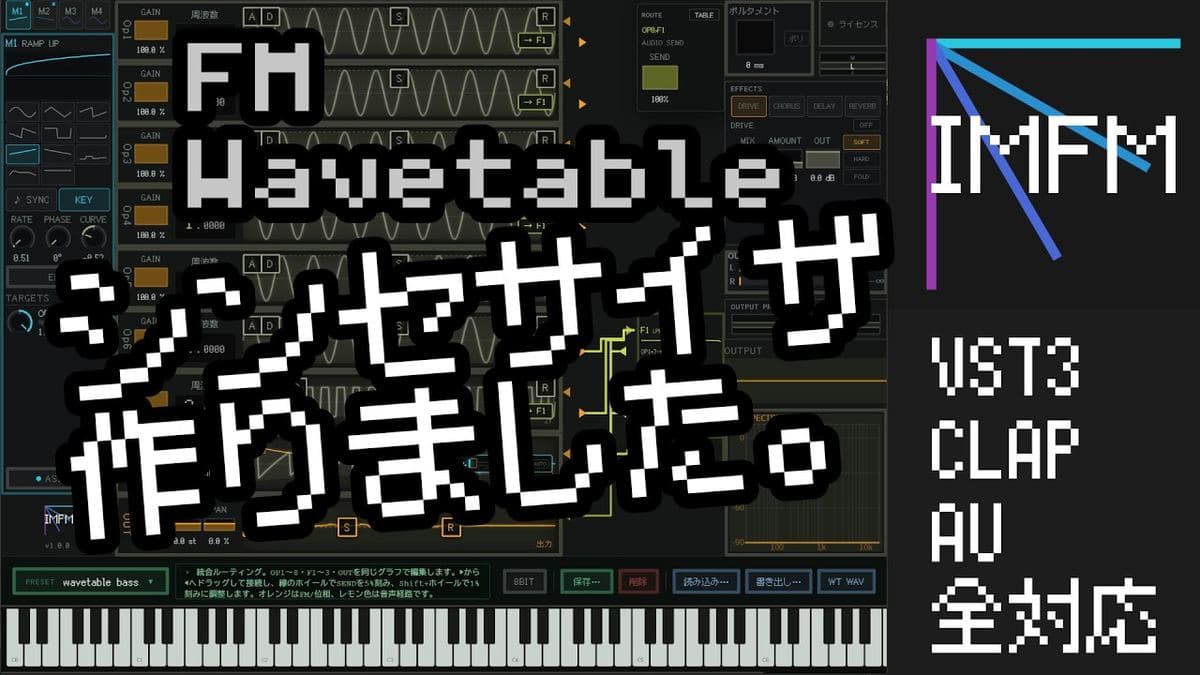
KaitoSato shipped IMFMSynth as version 1.0.0, an eight-operator FM synthesizer that can also run wavetable operators. The official beta campaign price is ¥3,000 (the English shop prints $19). The listed price is ¥7,400 ($49). The license is one-time, three devices, and offline after the first activation.
At a glance: ¥3,000 / $19 beta, then ¥7,400 / $49. VST3 and CLAP on Windows 10+. VST3, AU, and CLAP on macOS 10.13+ (Intel and Apple Silicon). Free-routing FM, Serum / Vital WAV tables, DX7 .syx import, three filter stages, four mod slots, and a drive / chorus / delay / reverb rack. Sold direct from imfm-synth.com.
This is a first look at the shipping 1.0.0 synth and the specs on the official English and Japanese pages. We have not had IMFMSynth open in a session yet.
What IMFMSynth is
KaitoSato's pitch is the gap between free FM editors that are painful to live in and full-price synths that cost hundreds. Eight operators sit on one screen with the filters and the output. You draw an arrow from a port to a port. An operator can be a basic waveform, noise, or a wavetable. A DX7 bank loads as 32 editable patches. The UI runs in nine languages, including English and Japanese.
It is not a DX7 emulator. The FAQ says that twice. You can import .syx data. You do not get a Yamaha clone. You get eight free-wired operators, wavetables, and a modern filter and FX stack.
The nearest tools we already cover are FM8 for classic software FM, Dexed for a free DX7-style editor, Phase Plant for a modular rack that can do FM among other things, and Serum 2 if the wavetable half is what you actually wanted.
The walkthrough linked from the product page is in Japanese. Auto-generated subtitles are the English path if you need them.
Eight operators, no fixed algorithms
Any operator can modulate any other. Each connection has its own depth and phase. An operator can feed back into itself. There is no algorithm picker, which is the whole point: you wire the graph instead of choosing a numbered DX recipe.
Operators are not sine-only. The author's official feature write-up lists sine, triangle, square with variable duty, saw, several noise colors, and wavetable. Wavetable operators load Serum- or Vital-style WAV files. Scan position is a modulation target, so a table can walk while it also FMs something else.
Hand-drawn envelopes sit next to ordinary ADSR knobs. You drop as many points as you want, set a curve per segment, and place sustain and loop. That is the path for a bell that blooms, or a tremolo that grows after the note is already held. A pitch envelope is in the box as well.
Polyphony is 16 voices. MPE is supported: per-note pitch bend, with member channels read as ±48 semitones. The FAQ calls out CLAP note expression so per-note pitch editing in a host like Bitwig arrives intact.
Filters, modulation, and the FX rack
Three filter stages sit on the same canvas. Each stage has type, cutoff, resonance, slope, key tracking, drive, and character. The author's write-up lists the types: LPF, BPF, HPF, comb, ring, notch, peak, and allpass. You can send operators into filters, and you can send a filter back into an operator's phase input. That last trick is how FM and filtering start talking to each other instead of sitting in a series chain.
Four modulation slots cover the motion. LFOs have six shapes including sample-and-hold, with tempo sync, note divisions, fade-in, and note-on phase reset. An ADSR can drive a slot too. The author also lists a constant and extra ramp / random options in the longer write-up. Draw an envelope, park a constant, and you have a timed ramp that is not an LFO.
The effect rack is drive, chorus, delay, and reverb, running at the oversampled rate ahead of the output protection stage. Oversampling is 2×. Output protection is soft clipping. An 8-bit output mode is a separate switch if you want the crunch on purpose.
Also in the published list: fixed-frequency oscillators, detune in cents, keyboard level scaling, rate scaling, per-operator velocity and feedback, note-on phase reset, per-connection phase offset, waveform invert, per-voice pan and pan law, peaking EQ per filter stage, and a master ADSR bypass.
Presets, languages, and the trial
Factory presets are not in 1.0.0. KaitoSato says they are in progress for the next version. You start from Init, or you import a DX7 .syx bank (32 voices, including ratios, fixed frequencies, key scaling, rate scaling, LFO, and sensitivities). Your own patches save and export.
The UI languages are Japanese, Simplified Chinese, Traditional Chinese, Korean, English, German, French, Spanish, and Russian. A wheel inside the plugin switches them. Technical labels such as LPF and dB/oct stay as they are.
Two official try-before-you-buy paths exist. The product page embeds a browser demo that runs the same C++ DSP compiled to WebAssembly (about 400 KB once you start it). The FAQ also offers the older v0.1.3 build as a free download after account registration, with no trial clock. That older build does not include current features. The browser demo is the current engine with some controls limited.
Bitwig Studio is the DAW KaitoSato lists as verified. Other VST3, AU, or CLAP hosts should load it, but they are unpublished test targets. The Windows installer is currently unsigned. SmartScreen may warn on first run; the official note is More info, then Run anyway. There is no Linux build and no AAX.
IMFMSynth specifications
| Spec | Detail |
|---|---|
| Type | 8-operator free-routing FM + wavetable synth |
| Version | 1.0.0 |
| Operators | 8, any-to-any, per-connection depth and phase, self-feedback |
| Wavetables | Serum / Vital WAV, modulatable scan |
| Envelopes | ADSR plus multipoint hand-drawn envelopes with per-segment curves |
| Filters | 3 stages (type, cutoff, resonance, slope, key track, drive, character) |
| Modulation | 4 slots, 6 LFO shapes incl. S&H, tempo sync, ADSR as source |
| FX | Drive, chorus, delay, reverb (oversampled, before output protection) |
| Import | DX7 .syx banks (32 voices) |
| Polyphony | 16 voices |
| MPE | Yes (per-note bend, ±48 semitones on member channels) |
| Extra | 8-bit output, 2× oversampling, 9 UI languages |
| Presets | In progress for the next version; start from Init or .syx |
| Formats | Windows: VST3, CLAP. macOS: VST3, AU, CLAP |
| System | Windows 10+ 64-bit; macOS 10.13+ Intel and Apple Silicon |
| License | 3 devices, offline after first activation |
| Trial | Browser WASM demo + free v0.1.3 download |
| Price | ¥3,000 / $19 beta; ¥7,400 / $49 list |
IMFMSynth vs FM8, Dexed, and Phase Plant
| IMFMSynth | FM8 | Dexed | Phase Plant | |
|---|---|---|---|---|
| Job | Free-routing FM + wavetable | Classic software FM | Free DX7-style editor | Modular synth rack |
| Operators | 8, no fixed algorithms | 6, algorithm set | 6, DX7 algorithms | FM among many modules |
| Wavetable ops | Yes (Serum / Vital WAV) | No | No | Yes (separate modules) |
| DX7 .syx | Yes (not an emulator) | Related FM workflow | Yes | No |
| Polyphony | 16 | High (host-dependent) | 16 | High |
| Formats | VST3, AU, CLAP | VST, AU, AAX | VST, AU | VST, AU, AAX |
| Linux | No | No | Yes (community builds) | No |
| Price | ¥3,000 / $19 beta | $99 | Free | $199 |
Pick IMFMSynth when you want eight free-wired operators and wavetables in one window at a beta price. Pick FM8 when you want the long-running Native Instruments FM instrument and its library. Pick Dexed when you want a free DX7 editor and do not need wavetable operators. Pick Phase Plant when FM is one module in a larger modular rack and $199 is acceptable. Serum 2 and Vital remain the wavetable-first alternatives if the FM graph is not the point.
Who IMFMSynth is for
IMFMSynth suits producers who want a serious FM graph without a three-figure synth, and anyone sitting on DX7 banks who wants those patches inside a modern, free-routed editor. Japanese UI and Japanese support are first-class, not an afterthought. The $19 / ¥3,000 beta is the reason to try it this week.
Skip it if you need AAX, Linux, or a DAW that is not Bitwig and you do not want to be a tester. Skip it if you need a factory library on day one. Skip it if you wanted a DX7 clone rather than an 8-operator instrument that happens to read .syx. Skip it if an unsigned Windows installer is a hard no.
How much does IMFMSynth cost?
The official prices are ¥3,000 on the Japanese shop and $19 on the English shop during the beta campaign. The listed prices are ¥7,400 and $49. One-time. No subscription. The license signature has no expiry. Three devices per license, movable from the account page. After the first activation the plugin does not use the network.
IMFMSynth is not listed on Plugin Boutique, Thomann, or Best Service. Buy it on imfm-synth.com.
FAQ
How much does IMFMSynth cost?
¥3,000 (English shop: $19) during the beta campaign, then ¥7,400 / $49. One-time, three devices.
Is IMFMSynth a DX7 emulator?
No. It imports DX7 .syx banks as editable patches. The engine is eight free-routed operators with wavetables, not a Yamaha recreation.
What formats does IMFMSynth support?
Windows: VST3 and CLAP on Windows 10 or later, 64-bit. macOS: VST3, AU, and CLAP on macOS 10.13 or later, Intel and Apple Silicon. No AAX. No Linux.
Does IMFMSynth include presets?
Not in 1.0.0. Factory presets are planned for the next version. Start from Init or import a DX7 bank.
Can I try IMFMSynth before buying?
Yes. The product page has a browser demo of the current DSP, and the FAQ offers a free v0.1.3 download after you create an account.
Verdict
IMFMSynth is an 8-operator FM synth that also eats wavetables, at a beta price of ¥3,000 / $19. Free routing, hand-drawn envelopes, three filter stages, and DX7 import are the reasons to care. Missing factory presets, Bitwig-only verification, and an unsigned Windows installer are the reasons to go in with eyes open. It will not replace FM8's library or Phase Plant's modular rack. If you want the graph and the tables in one window, this is the cheap way in.