Harrison Flex-10: Console Preamps in a USB Interface
Harrison Flex-10 is a 10-in/12-out USB-C interface with two console preamps, H-DRIVE, ADAT, and Mixbus 12. A first look at the specs and £547 Thomann price.
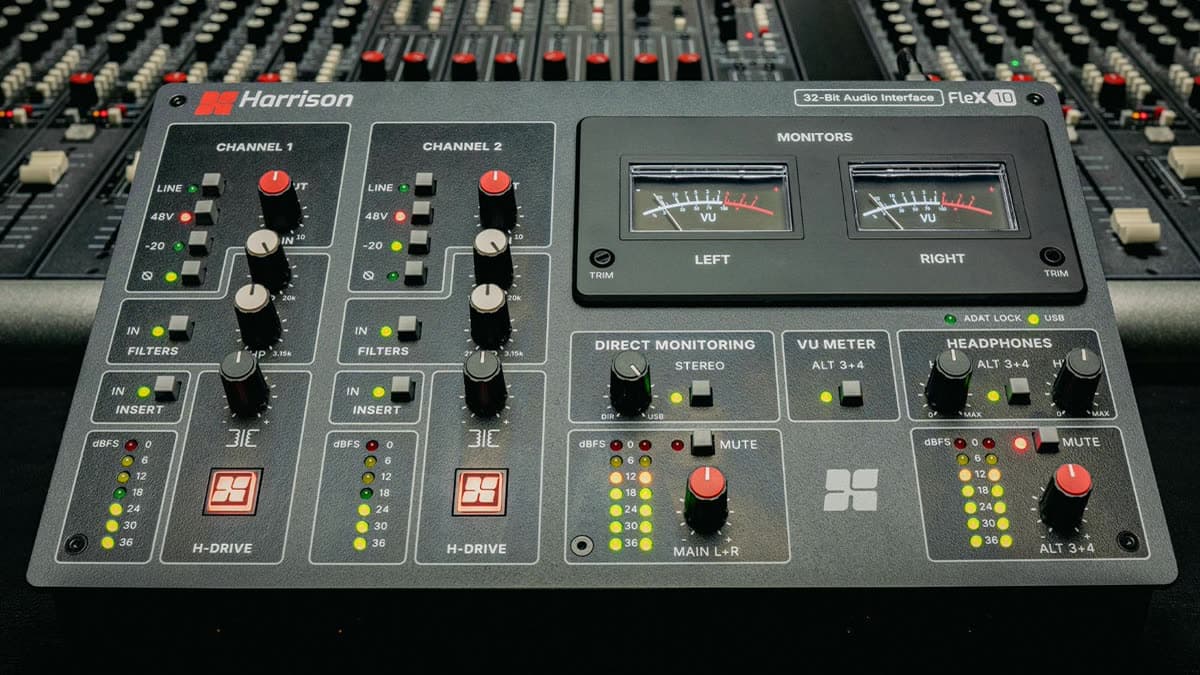
Harrison Audio announced the Flex-10 on August 18, 2026. It is a 10-in/12-out USB-C and ADAT desktop interface with two Harrison mic preamps, H-DRIVE transformer saturation, and a bundled Mixbus 12 license. This is a first look at the official product pages and a live retailer listing. We have not recorded through one.
At a glance: £547 at Thomann UK on August 20, 2026 (item 651161). You get 10-in/12-out, 32-bit/192 kHz conversion, two Harrison preamps, ADAT, MIDI, and Mixbus 12 with the Creator Pack. Mac is class-compliant. Windows needs Harrison's ASIO driver. Thomann lists the unit as back in stock within 3–4 weeks.
What the Flex-10 actually is
Harrison is selling console front-end behavior in a USB box. The official Flex-10 page frames it as a high-performance 10-in/12-out interface "inspired by the golden era of music," using the same analog language the company applies to the 32Classic desk.
The job is specific. Two Harrison preamps sit at the front, each with H-DRIVE transformer saturation, high-pass and low-pass filters derived from the 32 Series, a balanced insert, a pad, phase invert, and 48V. ADAT adds eight more digital paths. Two monitor outputs and two headphone outputs cover a second pair of speakers and a second set of ears.
That is a different pitch from a clean 2-in/2-out starter box. Harrison's FAQ aims Flex-10 at artists and small studios that have outgrown one or two sources and now need routing, monitoring, and outboard inserts. If you are still choosing a first interface, start with the 2026 audio interfaces guide. Flex-10 is the step after that guide's two-preamp desks, not a replacement for them. At the larger end of the desktop range, the 18x20 Arturia AudioFuse Studio Rev2 covers similar studio-hub duties.
Harrison's official channel posted a Flex-10 conversation with guitarist Joe Coombs. It is an artist interview, not a bench test:
The analog path Harrison is selling
Two Harrison preamps, not generic gain
Each input is a Harrison preamp with dedicated mic and line paths. Front-panel Hi-Z jacks take guitar and bass. Line inputs take synths and drum machines. You should not have to re-patch every time the source changes.
The launch note lists the analog housekeeping on each channel: a line-level switch, 48V, a −20 dB pad, and phase invert. Those are tracking controls, not extras. The pad keeps a hot condenser or a slammed synth out of the converters. Phase invert saves a cable flip when two mics fight each other.
H-DRIVE is a real transformer circuit
H-DRIVE is the headline analog feature. Harrison describes it as a transformer saturation circuit on each input channel, with the amount set from the front panel. The official copy promises "'70s Harrison console" character at the source.
That shapes how you should judge the box. A clean interface asks plugins to add color later. Flex-10 asks you to commit some of that color while you track. Leave H-DRIVE off if you want a sterile capture and a transparent reverb afterwards. Turn it up if you want the preamp doing the work.
We have not heard the circuit. The claim to weigh is architectural: analog saturation before conversion, not a digital drive control after it.
32 Series filters on the way in
Both channels include high-pass and low-pass filters that Harrison says come from the original 32 Series consoles. The official copy presents them as immediate tone shaping — cut rumble, tame a harsh source, carve space before the take hits the DAW.
You do not have eight console channels of EQ here. You have two paths and a pair of filters. Used well, they stop a vocal or DI bass from eating the converters. Used badly, they become decisions you cannot undo. Treat them as tracking tools, not mix EQ.
Inserts, meters, and the monitor section
Each channel has a balanced insert. Harrison's examples are a compressor, a 500 Series module, or a boutique effects box. That is the hybrid-studio argument in one sentence: track through hardware, print the result, and keep using the USB path as the recorder.
The faceplate carries switchable VU meters for Main or Alt outputs. Two independent monitor outputs get dedicated level controls, and two high-current headphone outputs get independent volume. MIDI I/O runs on 3.5 mm TRS.
Thomann lists the chassis at 305 × 184 × 89 mm and 2.15 kg, with an external 12V supply, USB 2.0, and no bus power. If you wanted a bus-powered laptop companion, this is not it.
Digital I/O, expansion, and the bundle
Conversion runs at 32-bit/192 kHz. Eight channels of ADAT I/O are the expansion path, and Harrison's launch note pairs Flex-10 with a D510r rack and D510ua ADAT card. Read that carefully. Flex-10 is already 10-in/12-out on its own; ADAT is how you grow past the two analog pres without buying a larger USB interface.
The software bundle is Mixbus 12 plus the Harrison Creator Pack. Official copy names partners inside the pack: Solid State Logic, Slate Digital, Sonible, Loopcloud, AAS, Native Instruments, IK Multimedia, "and more." Mixbus 12 is Harrison's analog-console DAW, with Harrison console EQ on every channel. That is a real bonus if you do not own a DAW. It means less if you live in Ableton, Logic, or Pro Tools and will never open Mixbus.
Do not treat the Creator Pack as a substitute for a plugin folder you already paid for.
Harrison Flex-10 specifications
| Spec | Detail |
|---|---|
| Product | Harrison Flex-10 USB-C / ADAT audio interface |
| Announced | August 18, 2026 (Harrison launch note) |
| Analog I/O | 2 mic pres, 2 Hi-Z, 2 line in, 2 main outs, 2 headphone outs |
| Digital I/O | ADAT I/O (8 channels), USB-C |
| MIDI | I/O on 3.5 mm TRS |
| Conversion | 32-bit / 192 kHz |
| Analog extras | H-DRIVE transformer, HP/LP filters, balanced insert per channel, −20 dB pad, phase invert, 48V |
| Monitoring | Two independent monitor outs, two headphone outs, switchable VU meters |
| Computer | Class-compliant Mac; Windows ASIO driver from Harrison |
| Bundle | Mixbus 12 DAW + Harrison Creator Pack |
| Power | External 12V supply (Thomann). Not USB bus-powered |
| Size / weight | 305 × 184 × 89 mm, 2.15 kg (Thomann) |
| Price | £547 at Thomann UK, item 651161, August 20, 2026 |
| Stock language | Thomann: in stock within 3–4 weeks |
Flex-10 vs a typical 2-preamp USB desk
Compare it to the class in the interfaces guide: Focusrite Scarlett 2i2, SSL 2+ MkII, MOTU M2, Audient iD14. Those boxes record two analog sources well. They do not pretend to be a console slice.
| Harrison Flex-10 | Typical 2-preamp USB desk | |
|---|---|---|
| Analog mic pres | 2 Harrison pres | 2 clean or lightly colored pres |
| Color at input | H-DRIVE transformer, HP/LP filters | Often none, or a single "air" switch |
| Inserts | Balanced insert per channel | Usually none |
| Monitor outs | Two independent stereo outs | Usually one speaker pair |
| Headphone outs | 2, independent level | 1, sometimes 2 |
| Digital expansion | ADAT I/O | Often none at this size |
| MIDI | 3.5 mm TRS I/O | Hit or miss |
| Software | Mixbus 12 + Creator Pack | Varies by brand |
| Price (Aug 20) | £547 at Thomann | Check the current retailer page |
| Bus power | No (external PSU) | Many 2-in/2-out units are bus-powered |
Pick Flex-10 when the analog front end and the extra routing are the point. Pick a Scarlett-class desk when you need two clean pres, a backpack, and a smaller bill. SSL 2+ MkII is the closest analog-character competitor in that guide, but it is still a compact 2-in desktop rather than a 10-in/12-out ADAT hub.
Fender Motion 16 and 32, which we covered earlier this month, are pad controllers rather than interfaces. They do not belong on this shortlist. For the conversion and gain-staging basics under any of these boxes, understanding audio interfaces is still the primer.
Who the Flex-10 is for
Buy it if you want Harrison's preamp and transformer character at the tracking stage, you need ADAT or a second monitor pair, and you will actually use the inserts. Guitarists, vocalists, and synth-plus-vocal rooms that have outgrown a 2-in/2-out box are the stated audience. The Mixbus license sweetens the deal if you do not already own a DAW.
Skip it if you need more than two analog mic pres without an expander, you need bus power, or you only ever record one source into a laptop.
How much the Flex-10 costs
The Flex-10 is £547 at Thomann as of August 20, 2026.
Thomann's listing includes a 30-day money-back window and a 3-year retailer warranty. The box ships with a power supply, power cable, and USB cable. Buy from Harrison's authorized dealers if you want local support, and start at the official Flex-10 page for the driver and user guide.
FAQ
How much does Flex-10 cost?
£547 at Thomann UK as of August 20, 2026.
When does Flex-10 ship?
Thomann lists the unit as back in stock within 3–4 weeks.
Is Flex-10 class-compliant?
On Mac, yes. Windows uses Harrison's ASIO driver, linked from the product page.
How is this different from a 2-in/2-out interface?
Flex-10 still has two analog mic pres. The additions are ADAT, two monitor pairs, two headphone outs, inserts, H-DRIVE, 32 Series filters, MIDI, and the Mixbus 12 bundle.
Does it come with Mixbus 12?
Yes. Harrison ships a full Mixbus 12 license and the Creator Pack. Partner brands are named on the official page.
The bottom line
Flex-10 puts two console preamps, a transformer circuit, and ADAT on a desktop USB-C interface. The analog story is the reason to care. The I/O count is the reason it costs more than a compact two-preamp desk.
We have not tracked a session through one. If the Harrison sound is the point, start at the official page and the £547 Thomann listing. If you only need clean conversion, stay in the cheaper two-preamp class and spend the difference on microphones.
Harrison Flex-10 is the manufacturer page. The street price is £547 at Thomann.