Some links on this page are affiliate links. If you buy through them, Dubspot may earn a commission at no extra cost to you. It never affects our scores or what we recommend — read our policy.
Fender Motion 16 & 32: First Look at the ATOM Successors
First look at Fender Motion 16 and 32, the PreSonus ATOM successors: poly-aftertouch FATAR pads, deep Studio Pro control and a bundled perpetual DAW license.
E
Elena Marsh
August 6, 2026 · 8 min read
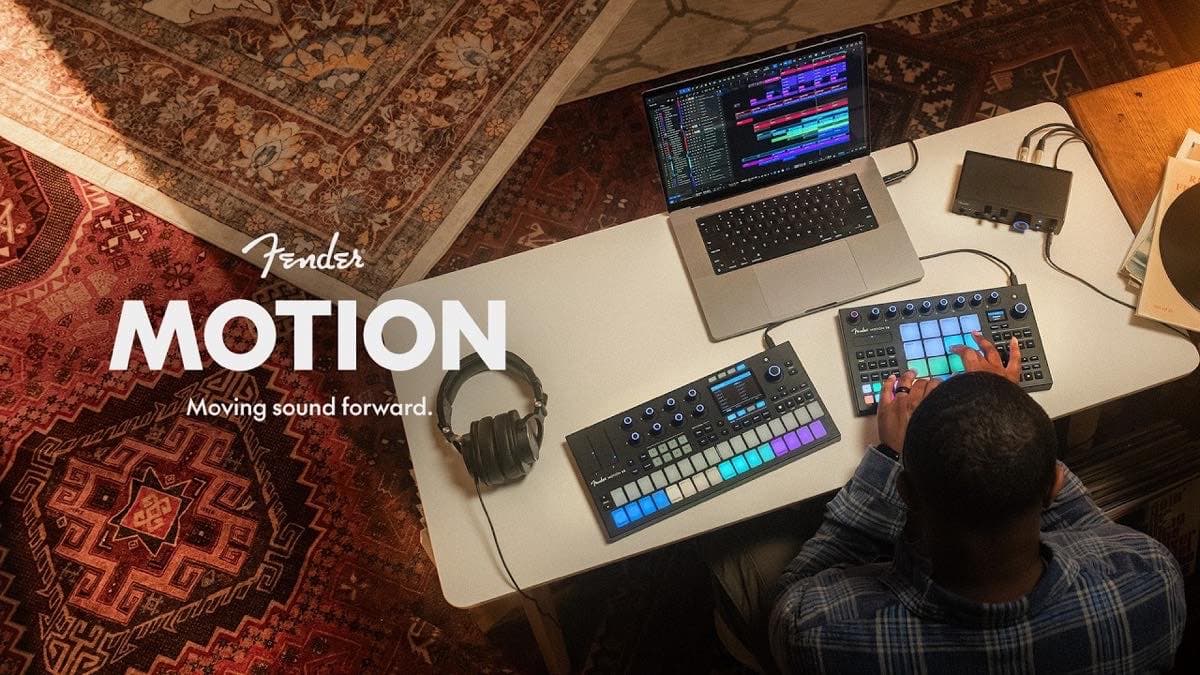
Fender has never built a pad controller. As of this week, it builds two.
The Motion 16 and Motion 32 arrived via an official Fender announcement dated 4 August. Retail listings followed the next day. These are Fender's first pad-based production controllers, and they are also the replacements for the PreSonus ATOM and ATOM SQ. If you have been tracking the PreSonus-to-Fender transition since January, this is the hardware half of that story landing.
Here is what the lineup is, how far the software integration goes, and what still isn't clear.
What Fender Actually Launched
Two units, both shipping now, both USB-C bus-powered and class-compliant.
| Model | Pads | Encoders | Touch strips | Price (USD) |
|---|---|---|---|---|
| Motion 16 | 16 RGB pads, 4x4 grid | 8 assignable + navigation | 1 | $269.99 |
| Motion 32 | 32 RGB pads, staggered two-lane | 8 assignable | 2 (pitch + mod) | $329.99 |
Regional pricing runs £239 and £299 including VAT, €279 and €349, AU$479 and AU$549, and ¥42,570 and ¥50,820. Both models carry a color display, full transport controls, and two 3.5mm MIDI ports. Those ports drive external synths and drum machines.
The Motion 16 is the straightforward successor to the original ATOM. It is a compact 4x4 grid aimed at beats and clip launching. The Motion 32 carries forward the ATOM SQ concept with its staggered two-lane pad layout. It switches between a piano-style Keys mode and a Blocks mode that splits the surface into two 16-pad banks.
One pricing note worth flagging. At NAMM in January, Fender announced the Motion 32 at $349.99 with a spring release. The release slipped to August, but the price came down $20 rather than up. That is not the usual direction of travel.
FATAR Pads and Polyphonic Aftertouch
Fender did not build these pads. FATAR did.
FATAR is the Italian keybed manufacturer behind the actions in a large share of MIDI keyboards. Motion is the first pad design the company has produced. The pads are RGB backlit, velocity sensitive, and support polyphonic aftertouch — per-pad pressure, not a single channel-wide value. Fender also describes them as context-aware. Layout and behavior change depending on whether you hit drums, play melodies, or trigger chords.
On paper this is the most interesting part of the release. Poly aftertouch on pads at this price is uncommon. Pad feel is also exactly what a keybed specialist should get right. Early impressions from the NAMM showings were positive about responsiveness. Nobody has had shipping units long enough to judge long-term feel.
The MPE Question
Here is the gap. Poly aftertouch is not MPE, and Fender does not advertise MPE support anywhere in the launch materials.
That distinction matters if you were hoping to drive MPE instruments from the pads. Polyphonic aftertouch gives you independent per-note pressure. MPE adds per-note pitch bend and slide on separate channels. That is what expressive controllers like the Expressive E Osmose CE are built around. A recurring reaction has been that poly-AT pads in 2026 ought to cover MPE too.
We are not going to claim it does or doesn't beyond what Fender states. Treat it as unsupported until the documentation says otherwise.
How Deep the Studio Integration Goes
The differentiator Fender is leaning on is native control of Fender Studio Pro. That is the DAW that was PreSonus Studio One Pro until the January 2026 rebrand.
Four things happen when Motion talks to Studio Pro:
- Transport and timeline control without reaching for the mouse
- Track navigation directly from the hardware
- Automatic parameter mapping, with plugin and mixer controls landing on the encoders and the display showing what is where
- An Add button that instantiates virtual instruments, audio tracks, and effects from the controller
That last one is the genuinely useful piece. Auto-mapping is table stakes for a modern control surface, and dedicated DAW controllers like Softube Flow have covered mixer integration for a while. Creating a track and loading an instrument without touching the keyboard is a different kind of shortcut. It removes one of the last reasons to break out of the hardware while an idea is still forming.
Outside Studio Pro, both units drop back to class-compliant generic MIDI. They work in Live, Logic, Bitwig, or anything else that accepts a USB controller. You just lose the auto-mapping and the Add button.
Songwriting Tools
Three modes ship on both models:
- Chord Mode — 30-plus custom-voiced progressions mapped to pads
- Simple Chords — a diatonic mode that keeps you in key
- Smart Scale — assignable scales with Locked and Guide pad layouts
Locked constrains every pad to in-key notes. Guide keeps the full chromatic layout but highlights the ones that fit. That is a sensible split. Guide is the better teaching tool, because you still see the notes you are avoiding.
Whether 30 preset progressions earn permanent space in your workflow is a fair question. Features like these land as either a genuine unblocking tool or a novelty you use twice. Which one depends entirely on how you write.
The Bundled DAW Changes the Math
Both models include a perpetual Fender Studio Pro license. Standalone, that DAW sells for $199.99 / £169.99.
Run the numbers. If you wanted Studio Pro anyway, the Motion 16 costs an effective $70 in hardware. The Motion 32 costs an effective $130. That is an aggressive bundle, and it is the strongest argument in the launch. It also tells you who Fender is aiming at. The target is not existing Push and Maschine owners, but producers picking a DAW and a controller at the same time.
Where Motion Sits in the Market
Motion is not a standalone instrument. There is no onboard sound engine, no battery, no screen-driven sampler. It needs a computer.
That rules out a direct comparison with Ableton Push 3 in standalone form, or with the standalone MPC line covered in our Akai MPC buyer's guide. Against a computer-tethered Maschine rig or a Launchpad, the pitch is clearer. You get poly-aftertouch FATAR pads, a color display with auto-mapped encoders, and a full DAW in the box. The price sits well under the flagship controllers.
The honest read is that Motion is an incremental, well-specified refresh of the ATOM line rather than a new category. That is not a criticism. The ATOM was competent and underrated; a version with better pads, a display, and tighter DAW hooks is a reasonable thing to want.
Open Questions
Two days in, several things remain unanswered:
- Dimensions and weight are not published in any accessible spec sheet. If desk space or a backpack is the constraint, wait for numbers.
- MPE support is unconfirmed and unadvertised. Assume no.
- Encoder counts differ across retail listings for the Motion 16 — eight assignable plus a navigation encoder is the reading that reconciles them.
- ATOM and ATOM SQ support long-term is unclear. Existing units still work with the DAW, and nothing announced changes that, but Motion is now the supported line.
- Third-party DAW scripting beyond class-compliant MIDI has not been detailed.
There is also the broader question of the rebrand. Retiring the Studio One name has not landed universally well with long-time users. Some read it as a shift toward a more consumer-facing product. The counterargument is straightforward. The DAW and its perpetual licensing survived intact, and the hardware line got a real investment.
Should You Buy One?
Buy the Motion 16 if you are on Fender Studio Pro or shopping for a DAW, and you want a compact grid with good pads. At an effective $70 over the software, it is hard to argue with.
Buy the Motion 32 if you play melodically as well as programming drums. The staggered layout with switchable Keys and Blocks modes is more versatile than a 4x4 grid, and the second touch strip helps.
Skip both if you own an ATOM that still does the job, need standalone operation, or specifically need MPE. If a keybed matters more than pads, our MIDI keyboard roundup is the better starting point.
Fender's Chief Product Officer Max Gutnik says Motion gets "the same obsessive attention to detail we put into everything we build." The specs support the claim. What nobody can tell you yet is how the pads hold up over a year of use. That is the number that decides whether Motion replaces the ATOM in practice as cleanly as it replaces it in the catalog.
Check Fender Motion 16 price at Thomann Check Fender Motion 32 price at ThomannFull specs and the official announcement are on the Fender Motion controllers page.