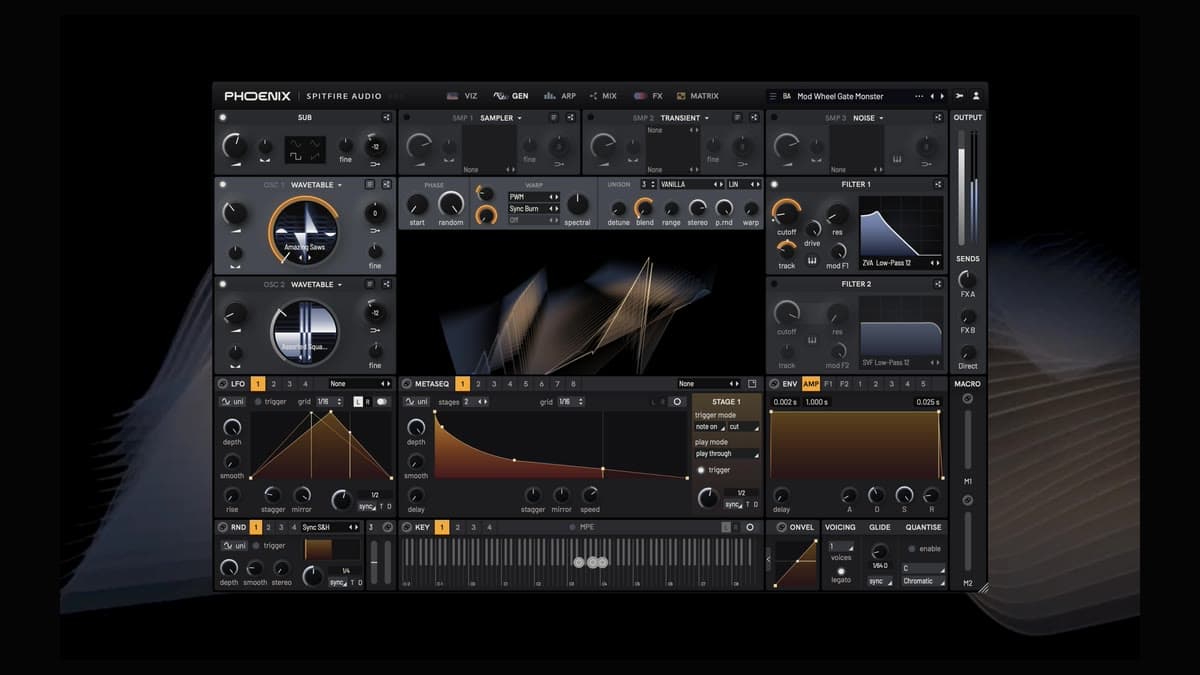
Phoenix is the hybrid synth in the Spitfire Audio and BT series, after Phobos and Polaris. Six engines share a signal path: spectral wavetables, FM, a sampler, 2-operator FM transients, subharmonic generation, and a complex noise oscillator. Left and right can warp independently. Modulation follows the rhythmic language of BT's Stutter Edit technique, with eight sequencers that also act as envelopes and a seeded step generator so a lucky pass can print again. Thirty-seven effects fill twelve slots. The current first look is Cherry Audio Pentaphonic.
The sampler is about 40 GB of moving sources: granular strings, quarter-tone brass, woodwinds, guitars, dulcimer, cimbalom, bells, and hits. Any sample can become an FM operator. Polyphony is 16 stereo voices with full MPE, and a heavy patch can use fewer. 552 presets are the way in.
Introductory pricing is $239 or £199 until 25 October 2026, then $299 or £249, from the Spitfire page. Formats are standalone, VST3, AU, and AAX. macOS 15 or later, Windows 10 22H2 or 11. The machine has to stay online while it runs, and the install wants about 80 GB free.
Use Omnisphere 3 when you want the larger hybrid library, listed at $479 on that card, and a standalone FX rack. Use Serum 2 when the work is wavetable design at $249, without a 40 GB cinematic pool. Use Zebra 3 when you want spline wavetables and additive partials at €249. The longer breakdown is the Phoenix first look.