Phoenix: Six Engines Under One Cinematic Patch
Phoenix is Spitfire Audio and BT's hybrid cinematic synth: six engines, dual stereo chains, and 16-voice MPE. Intro is $239 or £199 through 25 October 2026.
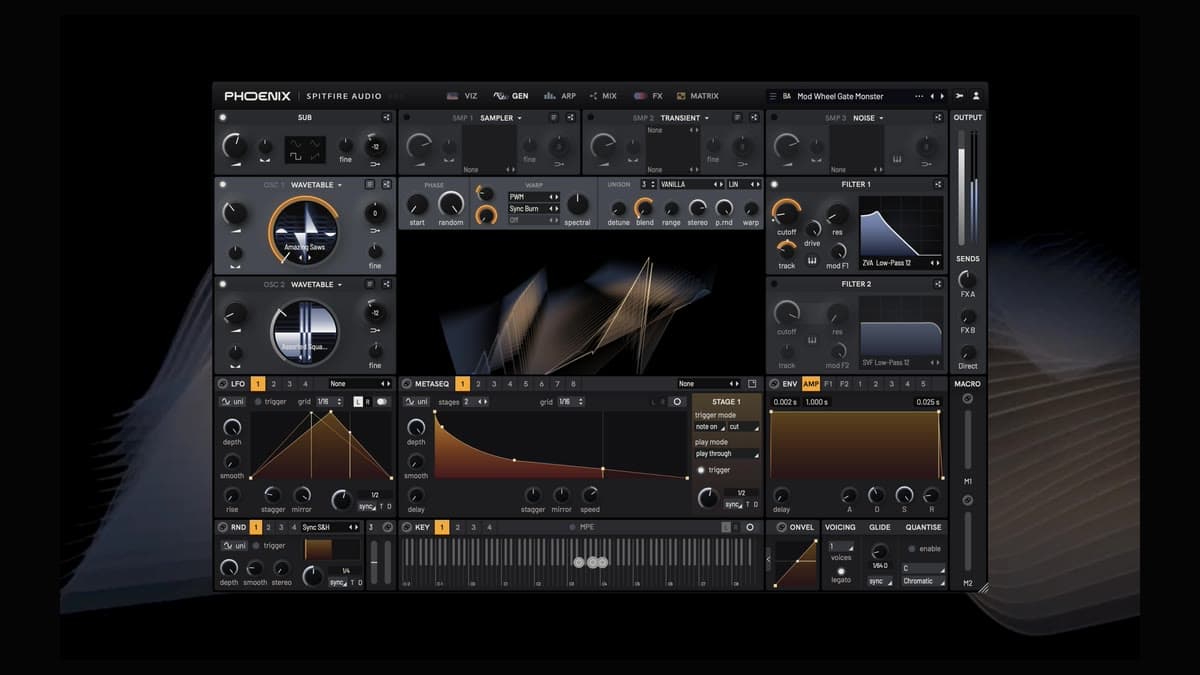
Spitfire Audio and BT have released Phoenix, a hybrid synthesizer built for cinematic writing and sound design in the same patch. It went up on the Spitfire shop on 29 September 2026. The introductory price is £199 against £249, which the page prints as 20% off until 25 October. The US store lists the same offer as $239 against $299. This is a first look at the shipping instrument and the specs Spitfire publishes. We have not had Phoenix open in a session yet.
At a glance: $239 / £199 intro, $299 / £249 after 25 October 2026. Six engines. 552 presets. 37 effects. 16-voice MPE. About 40 GB of content, with 80 GB free recommended for the install. Standalone, VST3, AU, and AAX. macOS 15 or later. Windows 10 22H2 or Windows 11. The computer has to stay online while Phoenix runs.
What Phoenix is
Phoenix is the third instrument in the Spitfire and BT collection, after Phobos and Polaris. Spitfire describes Phobos as polyconvolution, with impulse responses used as a tonal and rhythmic element. Polaris is the one where orchestras recreate vintage synths. Phoenix is the hybrid synth in that set: a score that can stay composed, then break into texture, without loading a second instrument.
The pitch on the product page is one patch doing both jobs. A modern cue often gets its tension from a drone or a grain as much as from a melody. Phoenix is built so those live in the same note. Six engines share a signal path. Left and right can run as two different chains. Modulation draws on the rhythmic language of BT's patented Stutter Edit technique. Thirty-seven effects sit on top.
BT's own line on the page is that this is cross-synthesis he had not seen in a related form. The credits he lists around that claim are the film scores for Monster and The Fast and the Furious, the 5.1 record Binary Universe, and the four hours of music written for the 200 speakers at Shanghai Disneyland. Phoenix is the instrument where Spitfire says those instincts meet.
Six engines, and a sampler that is one of them
The six engines are spectral wavetables, FM, a sampler, 2-operator FM transients, subharmonic generation, and a complex noise oscillator. They share one architecture, so a note can stack them instead of switching instruments mid-cue.
The sampler is the part that makes this a Spitfire instrument and not only a synth. The library is about 40 GB of recordings chosen for movement. Spitfire lists fluttering granular strings, brass in quarter-tone clusters, dark woodwinds, guitars, dulcimer, cimbalom, autoharp, hand bells, and a music box, plus hits and atonal textures. Any sample can also become an FM operator, so the recordings are not locked in a playback slot.
The wavetable side is where the stereo split shows up. Eighty-plus warp modes sit in two serial slots. Depth is modulatable per channel, so the left ear and the right ear can warp differently. Spitfire's line for that is two instruments on one note: independent wavetable positions, independent warps, drifting apart while you hold the key.
FM is a full vintage toolkit. Six operators. Thirty-four algorithms. Up to 48 oscillators stacked into a single note. That is the density control. A theme can stay thin, or the same patch can fill a frame once the operators open up.
Modulation built like Stutter Edit
The modulation is the BT-specific part. Spitfire ties it to the rhythmic language of Stutter Edit, the patented stutter-editing technique BT developed to pull rhythm out of any sound. In Phoenix that shows up as sequencers that also behave like envelopes.
There are eight of them. Each has four drawable stages. Sections can loop or run as a palindrome. Speed is bipolar, so a sequence can run backwards in the middle of a note. Each channel can run its own program. A pad can bloom on the left while the right chops.
A separate line is four stages of 128 hand-drawn steps, with play probability per stage, eight scale modes, and a seeded random generator. The seed is the practical bit. If a pass prints the gesture you want, that take can print again. Probability stays in the patch. It does not become a one-time accident you cannot recall.
Thirty-seven effects, twelve slots
Phoenix ships 37 processors, each with its own interface. Twelve slots run across three chains. Spitfire's examples run from spectral smearing to granular reverbs. An on-page demo walks four effects in series and lets you toggle each one against the source, which is the right way to hear a chain this long: one processor at a time, then the stack.
The effect count matters because the instrument is meant to finish a cue inside one patch. A shimmer, a smear, and a rhythmic chop can live on the synth instead of on three inserts you then have to automate in the host. Twelve slots is enough to overdo it. The bypass on each slot is how you find out which one actually moved the picture.
Phoenix specifications
| Spec | Detail |
|---|---|
| Price | $239 / £199 intro until 25 October 2026, then $299 / £249 |
| Presets | 552 |
| Engines | Spectral wavetable, FM, sampler, 2-op FM transients, subharmonic, complex noise |
| Sampler | About 40 GB. Allow 80 GB free for install |
| Voices | 16-voice stereo MPE. Count can drop with patch complexity |
| Warp | 80-plus modes, two serial slots, depth per channel |
| FM | 6 operators, 34 algorithms, up to 48 oscillators in one note |
| Sequencers | 8 sequencers that also act as envelopes. 4 stages of 128 steps, seeded RNG |
| Effects | 37 processors, 12 slots across 3 chains |
| Formats | Standalone, VST3, AU, AAX |
| macOS | 15 or later. Minimum Apple M1 or a 2019 or newer 8-core Intel Core i9, 16 GB RAM. Recommended M2 Pro, M3, or newer, 32 GB RAM |
| Windows | 10 version 22H2 or Windows 11, 64-bit. Minimum Intel Core i7 10th gen or AMD Ryzen 5 5000, 16 GB RAM. Recommended Core i7 12th gen or Ryzen 7 5000 or newer, 32 GB RAM |
| Disk | SSD required. 64-bit DAW required |
| Connection | Must stay online while Phoenix is in use. Offline use is not supported |
Phoenix vs Omnisphere 3 and Serum 2
Phoenix sits next to two instruments composers already reach for when one synth has to cover a cue. Omnisphere 3 is the deep hybrid workstation. Serum 2 is the wavetable instrument most electronic producers already know. They overlap Phoenix on "hybrid" and then leave.
| Phoenix | Omnisphere 3 | Serum 2 | |
|---|---|---|---|
| Price | $239 intro / $299, or £199 / £249 | $479 full, $199 upgrade from Omnisphere 2 | $249 |
| What it is | Cinematic hybrid with a 40 GB sampler and Stutter Edit-style motion | Hybrid workstation, 26,000-plus patches, 93-processor FX rack | Five-engine wavetable synth with an arpeggiator and clip sequencer |
| Voices | 16-voice MPE | Layered hybrid patches | Five engines, including wavetable, sample, granular, and spectral |
| Formats | Standalone, VST3, AU, AAX | VST3, AU, AAX | VST3, AU, AAX |
| Install | About 40 GB, 80 GB free to install | Large library, heavy on CPU and RAM | No 40 GB sample pool |
| Offline | Online connection required while it runs | Sold as a standard desktop licence | Standard desktop licence |
| Buy | Spitfire Audio | Best Service | Xfer Records |
Pick Phoenix when the job is one patch that can carry a theme and then decompose it, with recorded Spitfire sources and rhythmic stutter already in the instrument. Pick Omnisphere 3 when you want the larger preset library and a standalone FX rack you can put on any track. The longer breakdown is the Omnisphere 3 review. Pick Serum 2 when the work is visual wavetable design across electronic genres, at $249, and you do not need a 40 GB cinematic sampler. u-he Zebra 3, listed at €249 on its card, is the other deep hybrid if you want spline wavetables and additive partials rather than a scored sample pool.
Who Phoenix is for
Phoenix is for media composers and sound designers who want cinematic motion inside a single patch. Hold a note and the engines, the stereo split, and the sequencers do the move. The 552 presets are the way in. The engines are there when a preset is close and the cue needs a different warp on one side.
It is also for anyone who already liked Phobos or Polaris and wants the synth in that series, rather than another convolution trick or another orchestra-plays-a-synth library.
Skip it if the studio machine cannot stay online. Spitfire is explicit: offline use is not supported, and the computer running Phoenix must stay connected the whole time. Skip it if you are on macOS 14 or earlier, or on a Windows build older than 10 22H2. Skip it if 80 GB of free disk is not available for the install. Skip it if you need a small, offline, CPU-light bass synth for club tracks. Serum 2 and Zebra 3 are closer to that job. If you want a recorded orchestra rather than a synth that contains orchestral fragments, start with BBC Symphony Orchestra or a dedicated library, and keep Phoenix for the texture around it.
A lighter cinematic bed, without this engine depth, is Teletone Nora, an $89 texture instrument. Nora is a library of finished sounds. Phoenix is the instrument you design.
How much Phoenix costs
Spitfire sells Phoenix direct. The introductory offer is 20% off until 25 October: £199 from £249 on the UK store, and $239 from $299 on the US store. After that date the price is the higher figure. There is one product on the page, not a tiered edition list.
Buy it from the Phoenix page.
FAQ
How much does Phoenix cost?
The introductory price is $239 or £199 until 25 October 2026. The full price after that is $299 or £249. Spitfire prints the discount as 20% off.
What does Phoenix run on?
Standalone, VST3, AU, and AAX. macOS 15 or later, on Apple silicon or a 2019 or newer 8-core Intel Core i9, with 16 GB RAM minimum and 32 GB recommended. Windows 10 22H2 or Windows 11, on a 10th-gen Core i7 or Ryzen 5 5000 minimum, with the same RAM guidance. An SSD and a 64-bit DAW are required.
Can Phoenix run offline?
No. The computer has to stay connected to the internet while you use it. Offline operation is not supported.
How big is the download?
The library is about 40 GB. The installer needs roughly twice that, so Spitfire asks for 80 GB or more free on the drive.
Phoenix or Omnisphere 3?
Phoenix is the narrower cinematic instrument: six engines, a 40 GB Spitfire and BT sample set, 16-voice MPE, and an online requirement, at $239 during the intro. Omnisphere 3 is the broader hybrid, at $479, with 26,000-plus patches and a 93-processor FX rack. Use Phoenix for one-patch scored motion. Use Omnisphere when the library itself is the point. Read the Omnisphere 3 review for that instrument in full.
This is a first look, not a scored review. We have not lived with the six engines or the seeded sequencers. Read the official page, check the disk space and the online requirement, and watch Spitfire's own walkthrough before you plan a template around it.