Some links on this page are affiliate links. If you buy through them, Dubspot may earn a commission at no extra cost to you. It never affects our scores or what we recommend — read our policy.
Cherry Audio Pentaphonic: The Gleeman Synth at $59
Cherry Audio Pentaphonic brings the rare 1981 Gleeman hybrid to the DAW for $59, with up to 16 voices, three UI themes, and a polyphonic step sequencer.
T
Theo Nakamura
October 7, 2026 · 13 min read
Black Friday 2026Cherry Audio Black Friday 2026: dates and deals →
Cherry Audio released Pentaphonic on 6 October 2026. It is a software recreation of the Gleeman Pentaphonic, a 1981 hybrid polysynth of which fewer than 70 units were ever made. The street price is $59. This is a first look from Cherry Audio's product page, news post, and the official introduction video, not a scored session review.
At a glance: Pentaphonic keeps the original digitally controlled oscillators and Curtis analog filter, then opens the instrument up. Mono, unison, or 2 to 16 voices. Pulse-width modulation, noise, oscillator sync, and a second LFO. A 24 dB low-pass plus a 12 dB mode, with key tracking and a limiter. Velocity, channel aftertouch, and polyphonic aftertouch, with 14 parameters open to keyboard pressure. A syncable arpeggiator, a 16×4 polyphonic step sequencer, a Parameter Animator, and 22 effects. Three panel themes, including two clear skins with adjustable opacity. AU, VST, VST3, AAX, and standalone, with a 30-day demo. Buy it from Cherry Audio or Thomann at £51 including VAT.
What the Gleeman Pentaphonic was
In the early 1980s, brothers Bob and Al Gleeman built a portable polysynth in a Mountain View garage. Al handled the electronics. Bob handled the business. The goal was an instrument that would stay in tune under stage lights, in a market already full of analog polys such as the Prophet-5 and the Memorymoog.
The hardware was a hybrid. Five voices, which is where the name comes from, used fifteen digitally controlled oscillators run by a pair of Intel 80186 processors. Each oscillator offered eight waveforms, including two harmonically rich shapes called Complex 1 and Complex 2. Those were low-resolution, 32-sample waveforms played back at a variable clock. A single digital LFO supplied triangle-wave tremolo and vibrato. The analog half was a Curtis CEM3320 4-pole, 24 dB/octave resonant low-pass, plus a CEM3360 dual VCA.
The first version arrived in 1981 in a plain black chassis with a handle and a built-in speaker. Cherry Audio calls it an "ultimate portable" at 18 pounds. Under the panel sat a 37-note keybed, a 300-note real-time polyphonic sequencer, computer-tuned chorusing, and a joystick for pitch. Priced under $3,000, it sat against a Prophet-5 at $4,600, with tuning stability the analog rivals of that moment did not match. Gleeman handmade around 30 black units, and the feature set kept moving.
A clear version followed. The Pentaphonic Clear used an acrylic housing, plexiglass knobs, and optional lighting so the green boards showed on stage. It shipped with a shoulder strap, a remote power supply, and a 20-foot cable, so it could work as a keytar. The Clear also added the Presetter, with 100 programmable patches, a two-axis joystick for pitch and mod together, an improved chorus, and a 600-note sequencer. Fully loaded, it cost around $3,400. Fewer than 20 Clears were built.
Cherry Audio describes the tone as thick pads and strings that can make an OB-Xa sound thin beside them, with a clarity closer to a Memorymoog. Complex 1 and Complex 2 threw off bright, bell-like overtones that anticipated FM, years before the DX7. The original also had real limits. It lacked the grit and the experimental corners of its analog competitors. There was no oscillator sync. Some players found the 37-key range and the lack of touch sensitivity restrictive. As the market moved toward digital synths, Gleeman wound production down. In 1994, David Kean of the Audities Foundation bought the remaining parts and assembled a small later batch, reportedly seven more Pentaphonics and seven Clears. For a modern Oberheim voice in plugin form, see our first look at TED-8 from discoDSP.
Surviving instruments are scarce. Oscar Peterson bought a Clear on the spot. Kevin Gilbert used one early on. The Moog Cookbook, Kansas, The Band, and R.E.M. played them, and Depeche Mode's Martin Gore is among the owners.
What Cherry Audio added
Pentaphonic is not a museum freeze of the five-voice original. Cherry Audio frames it as the unrealized 1983 Gleeman prototype brought forward: that sketch called for eight voices, a 61-key keyboard, a stronger sequencer, and MIDI. The plugin goes past that sketch and keeps the hybrid core.
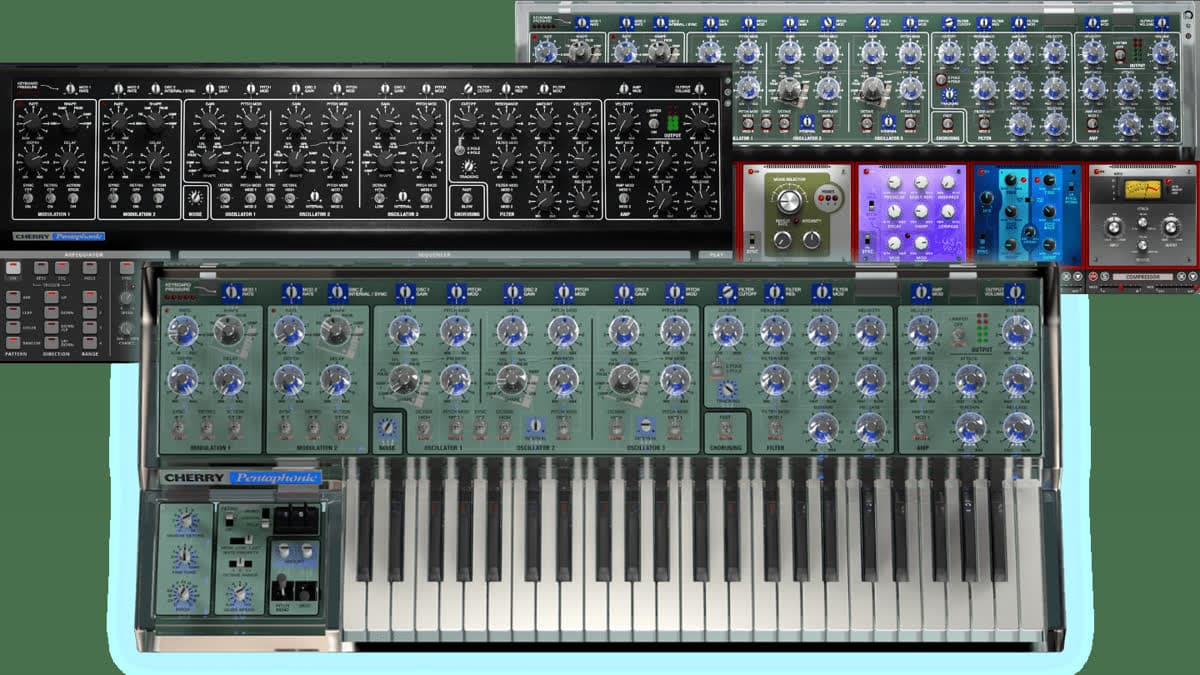
Three interface themes cover the instrument's history. Black is the first chassis. Clear and "Audities" clear recall the acrylic units, and opacity is a click-and-drag control, so the panel can sit solid or show through. That is a visual feature with a practical side. The clear skins are the reason this synth was talked about as something meant to be seen, and the opacity slider lets you keep that look without losing the knobs on a bright screen.
Voice count is the largest musical change. Monophonic mode adds last or high note priority and retrigger. Unison brings detune. Polyphonic mode runs from 2 to 16 voices, against the original five. Each voice still has three oscillators based on the Gleeman DCOs, with the original stair-stepped shapes: Complex 1, Complex 2, 3% pulse, 12% pulse, 50% pulse, ramp, triangle, and sine.
Cherry Audio then fills the holes the hardware left open. Each oscillator gains pulse-width modulation. A noise generator is new. Oscillator sync is new, which is the sync the original never had. A second LFO joins the first, and both LFOs now use the same eight waveforms as the oscillators, not triangle alone. Those LFOs can reach the oscillators, the filter, and the amp. The original fast and slow chorusing stays.
The filter keeps the 4-pole, 24 dB low-pass and adds a 2-pole, 12 dB mode, plus polarity and keyboard tracking. The amplifier adds a limiter. On the original, resonance at the top of the 4-pole filter could push the CEM3320 into self-oscillation. The plugin keeps that low-pass character and gives you the gentler 12 dB slope when the 24 dB mode is too steep for the part.
Expression is the other gap the hardware left. Pentaphonic responds to velocity on the filter and the amp, and to channel aftertouch and polyphonic aftertouch. Fourteen parameters can move from keyboard pressure, with bipolar amount trimmers. Cherry Audio lists modulation rate, oscillator 2 sync, oscillator gain and pitch, filter cutoff, resonance, and modulation, and amp modulation and volume among them. Pitch bend range is assignable, and a dedicated mod stick sits beside it.
The sequencer side is where the plugin stops being a panel replica and starts being a writing tool. The arpeggiator has four pattern modes, Arp, Leap, Order, and Random, plus swing, chance, and feel, so a pattern can loosen without leaving the clock. The polyphonic step sequencer is 16 steps by 4 patterns, syncable and transposable, with Start, Stop, Auto Start, and humanize, locked to the DAW clock. The Parameter Animator is a separate per-layer sequencer, also 16 steps by 4 patterns, aimed at cutoff, resonance, oscillator pitch modulation, and oscillator gain. Notes and tone can move on different grids.
Effects sit in a chain of up to five, chosen from 22 and reorderable. The list is BBD Flanger, Compressor, DCO Chorus, Digital Delay, Digital Reverb, Distortion & EQ, Dual Delay, Dual Ensemble, Dual Phaser, Envelope Filter, Flanger & Chorus, Galactic Reverb, Lo-Fi, Lushverb, Panner, Pulser, Ring Modulator, Rotary Speaker, Seven Band EQ, Spring Reverb, Tape Echo, and Wide Phaser. Each slot has on, solo, a bipolar modulator amount, and dry/wet. A global switch covers level and stereo expand. The original chorus is still there. The rest is the modern studio half.
The factory set is more than 375 presets in 14 categories, and that count includes the original 50 hardware patches. James Terris, Cherry Audio's director of sound design, leads the new library, with contributions from Andrew Longhurst, James Dyson, and Steve Peglar. Focus zoom, UI scaling, user oversampling, and MIDI learn on every control round out the instrument. Preset and global MIDI maps are separate.
Pentaphonic specifications
| Spec | Detail |
|---|---|
| Type | Hybrid polysynth: digitally controlled oscillators into an analog low-pass |
| Developer | Cherry Audio |
| Based on | Gleeman Pentaphonic, 1981, fewer than 70 hardware units |
| Voices | Mono with last/high priority and retrigger, unison with detune, poly 2–16 |
| Oscillators | 3 per voice, 8 stair-stepped waveforms, PWM, noise, oscillator sync |
| LFOs | 2, each with the same 8 waveforms, routed to oscillators, filter, and amp |
| Filter | 4-pole 24 dB low-pass and 2-pole 12 dB mode, polarity, key tracking |
| Amp | Limiter, velocity |
| Expression | Velocity, channel aftertouch, polyphonic aftertouch, 14 pressure destinations |
| Arpeggiator | Arp, Leap, Order, Random, with swing, chance, and feel |
| Sequencer | 16×4 polyphonic step sequencer, sync and transpose, humanize |
| Animator | 16×4 parameter sequencer for cutoff, resonance, pitch mod, oscillator gain |
| Effects | 22, up to 5 in a reorderable chain, plus the original chorus |
| Presets | 375+ in 14 categories, including the original 50 factory patches |
| UI | Black, Clear, and Audities Clear, with drag opacity, Focus zoom |
| Formats | AU, VST, VST3, AAX, standalone |
| macOS | 10.13 or later, 64-bit, Apple Silicon including Ultra. 196 MB. Recommended 3.4 GHz quad-core or M1, 8 GB RAM |
| Windows | 7 or later, including Windows 11, 64-bit. 196 MB. Recommended quad-core, 8 GB RAM |
| Activation | Internet connection required |
| Demo | 30 days |
| Price | $59. Thomann £51 including VAT. Translucent pack $9.99 |
Pentaphonic vs other Cherry Audio polys
The useful comparison inside this catalog is not a Minimoog clone. It is the other vintage polys Cherry Audio already sells at the same kind of price. GX-80 is the CS-80 and GX-1 instrument: dual layers, 16 voices on each layer, $59 on Cherry Audio's GX-80 page. Memorymode 2 is the Memorymoog instrument, a dual-layer analog poly at $69, with a $39 upgrade from version 1. Pentaphonic is the Gleeman, a DCO-plus-filter hybrid with the clear chassis as part of the product.
| Pentaphonic | GX-80 | Memorymode 2 | |
|---|---|---|---|
| Price | $59 | $59 | $69, or $39 to upgrade |
| Instrument | 1981 Gleeman Pentaphonic | CS-80 / GX-1 style | Memorymoog style |
| Voices | Mono, unison, or 2–16 | 16 per layer, two layers | Dual-layer analog |
| Oscillators | 3 DCOs, 8 stair-stepped waves, PWM, sync, noise | CS-80-style dual layer | Analog Memorymoog lineage |
| Motion | Arp, 16×4 note sequencer, Parameter Animator | Layered pads and splits | Stacked analog layers |
| Best when | You want the Gleeman hybrid and the clear panel | You want CS-80 pads at $59 | You want Memorymoog stacks |
Pick Pentaphonic when the source instrument matters. The stair-stepped Complex waves and the CEM-style low-pass are a different color from a CS-80 layer or a Memorymoog stack. Pick GX-80 when the session needs those wide, chorused polys and you already know that sound. Pick Memorymode 2 when the part should sit in six-Minimoogs-in-a-box territory and you want the version 2 model. The full Memorymode 2 breakdown is in the August first look. All three live in the same $59 to $69 band, so this is a tone choice, not a budget stretch.
Who Pentaphonic is for
Pentaphonic fits producers who want a rare hybrid poly without hunting a collector's instrument, and players who already like Cherry Audio's vintage line and want the Gleeman specifically. The sequencer, animator, and aftertouch routing make it useful for parts that need to move, not only for static pads. The clear themes matter if you play it on screen or on camera. If a late-1990s analog flagship is more your era, the Isla ASYX Andromeda A6 plugin imports original A6 patches.
Skip it if you need a modern wavetable, a sampler, or a drum machine. Skip it if your only goal is a CS-80 or a Memorymoog, because GX-80 and Memorymode 2 already occupy those seats. Skip it if you cannot run a plugin that phones home once for activation.
How much Pentaphonic costs
The instrument is $59. That is the price on Cherry Audio's news post of 6 October 2026 and on the product page. Thomann UK lists it at £51 including VAT, article 655362, as a download in stock.
The Translucent Preset Pack is $9.99, sold separately and only from Cherry Audio. James Dyson programmed 100 presets in eight categories, aimed at slower, hypnotic sounds that use the new modulation, aftertouch, arp, sequencer, and effects. It is not included in the $59 instrument.
Until 19 October 2026, Pentaphonic can also go into Cherry Audio's Build Your Own Bundle. A Pick 3 bundle is $99, from $119. A Pick 6 bundle is $149, from $169. That is the route if you want Pentaphonic alongside other Cherry Audio instruments and the per-plugin price matters.
Formats are AU, VST, VST3, AAX, and standalone, on macOS 10.13 or later and Windows 7 or later, both 64-bit. Apple Silicon is native, including Ultra. Cherry Audio recommends a 3.4 GHz quad-core or an M1 and 8 GB of RAM, and the install is 196 MB. A free 30-day demo is on the product page. Activation needs an internet connection.
FAQ
How much does Cherry Audio Pentaphonic cost?
Pentaphonic is $59 from Cherry Audio. Thomann UK lists it at £51 including VAT. The Translucent pack of 100 extra presets is $9.99, sold only by Cherry Audio. Through 19 October 2026, Pick 3 and Pick 6 bundles are $99 and $149.
What is the difference between Pentaphonic and Memorymode 2?
Pentaphonic recreates the Gleeman Pentaphonic, a DCO and analog-filter hybrid, at $59, with up to 16 voices and the clear panel themes. Memorymode 2 recreates the Memorymoog as a dual-layer analog poly at $69. They share a price band and a Cherry Audio interface habit. They do not share a sound source.
Does Pentaphonic support aftertouch?
Yes. The plugin responds to velocity, channel aftertouch, and polyphonic aftertouch. Fourteen parameters can be modulated from keyboard pressure, with bipolar amount controls.
What are the system requirements?
macOS 10.13 or later, 64-bit, with native Apple Silicon. Windows 7 or later, including Windows 11, 64-bit. Cherry Audio recommends a quad-core CPU and 8 GB of RAM. The disk footprint is 196 MB. Formats are AU, VST, VST3, AAX, and standalone. Activation requires an internet connection.
Is there a demo?
Yes. Cherry Audio offers a 30-day demo from the Pentaphonic product page. The full instrument is $59 once the demo period ends.
Pentaphonic is the Gleeman instrument, expanded until it can live in a current session: more voices, sync, aftertouch, a real sequencer, and a clear panel you can actually see. At $59 it sits next to GX-80, and the reason to choose it is the hybrid tone and the rarity of the original, not a feature-count contest. Read the matching Pentaphonic plugin card for the spec sheet, and start from the official product page if you want the demo first.


