Cryptid Audio First Look: Aura, Nessie and Mothman
Cryptid Audio ships Aura, Nessie and Mothman: a Windows channel strip, parallel lo-fi, and tape echo plus aura reverb. Intro prices, specs, and who each is for.
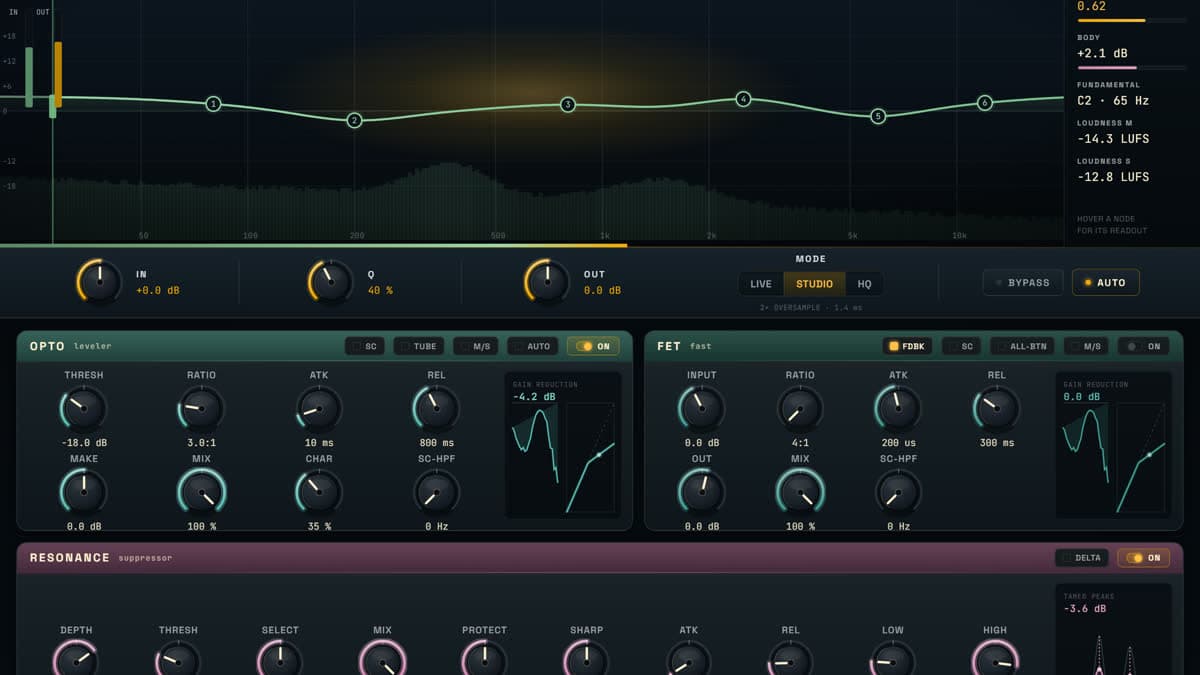
Cryptid Audio has opened its Field Guide with three shipping plugins: Aura, Nessie, and Mothman. Aura is a parametric EQ wrapped around a channel strip. Nessie handles parallel lo-fi and vinyl character. Mothman is a tape space echo with an aura reverb. Intro prices run $49, $29, and $59 against $89, $59, and $79 lists.
This is a first look rather than a scored review, because all three are brand new and Windows-only. That second detail will settle the question for a lot of readers before they get to the feature lists.
At a glance: three one-time purchases. VST3 and standalone, Windows 10 and 11, 64-bit. A 14-day full trial and a 30-day refund. Serial or keyfile license that installs on all of your own machines. Mac and AU are on the roadmap with no date attached. Sold direct from cryptid.audio.
What the Field Guide is
Cryptid treats its catalog like a bestiary. Aura is specimen 001, Nessie 002, Mothman 003. Chupacabra (a 1176-style FET compressor), Banshee (a dynamic resonance tamer), and Bigfoot (tape and saturation) are all still listed as in the field. Every purchase credits toward the full Field Guide bundle, but Cryptid doesn't print a bundle price on the hub, so there's no figure to quote yet.
The shared idea is an "aura": a display and a processing bias that lights the sustained, musical core of a sound and leaves noise and transients dimmer. Cryptid's stated field principle is that every curve you see is drawn by the same code that processes the audio, never a separate analyzer guess, and that a golden test fails the build if the picture drifts from the sound.
Each plugin applies that idea differently. Aura uses it as an EQ display. Nessie uses it so character lands on the body of a note. Mothman uses it so echo and reverb bloom on held, in-tune material while hash dies away.
Aura: parametric EQ plus a full strip
Aura is the flagship, and Cryptid describes it as a parametric EQ wrapped around an aura. The warm, sustained core of a sound glows amber. Noise and transients stay dim and cool. You end up watching tone rather than loudness.
Eight stages sit on one signal path.
- EQ. Parametric bands on a curve measured from the real filter. Bell, shelf, and cut, with Q and gain Cryptid says you can trust to the decibel. Channels are mono, stereo, and mid/side.
- Opto. Program-dependent optical leveling. Slow glue that doesn't grab at transients.
- FET. 1176-style attack for punch. Mid/side aware, with a sidechain high-pass so low end doesn't pump the whole band.
- Resonance. Dynamic taming in the soothe style, which finds frequencies that ring and ducks them only while they ring.
- De-Ess. Dynamic sibilance control instead of a static shelf.
- Aura. The amber glow, plus a Bloom control that swells the display on held, in-tune notes.
- Analog. Saturation modeled across the whole strip.
- Bus Glue. A VCA-style compressor as the final dynamics stage.
Intro price is $49 against an $89 list, one-time, with lifetime updates inside v1. There's no subscription, no account wall, and no iLok. The 14-day trial is full-featured, and when it expires Aura inserts brief periodic silence so projects stay intact. Cryptid tests heavily in FL Studio and says any VST3 host will load the plugin.
Open Aura first if you want a single insert that can EQ, compress, de-harsh, and color a vocal or a bus. It also invites the obvious comparisons: FabFilter Pro-Q 4 for the EQ and soothe3 for the resonance stage. Aura is cheaper and narrower than either. It's a Windows channel strip built around a display thesis, not a replacement for a $199 surgical EQ.
Nessie: lo-fi that keeps a clean core
Most lo-fi tools degrade the whole signal in series until the take turns to mud. Nessie builds its character in parallel and keeps a clear center underneath, so vinyl noise ducks below the program and dodges transient onsets. Cryptid's claim is blunt: put it on a lead vocal and you'll still have a lead vocal. The current first look is Yurt Rock DECADE.
Everything lives in one window.
- Character. Tube or tape color with drive, warmth, and a crisp edge, oversampled so it doesn't turn brittle. The default Color setting is Tape.
- Tone. Smooth the top, trim the lows, add air, so the grit has a clear core underneath it.
- Aura. Character lands on the body of the sound while noise dodges transients, with Bloom on held notes.
- Motion. Wow and flutter built from record eccentricity, capstan flutter, and a random wander that doesn't repeat like a looped LFO.
- Vinyl. Crackle, hiss, and rumble that duck under the program.
- Space. A rotary speaker and auto-pan for width and movement.
- Crush. Bit-crush and sample-rate reduction when you want digital dirt on tap.
- Mix. Blend back to the clean path, which Cryptid says is always underneath you.
Intro price is $29 against a $59 list. Formats, licensing, and trial terms match Aura exactly.
Nessie sits next to RC-20 Retro Color as a one-window vintage suite, and next to Decimort 2 if all you actually want is the digital crush. RC-20 is the deeper, pricier lo-fi desk. Nessie is the cheaper parallel take that promises it won't wreck a vocal, and the free trial is the cheapest way to test that promise on your own material.
Mothman: tape echo and an aura reverb
Mothman handles space. Tape repeats keep coming back with flutter and warble, and the aura reverb blooms on sustained notes while the noise wash falls away. Cryptid's most useful line about it: at the same feedback setting, a held note can ring for ages while a noisy hit dies in a repeat or two.
Inside the window:
- Tape Echo. RE-201-style repeats with wow, flutter, and age, either tempo-synced or free-running.
- Lure. Tuneful, sustained repeats linger while noisy ones fade, at the same feedback setting.
- Wake. A faint tail that carries a ghost of recent notes across the rests.
- Aura Reverb. A tail that swells on held, in-tune notes and lets the wash fall away.
- Clarity. Holds the musical body of the reverb tail and clears the noisy wash.
- Sub Bloom. Octave-down weight that arrives on a held low note and goes quiet on chords, noise, and transients.
- Movement. Chorus and a barber-pole drift, from a light shimmer to a rising sway.
- Character. Saturation and wear that build across the repeats.
Intro price is $59 against a $79 list, on the same formats and terms as the other two.
Mothman isn't a static lush hall, and Cryptid says so directly when it stacks the plugin against Valhalla VintageVerb. A great lush reverb gives you a beautiful, consistent tail no matter what you feed it, which is the right answer for plenty of music. Mothman lets the source shape the space instead. If you want a delay that behaves identically on every send, Valhalla Delay still does that job at $50. If you want repeats that clean up after a busy vocal, this is the experiment. Our best reverb plugins guide covers the more conventional spaces.
Cryptid Audio Field Guide specifications
| Spec | Aura | Nessie | Mothman |
|---|---|---|---|
| Role | Parametric EQ + channel strip | Parallel lo-fi / vinyl | Tape space echo + aura reverb |
| Intro / list | $49 / $89 | $29 / $59 | $59 / $79 |
| Formats | VST3, standalone | VST3, standalone | VST3, standalone |
| OS | Windows 10/11, 64-bit | Windows 10/11, 64-bit | Windows 10/11, 64-bit |
| Mac / AU | Roadmap, no date | Roadmap, no date | Roadmap, no date |
| iLok | No (serial / keyfile) | No (serial / keyfile) | No (serial / keyfile) |
| Trial | 14 days, full | 14 days, full | 14 days, full |
| After trial | Periodic silence | Periodic silence | Periodic silence |
| Refund | 30 days | 30 days | 30 days |
| Updates | Lifetime within v1 | Lifetime within v1 | Lifetime within v1 |
The stated system requirements are modest: a 64-bit Windows 10 or 11 machine, a reasonably modern multi-core CPU, and a VST3 host or nothing at all if you run the standalone. No special hardware is needed, and no internet connection is required after install. Trials are limited to one per user, and Cryptid won't guess a Mac date.
How the three stack against tools you already own
| Cryptid plugin | Named alternative | Pick Cryptid when | Pick the other when | |
|---|---|---|---|---|
| Aura | $49 intro channel strip | Pro-Q 4 at $199 | You want EQ plus Opto, FET, de-ess, and glue on Windows | You need AAX, Mac, or a dedicated surgical EQ |
| Nessie | $29 intro parallel lo-fi | RC-20 | You want vinyl and tape on a vocal without burying the core | You want the deeper, more configurable lo-fi suite |
| Mothman | $59 intro echo + aura reverb | Valhalla Delay at $50 | You want repeats and a tail that drop the noise | You want a consistent delay or hall on every source |
If Aura's full strip is more than you need, Parish Audio's Parametric Compressor is the other current dynamics tool that thinks in EQ-like bands.
Who these plugins are for
Aura suits Windows mixers who want one insert for a vocal, a guitar, or a bus, and who like a display that claims to show what's alive rather than what's loud. Nessie suits producers who want vinyl and tape on a lead without turning the take into hash. Mothman suits anyone who drowns parts in echo and then spends the next hour fighting the mud.
Skip the whole Field Guide if you're on a Mac today, because AU and macOS are on the roadmap rather than in the box. Skip it if you need AAX or an iLok-based studio deployment. Everyone else can start the trials and pay nothing to find out.
How much do Aura, Nessie, and Mothman cost?
All three are one-time purchases from Cryptid Audio.
Each license covers every v1 update and all of your own machines. The 14-day trial is the full plugin, and the 30-day refund runs from purchase. There's no Plugin Boutique, Thomann, or Best Service listing, so direct is the only route.
FAQ
Are Aura, Nessie, and Mothman available on Mac?
Not yet. Cryptid lists macOS and AU as on the roadmap and won't print a date. Shipping formats today are VST3 and standalone on 64-bit Windows 10 and 11.
Do I need iLok?
No. Each plugin uses a serial or signed keyfile that arrives with your receipt, works offline, and installs on all of your own machines. Cryptid says there's no activation server and no machine lock.
How much does Aura cost?
Aura is $49 at its introductory price and $89 regularly, as a one-time purchase.
What happens when the trial ends?
After 14 days an unlicensed copy inserts brief periodic silence. Projects stay intact until you license the plugin.
Is there a Field Guide bundle price?
Purchases credit toward the Field Guide bundle, but Cryptid doesn't publish a bundle dollar price on the hub, so check the live shop if you plan to collect all three.
Which specimen to try first
Cryptid's first three plugins share a display idea and a Windows-only shipping list. Aura is the channel strip, Nessie is the parallel lo-fi, and Mothman is the echo that tries to keep the note and drop the noise. Intro prices sit well below the tools Cryptid names as neighbors, and the trials aren't crippled in any way.
The constraint is the real story. No Mac, no AU, no AAX. If you're already on Windows and you want a new strip, a vocal-safe lo-fi box, or a tape echo with an opinion, the 14-day trials at cryptid.audio cost nothing. Start with whichever gap in your template annoys you most, then decide which specimen you actually keep.