The Remnant: An 8-Voice FM Drone Synth for $19
All The Machines The Remnant is an FM drone synth with an 8x8 feedback matrix, four acoustic filters, and morphing snapshots, out now for $19.
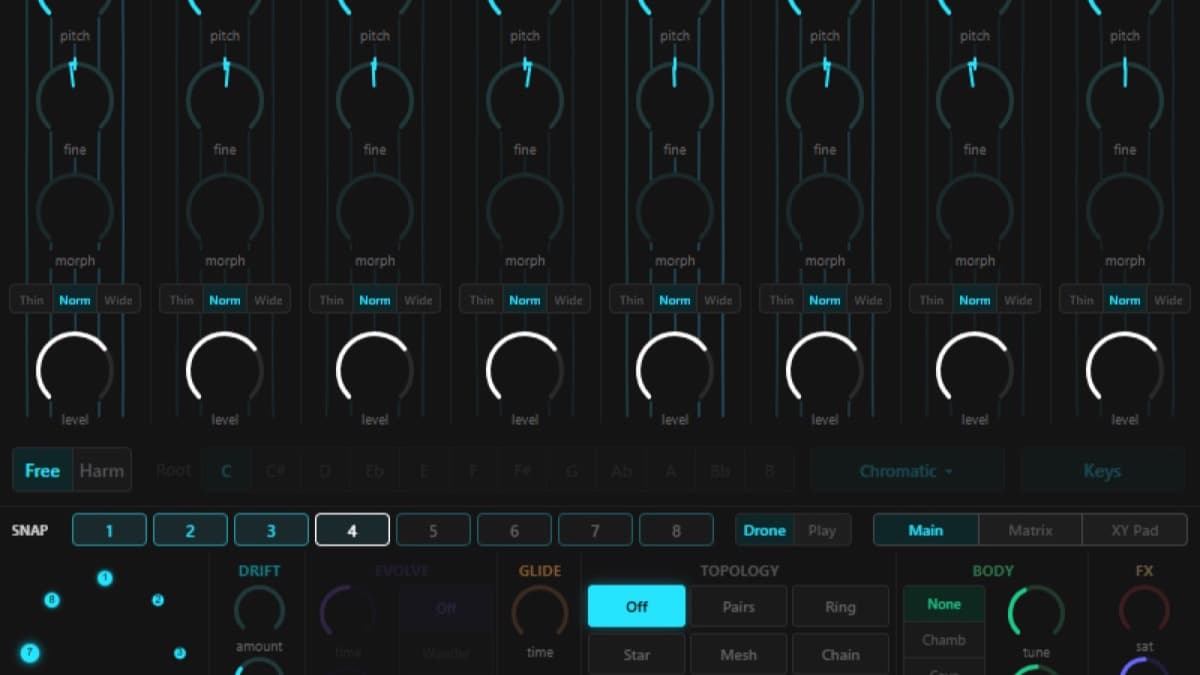
All The Machines has released The Remnant, an FM drone synthesizer built around eight voices that feed back into each other. It landed on 25 September 2026 for desktop, with an iOS version in App Store review. The pitch is simple and unusual: patch eight FM voices through a matrix, then let the sound move on its own. This is a first look based on the official product page and All The Machines' own demo. We have not run it through a full session yet.
At a glance: The Remnant is a $19 intro drone synth, rising to $29 after the promotion. It runs as VST3, AU, CLAP, and standalone on macOS and Windows, with an iOS AUv3 build coming. Eight FM voices modulate one another through an 8x8 feedback matrix, run into one of four acoustic filters, and can drift and evolve without you touching a control. It's inspired by the SOMA Lyra-8 but uses its own synthesis structure.
What is The Remnant?
The Remnant sits in a small but growing corner of the market: instruments that make continuous, evolving drones rather than notes you play and release. The clearest reference is the SOMA Lyra-8, the cult hardware synth whose eight interacting voices produce shifting, organic textures. The Remnant chases that same feeling in software, with its own engine and control scheme rather than a straight clone.
What makes it interesting is how it treats routing as the main instrument. Most synths give you a fixed signal path and a modulation matrix bolted on the side. The Remnant makes the matrix the point. Eight FM voices can modulate each other in any combination, so the character of a patch comes from how the voices are wired together, not just from their individual settings. Change the topology and you change everything.
What The Remnant gives you
Eight FM voices with waveform morphing. Each voice moves continuously between sine, triangle, saw, and noise rather than switching between fixed shapes. That continuous morph is a big part of why the sound never sits still, because even a held drone keeps shifting timbre underneath.
An 8x8 feedback matrix with topology presets. This is where the instrument earns its character. Any voice can modulate any other, and a dedicated page lets you wire the whole thing by hand or start from presets called Pairs, Ring, Star, Mesh, Chain, and Random. Each topology gives a different feel: tight and paired, endlessly circulating, or chaotic. This is where the real sound design happens.
Four acoustic filters. The combined output runs through one of four resonant body filters named Chamber, Cave, Metal, and Void. They add a sense of physical space and resonance, turning a raw FM cluster into something that sounds like it is ringing inside an object.
Touch pads and playable voices. Eight touch pads let you play each voice individually with attack-release envelopes, much as you would strike the panel of a Lyra-8. There is also a touch XY surface with twelve assignable destinations and scale-aware pitch quantization across thirteen scales, so you can keep things musical when you want to.
Drift and Evolve for hands-off movement. A Drift engine adds organic pitch wandering, and the Evolve system mutates the patch on its own over anywhere from five seconds to ten minutes, with Wander, Breathe, and Decay modes. You can start a sound and walk away while it develops.
Morphing snapshots. Snapshots capture the entire state, voices, matrix, and effects, in eight slots, and you can glide smoothly between them over up to thirty seconds. That turns two saved sounds into a slow, controllable transition, which is exactly what long-form ambient and film work needs.
The Remnant specifications
| Spec | Detail |
|---|---|
| Type | FM drone synthesizer |
| Release | 25 September 2026 (iOS in review) |
| Voices | Eight FM voices with continuous waveform morphing |
| Routing | 8x8 feedback matrix with six topology presets |
| Filters | Four acoustic body filters (Chamber, Cave, Metal, Void) |
| Effects | Saturate (2x oversampled), Space, Air |
| Movement | Drift engine, Evolve system (5 sec to 10 min), morphing snapshots |
| Playability | Eight touch pads, XY surface, thirteen scales |
| Desktop formats | VST3, AU, CLAP, standalone (macOS 12+, Windows 10/11) |
| iOS | AUv3 plugin and standalone (iOS 17+, in review) |
| Price | $19 intro, then $29 |
The Remnant vs Vital
There is no exact plugin competitor, which is part of the appeal, so the useful comparison is against a capable general-purpose synth. Vital is free, does wavetable synthesis, and can be pushed into drones with enough patching. The Remnant is cheap, specialized, and designed to drone from the first second. The question is whether you want a tool that does everything or one that does this one thing without setup.
| The Remnant | Vital | |
|---|---|---|
| Type | Dedicated FM drone synth | General wavetable synth |
| Drone workflow | Built in, immediate | Possible, needs patching |
| Signature feature | 8x8 feedback matrix | Wavetable morphing and modulation |
| Self-evolving sound | Yes (Drift and Evolve) | Only via LFOs and modulation you build |
| Price | $19 intro, $29 after | Free (paid tiers add content) |
| Reach for it when | You want instant evolving texture | You want one synth for everything |
Which to pick. If you already own a do-everything synth and want a shortcut to living, evolving drones, The Remnant earns its low price fast. If you want a single flexible instrument and do not mind building your own movement, a synth like Vital or Pigments 6 covers more ground. Many sound designers will keep both.
Who The Remnant is for
Buy it if you score film, games, or ambient music and need textures that move on their own. The Evolve system and morphing snapshots are built for exactly that.
It's also a strong pick if you love the Lyra-8 idea but want it in the box, recallable and automatable, at a fraction of the hardware cost.
Skip it if you need conventional playable patches, chords, and leads. This is a texture and drone instrument first, and a keyboard synth a distant second.
How much does The Remnant cost?
The Remnant is $19 as an introductory price, rising to $29 once the launch promotion ends. That single desktop purchase covers macOS and Windows in one download, with VST3, AU, CLAP, and standalone formats. The iOS version, offered as an AUv3 plugin and standalone app for iOS 17 and later, is in App Store review at launch. It's sold directly by All The Machines.
For where this fits in a wider setup, our guide to the best free synth VSTs of 2026 covers the generalist options, and Zebra 3 shows what a deep modular-style synth brings if you want to build drones yourself.
FAQ
Is The Remnant a clone of the SOMA Lyra-8?
No. It's inspired by the Lyra-8's idea of eight interacting voices and hands-on drone playing, but it uses its own synthesis structure and control approach, including an 8x8 feedback matrix and morphing snapshots the Lyra-8 does not have.
What formats and systems does The Remnant support?
On desktop it runs as VST3, AU, CLAP, and standalone on macOS 12 and later and Windows 10 or 11. An iOS version with AUv3 and standalone support for iOS 17 and up is in App Store review.
Can The Remnant make sounds on its own?
Yes. The Drift engine adds organic pitch movement, and the Evolve system mutates a patch automatically over five seconds to ten minutes using Wander, Breathe, and Decay modes, so a drone keeps developing without any input.
Is The Remnant worth $19?
For anyone who works with ambient, drone, or cinematic texture, the feedback matrix and self-evolving sound are hard to get elsewhere at this price. If you only need conventional playable synth patches, a general-purpose synth is the better spend.