Some links on this page are affiliate links. If you buy through them, Dubspot may earn a commission at no extra cost to you. It never affects our scores or what we recommend — read our policy.
Vengeance Q4ntum: Three Delay Engines, One FX Plugin
Vengeance Q4ntum is a standalone multi-FX delay with three engines, 12 FX slots, 27 effects per slot, and 673 presets. Full specs, how it compares, and price.
M
Marcus Feld
September 12, 2026 · 8 min read
See full specs, price, and alternatives in the plugin database →
Vengeance Sound released VPS Q4ntum on September 11, 2026. It's a standalone multi-effect delay that pulls the Q4ntum engine out of the Avenger 2 synth and turns it into a plugin you can drop on any track. Three independent delay engines, a 12-slot effects architecture, and per-slot modulation sit in one window, backed by 673 presets. This breakdown works from the official Vengeance Sound specifications.
At a glance: €89, VST3, AU, and AAX (64-bit), Windows 11 and macOS 10.14 or later. You get three independent delay engines plus a master layer, 12 FX slots with 27 effects each, a tempo-synced step sequencer and n-point envelope modulation on every slot, a dedicated reverb, and 673 factory presets. Think rhythmic multi-FX processor, not simple echo.
What is Vengeance Q4ntum?
Q4ntum began life as the multi-FX delay section inside Vengeance Sound's Avenger 2, the company's flagship synth. Producers took to it, so Vengeance rebuilt it as a standalone effect. The same engine can now process drums, vocals, synths, or a full bus without loading Avenger.
The word delay undersells it. Q4ntum is closer to a modular rhythmic effects rack that happens to be built around delay lines. Each of its three engines can run as a delay, as a live FX chain, or both at once, and every parameter can be animated by a step sequencer or a drawn envelope locked to your DAW tempo. That puts it in the same conversation as creative delays like ValhallaDelay and modulation multi-FX like Kilohearts Multipass.
What Vengeance Q4ntum does, feature by feature
Three independent delay engines
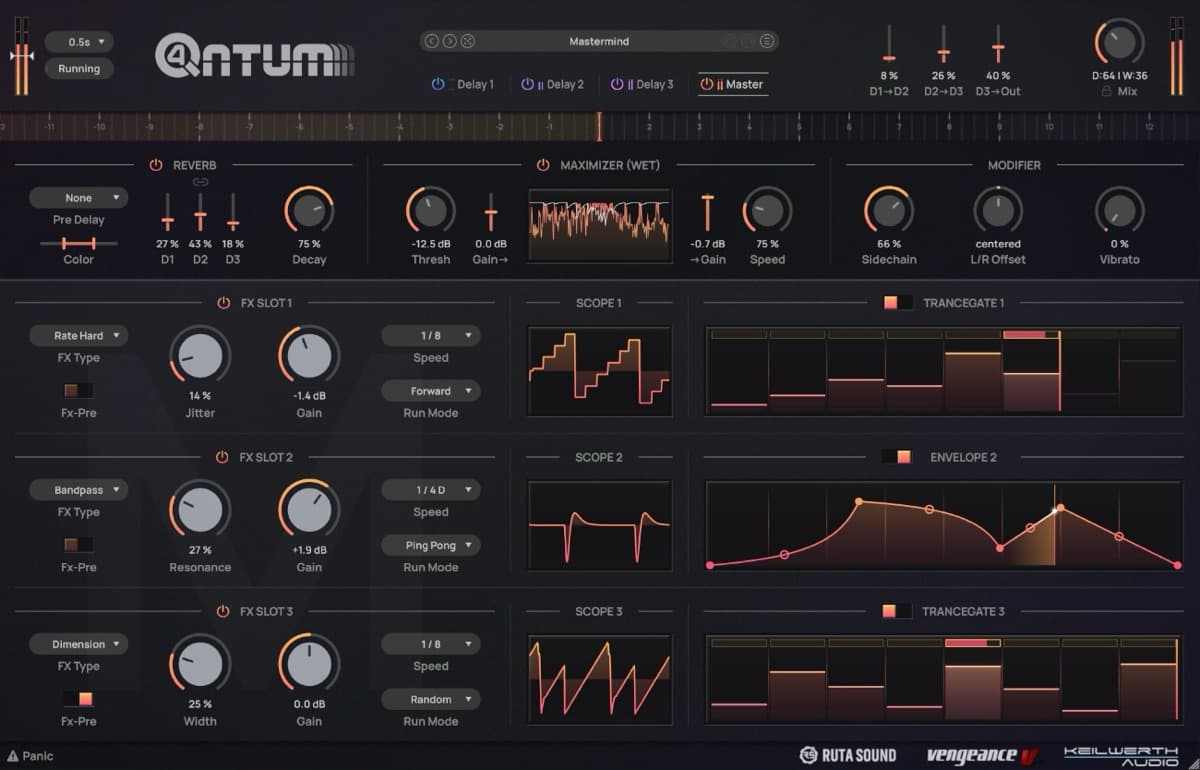
At the core sit three delay engines that work independently and route flexibly between each other. Each engine offers input strength, Normal, Ping-Pong, and Cross delay modes, delay time, and a feedback path with a dedicated feedback filter that Vengeance calls Ghost Q. Stereo drift and shift, plus per-engine vibrato, keep the repeats from sounding static. Run the three in parallel and you can build layered rhythmic patterns that no single delay line could produce.
Twelve FX slots, 27 effects each
Every engine carries three insert-effect slots, and the master layer adds three more, for 12 slots in total. Each slot can load any of 27 effects, so a single engine's feedback chain gets shaped completely on its own terms: distort one engine's repeats, filter another's, widen the third. The effects live inside the feedback path rather than after it, which is what pushes Q4ntum into sound-design territory. Every repeat can evolve as it decays.
Per-slot modulation: step sequencer and n-point envelope
Modulation is the feature that defines Q4ntum. Every FX slot has an integrated trancegate and envelope modulation, so any parameter can be driven by a tempo-synced step sequencer or a flexible n-point envelope, locked tight to the host. That's how you get gated, stuttering, rhythmically pumping textures without automating anything by hand. It's the same modulation logic that made the Avenger version popular.
FX Only mode and the master section
FX Only mode disables the delay while keeping the FX slots live, so each engine becomes an independent rhythmic multi-effect processor. On top of the engines sits a master layer with three more FX slots, a dedicated reverb that each engine routes into individually, a Wet Signal Maximizer for density and perceived loudness, master sidechain processing, and an Advanced Retrigger System with Live Play and DAW Sync modes. You get a complete signal path here, from source coloration through to a finished, reverberant, loud output.
673 factory presets
Q4ntum ships with 673 factory presets spanning delay, rhythmic, modulation, spatial, and sound-design categories. For a plugin this deep, the preset library doubles as a teaching tool. Reverse-engineering a preset is the fastest way to learn how the engines, slots, and modulators fit together.
Vengeance Q4ntum specifications
| Spec | Detail |
|---|---|
| Product | Vengeance Producer Suite Q4ntum |
| Type | Multi-effect delay / rhythmic FX processor |
| Processing layers | 4 (three delay engines + master layer) |
| FX slots | 12 (3 per engine + 3 on master) |
| Effects per slot | 27 |
| Delay modes | Normal, Ping-Pong, Cross |
| Feedback | Per-engine feedback with Ghost Q feedback filter |
| Modulation | Per-slot trancegate, tempo-synced step sequencer, n-point envelope |
| Master section | Reverb, Wet Signal Maximizer, sidechain, Advanced Retrigger (Live Play / DAW Sync) |
| Presets | 673 factory presets |
| Formats | VST3, AU, AAX (64-bit) |
| System | Windows 11 (Intel with AVX, OpenGL 3.2, 16GB RAM); macOS 10.14+ (Intel or Apple Silicon, 16GB RAM) |
| Price | €89 |
Vengeance Q4ntum vs ValhallaDelay
The obvious reference point is ValhallaDelay, the creative delay most producers already own. They aim at different corners of the same room.
| Vengeance Q4ntum | ValhallaDelay | |
|---|---|---|
| Developer | Vengeance Sound | Valhalla DSP |
| Engines | Three independent delay engines | One delay with multiple modes |
| FX architecture | 12 slots, 27 effects each, in the feedback path | Built-in modes (tape, BBD, ratio, etc.) |
| Modulation | Per-slot step sequencer and n-point envelopes | Global mod section (rate, depth) |
| Presets | 673 | Compact starting set |
| CPU footprint | Heavier, deep architecture | Light and efficient |
| Price | €89 | $50 |
Which to pick. Choose Q4ntum if you want rhythmic, heavily modulated, multi-layered delay and multi-FX that can carry a sound-design idea on its own. Choose ValhallaDelay if you want a gorgeous, efficient, easy-to-dial delay for everyday mixing at half the price. Producers who chase movement and complexity will reach for Q4ntum, while producers who want a fast, reliable echo will stay with Valhalla. If your taste runs to feedback-network sound design, FabFilter Timeless 3 is a third option worth a look.
Who Vengeance Q4ntum is for
Consider it if you build rhythmic, evolving effects, if you already enjoyed the Q4ntum FX inside Avenger 2, or if you want a single plugin that can turn a dry loop into a stuttering, gated, reverberant texture. Electronic producers, sound designers, and anyone who scores to picture will get the most out of the three engines and per-slot modulation.
Skip it if you mainly need a clean, simple delay to push a vocal back in a mix, or if you're on an older machine where a deep, modulation-heavy plugin will strain the CPU. The 16GB RAM requirement is a fair signal that this is a modern-machine tool.
How much does Vengeance Q4ntum cost?
Q4ntum is €89 as a standalone plugin in VST3, AU, and AAX formats. It's a one-time purchase, with no subscription and no separate hardware. Owners of Avenger 2 already have the engine inside that synth, but the standalone version is what lets you run it on any channel in any project.
Check price on Best ServiceFAQ
Is Vengeance Q4ntum the same as the Q4ntum FX in Avenger 2?
It's the same engine, rebuilt as a standalone plugin. Avenger 2 owners already have the FX inside that synth, but the standalone Q4ntum runs on any track without loading Avenger, so you can process drums, vocals, or a full bus with it.
Vengeance Q4ntum vs ValhallaDelay: which should I buy?
They solve different problems. Q4ntum is a deep, three-engine, heavily modulated multi-FX delay for rhythmic sound design at €89. ValhallaDelay is a light, efficient, beautiful everyday delay at $50. Many producers own both; if you can only pick one, choose by whether you want complexity or simplicity.
What are the system requirements for Q4ntum?
It runs on Windows 11 (Intel with AVX, an OpenGL 3.2 GPU, and 16GB RAM) and macOS 10.14 or later (Intel or Apple Silicon, 16GB RAM), in VST3, AU, and AAX at 64-bit. There is no standalone application.
Does Q4ntum only do delay?
No. In FX Only mode the delay is disabled and each engine works as an independent rhythmic multi-effect processor, using its three FX slots and per-slot modulation. With 27 effects per slot, it doubles as a modulation and distortion multi-FX rack even when no echo is involved.
The bottom line
Q4ntum takes one of the most popular corners of Avenger 2 and sets it free. Three independent delay engines, 12 FX slots with 27 effects each, and per-slot step-sequencer and envelope modulation add up to a rhythmic multi-FX machine that goes far past what most producers picture when they hear the word delay. Reach for something simpler when you just want a quick, clean echo, and expect to spend real time learning this one. But at €89 for this much sound-design range, it earns a spot next to a workhorse delay rather than replacing one.