UDO DMNO ON: The Desktop DMNO With Expandable Control
UDO DMNO ON puts the full 8-voice, 2-part DMNO engine in a desktop box with an expandable ONM control system, binaural analog filters and eight Play Modes.
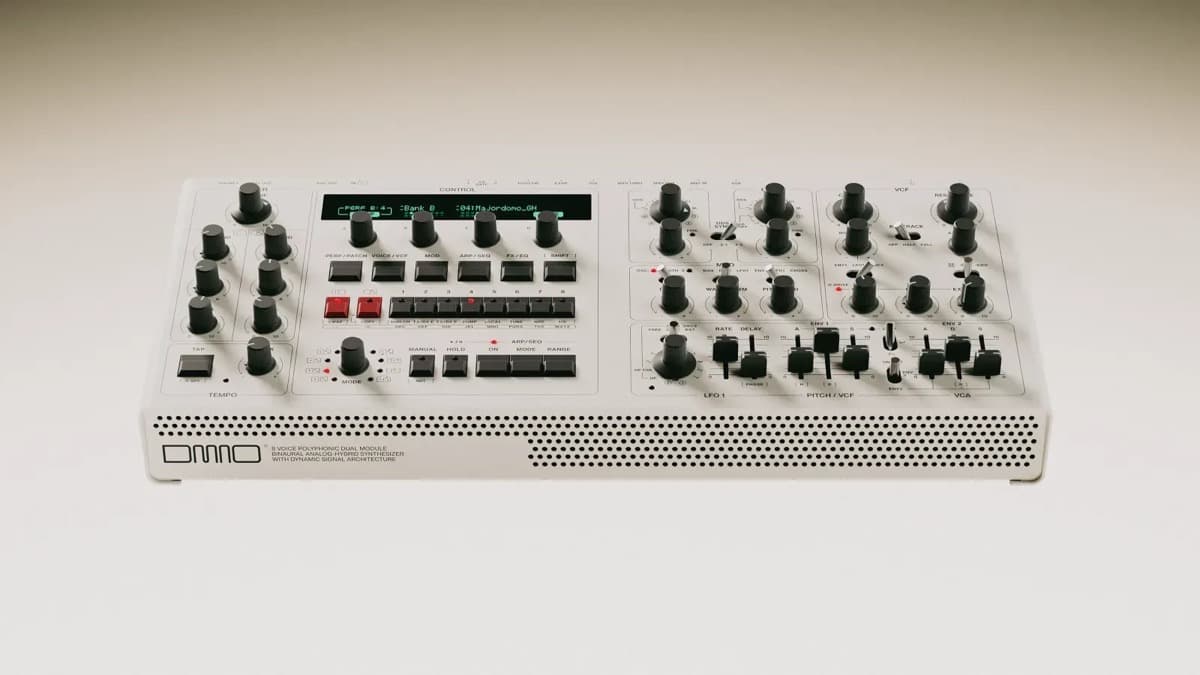
UDO Audio announced the DMNO ON on 6 October 2026. It takes the full 8-voice, 2-part multitimbral engine from the DMNO keyboard and drops it into a compact desktop box. From there you bolt hands-on control back on through a new system of plug-in panels called ON. This is a first look based on UDO Audio's official DMNO ON page and the company's launch video, not a hands-on review.
At a glance: DMNO ON is the keyboard DMNO without the keys. You still get two independent hybrid synthesizers, FPGA digital oscillators feeding per-voice analog Dynamic Multi-Core Stereo filters, 8 voices (4 in binaural mode), eight Play Modes, a sequencer, an arpeggiator and a full studio I/O set. The base unit ships with a single streamlined control set. Optional ONM expander modules add the controls back where you want them. UK launch pricing is around £2,099 for the base unit and £659 for the first expander. See the official DMNO ON page for your local dealer.
What is UDO DMNO ON?
UDO Audio is the Bristol company behind the Super 6 and Super Gemini, binaural analog-hybrid synths that built the brand's reputation for a wide, three-dimensional sound. The DMNO arrived in 2026 as something louder and more playful. It packs two complete synthesizers into one chassis, a stereo analog filter design UDO calls the Dynamic Multi-Core Stereo VCF, and a Play Modes system that reconfigures the whole instrument from a single control.
DMNO ON is the desktop edition of that instrument. It keeps every part of the synthesis engine and removes only the keybed. In its place UDO introduces the ON system: a base desktop unit with one control set, plus optional expander panels that clip on to rebuild the layout you prefer. If you sequence from a DAW or play from an existing controller, the base unit is the whole synth. If you want to turn knobs, you add the panels that matter to you.
What DMNO ON actually does
The two synthesizers sit at the centre of the design. UDO calls them DMNO 1 and DMNO 2, and each is a complete voice with its own oscillators, filter, modulation and effects. Both are driven by high-resolution FPGA digital oscillators, then routed into the stereo analog filter. You can run them as one bigger instrument or as two separate timbres.
The ON system: build the controls you need
The headline idea here is modular control rather than modular sound. The base DMNO ON carries the complete 8-voice, 2-part engine but exposes one streamlined control set. From there you expand. The ONM-1 Synth Control adds a second synth panel, so you get hands-on control of both DMNOs at once and recreate the dual-panel layout of the keyboard model. It is listed as available at launch. The ONM-2 FX Control breaks out the onboard effects and the 3-band EQ, with its own LED readouts, and is listed as coming soon. The panels connect over a screw-locking D-Sub cable, draw no separate power, and UDO says more ONM units are planned. The result is that two players who both own DMNO ON can end up with very different desks.
Eight Play Modes
Play Modes are how the two engines talk to each other, and you switch between them from a single control. There are eight:
- Single plays one DMNO.
- Dual plays both at once.
- Split divides the keyboard range between DMNO 1 and 2.
- One-Two sends the first key press to DMNO 1 and the following notes to DMNO 2.
- Rotate alternates between the two engines note by note.
- Random picks DMNO 1 or 2 at random.
- Chaos adds curated note randomisation on top of the random engine choice.
- Cascade feeds DMNO 1's audio into DMNO 2's oscillator mixer, so one engine becomes a complex oscillator for the other.
Splits and layers are familiar. Rotate, Chaos and Cascade are the reason this gets interesting, because they turn a two-part synth into a patch that behaves differently every time you play it.
The filters and the binaural path
Each engine runs a Dynamic Multi-Core Stereo filter. The twin analog filters use a reconfigurable voltage-controlled topology and can sit in series, parallel or stereo, and each arrangement opens up its own set of filter modes, from recognisable shapes to experimental ones. The binaural architecture is the UDO signature. In binaural mode each channel, left and right, gets a full synthesizer voice, so you can detune and de-phase the two sides against each other for width and a sense of 3D placement. That design choice is why the voice count reads as 8 standard or 4 super voices in binaural mode.
Connectivity, effects and the display
DMNO ON is built to live in a studio. It has a 2-in 2-out 24-bit USB class-compliant audio interface, so it connects straight to a computer. The analog I/O includes a stereo external input with a variable-gain preamplifier, a gate level detector and an envelope follower that feeds the modulation matrix. Outside audio can both pass through the filters and modulate the synth. There are two assignable CV and gate or clock outputs on 3.5mm jacks, and a stereo auxiliary output that can carry DMNO 1 or 2, USB audio from the host, or the effects send bus.
The effects engine is a 32-bit DSP chain with delay, reverb, EQ, overdrive distortion and chorus. Everything is shown on a high-contrast electroluminescent glass vacuum fluorescent display with a wide viewing angle, and UDO has deliberately kept parameters on the surface rather than buried in menus. A multi-mode arpeggiator with a smart hold and a sequencer round out the performance side, and the whole thing is VESA compatible so it can sit on a monitor arm.
DMNO ON specifications
| Spec | Detail |
|---|---|
| Type | Desktop analog-hybrid synthesizer, 2 independent engines |
| Developer | UDO Audio |
| Voices | 8, or 4 super voices in binaural mode |
| Multitimbral | 2-part (DMNO 1 and DMNO 2) |
| Oscillators | High-resolution FPGA digital oscillators (Super-Wave) |
| Filters | Per-voice Dynamic Multi-Core Stereo analog VCF, series / parallel / stereo modes |
| Play Modes | 8: Single, Dual, Split, One-Two, Rotate, Random, Chaos, Cascade |
| Modulation | Envelope follower and external audio input into the mod matrix |
| Sequencer | Onboard sequencer plus multi-mode arpeggiator with smart hold |
| Effects | 32-bit DSP: delay, reverb, EQ, overdrive distortion, chorus |
| Display | Electroluminescent glass vacuum fluorescent display (VFD) |
| Audio interface | 2-in 2-out 24-bit class-compliant USB |
| Analog I/O | Stereo external input with preamp, gate detector, envelope follower; stereo aux out |
| CV | Two assignable CV and gate/clock outputs (3.5mm) |
| Control expansion | ONM-1 Synth Control (at launch), ONM-2 FX Control (coming soon), D-Sub connection |
| Mounting | VESA compatible, flip-up rear feet |
| Format | Desktop hardware, no keyboard |
DMNO ON vs the DMNO keyboard vs Hydrasynth Desktop
The first question most buyers ask is whether to get DMNO ON or the keyboard DMNO. The second is how a boutique desktop at this price compares to the obvious affordable desktop poly, the ASM Hydrasynth Desktop. Here is how the three line up.
| DMNO ON | DMNO (keyboard) | ASM Hydrasynth Desktop | |
|---|---|---|---|
| Format | Desktop, expandable panels | 49-key keyboard synth | Desktop with pads |
| Engine | Analog-hybrid, FPGA osc into analog VCF | Same engine | Digital wavetable |
| Voices | 8 (4 binaural), 2-part | 8 (4 binaural), 2-part | 8, mono-timbral |
| Hands-on control | One set, add ONM panels | Full dual panel built in | Full panel built in |
| CV / audio interface | CV out, USB audio interface | CV out, USB audio interface | CV I/O, class-compliant USB |
| Launch price | ~£2,099 base, ONM-1 ~£659 | £2,499 / €2,969 / $3,500 | ~£641 street |
| Best when | You sequence or play from a controller and want to grow the controls | You want the keys and the full layout in one piece | You want an affordable, flexible digital poly |
Pick DMNO ON if you already own a keyboard or sequence from a DAW, and you like the idea of paying for the control surface in stages. Pick the keyboard DMNO if you want to sit down and play the complete instrument with no decisions to make. Pick the Hydrasynth Desktop if the budget is the deciding factor and you want a deep digital synth rather than an analog-filtered hybrid. The two sit in very different price brackets and sound worlds. For more desktop and keyboard options across price points, see our best hardware synthesizers guide.
Who DMNO ON is for
DMNO ON suits producers who work mostly in a DAW and want a characterful hybrid synth as an outboard voice. It also fits players who already have a master keyboard and do not want to pay for another one, and anyone drawn to the idea of shaping the control surface over time instead of buying it all at once. The binaural filters and the Play Modes make it a strong sound-design instrument, not a preset box, and the built-in audio interface and external input make it easy to fold into a small setup.
It is less obvious for players who want to perform standing at a keyboard, since there is no keybed. It is also awkward for anyone who wants every knob in front of them on day one, because the full dual layout means buying the base unit and the ONM-1 together. This is a premium boutique instrument, so it is not the pick if you need the most synth per pound. That is where a digital desktop poly like the Hydrasynth wins on price.
How much does DMNO ON cost?
UDO's own page lists dealers rather than prices, so treat the following as launch figures and confirm your local price through the Find a Dealer link. At launch, UK pricing is around £2,099 for the DMNO ON base unit and around £659 for the ONM-1 Synth Control. The ONM-2 FX Control is listed as coming soon, with pricing to follow. For reference, the keyboard DMNO launched at £2,499, €2,969 and $3,500. The desktop base unit comes in below the keyboard before you add any panels, and roughly matches it once you add the ONM-1 to rebuild the full layout.
Because DMNO ON is brand new, the major online retailers were still listing only the keyboard model at the time of writing. Buy through a UDO dealer, and check our plugin and gear database entry for the running spec sheet.
FAQ
What is the difference between DMNO ON and the DMNO keyboard?
They share the exact same synthesis engine: 8 voices, 2-part multitimbral, FPGA oscillators, the Dynamic Multi-Core Stereo analog filters and the eight Play Modes. The keyboard DMNO is a 49-key instrument with the full dual control panel built in. DMNO ON is a desktop box with no keys and a single control set that you expand with optional ONM panels. Choose on the basis of whether you want keys and a fixed layout, or a smaller footprint and modular control.
What are the ONM expander modules?
ONM units are control panels that clip on to the DMNO ON base unit over a screw-locking D-Sub cable and need no separate power. The ONM-1 Synth Control adds a second synth panel so you can control both engines at once, and it is available at launch. The ONM-2 FX Control breaks out the effects and the 3-band EQ with its own LED display, and is listed as coming soon. UDO says more ONM modules are planned.
Is DMNO ON multitimbral?
Yes. It is 2-part multitimbral, with two independent synthesizers that you can layer, split or combine through the Play Modes. In binaural mode the eight voices pair into four super voices, giving each a full left and right synth path for width.
Does DMNO ON have a USB audio interface?
Yes. It includes a 2-in 2-out 24-bit class-compliant USB audio interface, plus a stereo external audio input with a preamp, a gate detector and an envelope follower, two assignable CV and gate outputs, and a stereo aux output.
When is DMNO ON available and how much is it?
UDO announced DMNO ON on 6 October 2026. Launch pricing is around £2,099 for the base unit and around £659 for the ONM-1. Pricing and stock vary by region, so use the Find a Dealer link on the official DMNO ON page.
DMNO ON answers a real question: how do you sell a two-part boutique synth to people who sequence rather than play keys, without stripping out the character? UDO keeps the whole engine and lets you buy the control surface in pieces. If you liked the DMNO but never needed the keyboard, this is the version to watch. Start with the official DMNO ON page, and compare it with the stage-focused Arturia AstroLab and the software-recreated classics in our Cherry Audio Pentaphonic first look.