Inside Synthesizer V Studio 2 Pro, Dreamtonics' Vocal AI
Synthesizer V Studio 2 Pro is Dreamtonics' offline neural vocal synth: six-language cross-lingual singing, AI retakes, VST3/AU/AAX/ARA, $99 with one voice.
Dubspot's best Black Friday dealsDubspot Tracker Pro: $15, was $24.99 ↗Drum Programming and Groove Production Course: $19, was $99 ↗
Synthesizer V Studio 2 Pro is Dreamtonics' flagship vocal synthesizer, and it's quietly become the tool most producers mean when they say "AI vocals." It turns typed notes and lyrics into a sung performance, runs its neural engine entirely on your own computer, and keeps every parameter under your hand. With Yamaha's VOCALOID7 arriving this month, it's worth a close look at the benchmark it competes against.
At a glance: Synthesizer V Studio 2 Pro is a neural singing synthesizer for macOS and Windows. It runs standalone or as a VST3, AU, AAX, or ARA plugin, sings cross-lingually across six languages, and renders offline with no cloud account. The Pro edition is a one-time $99 and includes one voice of your choice, with a free 14-day trial and more than 100 add-on voices from $79 each.
What is Synthesizer V Studio 2 Pro?
Synthesizer V began more than a decade ago as an attempt to fix the thin, robotic tone of early singing synthesizers. The breakthrough was a fully neural engine that could capture the acoustic complexity of a real voice while still letting you edit every note, slur, and breath. The result is an instrument that sits between a sampler and a session singer: you write the part, pick a voice, and the engine performs it.
Two things set it apart from the AI song generators in the headlines. First, it's an instrument, not a prompt box. You're not asking it to invent a song; you're playing it like any other virtual instrument and shaping the output. Second, it runs offline. The deep-learning engine lives on your machine, so there's no upload, no queue, and no subscription. Dreamtonics also leans on an ethical-AI stance: every voice is built from licensed recordings of real professional singers rather than scraped audio.
It shares a lineage with Dreamtonics' other tools. Instrument X applies similar modeling to instrumental sound, and our Instrument X first look covers that side of the house.
What Synthesizer V Studio 2 Pro does
The engine combines physics-inspired voice signal processing with a deep neural network trained on singing samples. In practice, that means the voices phrase, slur, and breathe in a way that reads as a performance rather than a line of text read aloud. Live rendering shows every edit the moment you make it, with no batch wait, so adjusting a note or a vibrato depth is instant.
Cross-lingual singing is the standout. You can input lyrics in English, Japanese, Mandarin, Cantonese, Spanish, or Korean, and even mix languages inside a single line, while keeping one voice's identity throughout. That's a wider reach than most rivals, and a real advantage for producers working across markets.
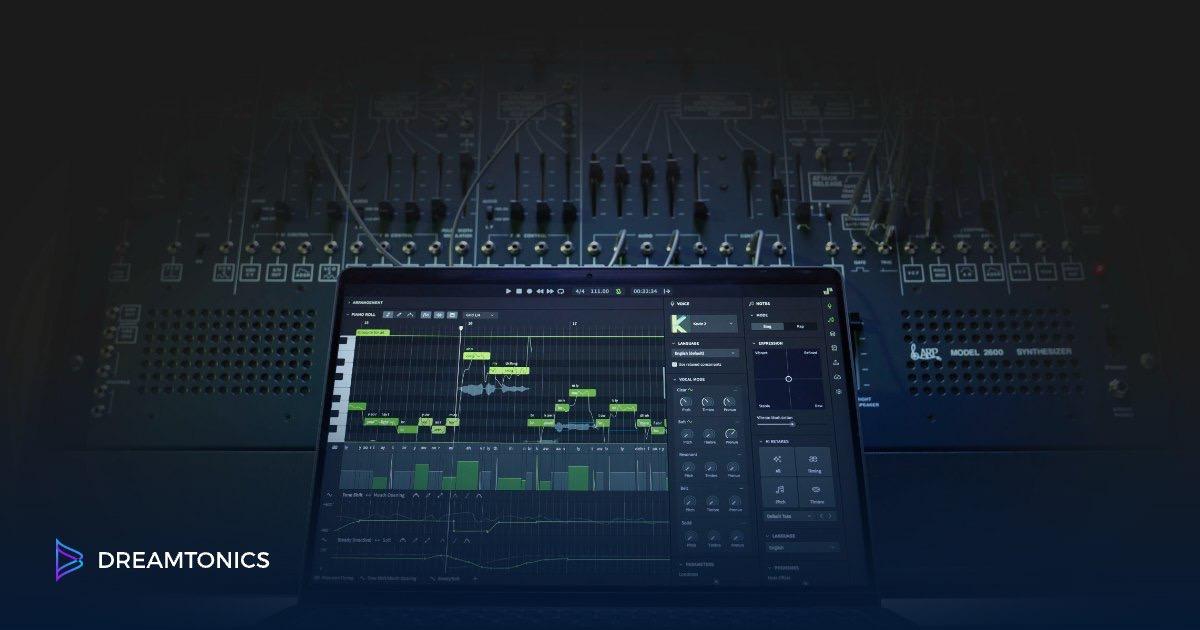
The editing depth is where it earns the Pro name. AI Retakes generate fresh takes of pitch, timbre, and timing so you can audition alternative performances of the same phrase and keep the best. Dynamic Vocal Modes shift a voice between registers and intensities. Beyond that sit a stack of fine controls: pitch deviation, vibrato, gender, breathiness, mouth opening, consonant and vowel strength, and a phoneme timing panel for syllable-level placement. You draw notes like any instrument, copy phrases between projects, and export finished audio to WAV, FLAC, or MP3 with full commercial licensing on most voices. Dreamtonics has continued to ship free updates to the version 2 line through 2026, improving rendering speed and tightening the workflow.
Synthesizer V Studio 2 Pro specifications
| Spec | Synthesizer V Studio 2 Pro |
|---|---|
| Type | Neural singing synthesizer (notes and lyrics to vocals) |
| Engine | Fully neural, physics-inspired, runs offline |
| Languages | English, Japanese, Mandarin, Cantonese, Spanish, Korean, mixable |
| Key tools | AI Retakes, Dynamic Vocal Modes, phoneme timing, pitch and vibrato control |
| Rendering | Live and offline, no cloud account required |
| Formats | Standalone, VST3, AU, AAX, ARA |
| Platforms | macOS and Windows |
| Export | WAV, FLAC, MP3, with full commercial licensing on most voices |
| Voices | 100+ available, each built from licensed professional singers |
| Price | $99 one-time, includes one voice; voices from $79 |
Synthesizer V Studio 2 Pro vs VOCALOID7
The natural comparison is Yamaha's VOCALOID7, released this month and the other name that defines the category.
| Synthesizer V Studio 2 Pro | Yamaha VOCALOID7 | |
|---|---|---|
| Price | $99, one voice included | $129, upgrade from $39 |
| Languages | Six, mixable in a line | Japanese, English, Chinese |
| Rendering | Fully offline neural | Second-gen VOCALOID:AI |
| Formats | Standalone, VST3, AU, AAX, ARA | Standalone, VST3, AU, ARA2 |
| DAW integration | ARA in supported hosts | Native in Cubase, ARA2 elsewhere |
| Voices | 100+ from $79 | VOCALOID voice banks, from $90 |
The choice comes down to ecosystem. VOCALOID7 is the better buy for Cubase users and anyone invested in the VOCALOID catalog, since it drops notes and lyrics straight into the Key Editor and reads voice banks going back to VOCALOID3. Our VOCALOID7 first look covers that integration in full. Synthesizer V Studio 2 Pro wins on reach and value: it's cheaper, covers twice as many languages, adds an AAX build for Pro Tools, and its AI Retakes make iterating on a performance faster. For processing a real recorded vocal into robotic or vocoded textures, which neither tool is built for, iZotope VocalSynth 2 is the different instrument.
Who Synthesizer V Studio 2 Pro is for
This is the pick for producers, composers, and songwriters who want sung vocals without booking a studio, whether for finished tracks, demos, reference vocals for a session singer, or backing-vocal stacks. The cross-lingual reach makes it especially strong for anyone releasing across languages, and the deep controls let vocalists and sound designers push beyond a human range into custom textures and vocal chops.
It's a weaker fit if you simply want a finished song from a text prompt, since you build the performance note by note yourself. It also asks for some learning: drawing convincing phrasing and dialing in the parameter controls takes practice, and a producer who never touches vocals may not need this depth. Cubase users who already own VOCALOID banks may find VOCALOID7 the more natural home.
How much does Synthesizer V Studio 2 Pro cost?
The Pro edition is a one-time $99 and includes one voice database of your choice, with no subscription and offline activation. A free 14-day trial unlocks most Pro features with no credit card. More than 100 voices are available from $79 each, and bundles bring the cost down: Pro with an extra voice is $149, and Pro with the Vocoflex voice-morphing tool is $249. You own what you buy and can keep creating offline.
Check price on Plugin BoutiqueFAQ
Is Synthesizer V Studio 2 Pro an AI song generator?
No. It's a vocal instrument you play by entering notes and lyrics, then shaping the performance with detailed controls. It doesn't invent songs from a text prompt. The neural engine runs offline on your computer.
How many languages can it sing?
Six: English, Japanese, Mandarin, Cantonese, Spanish, and Korean. You can mix languages within a single line while keeping the same voice identity.
Synthesizer V Studio 2 Pro vs VOCALOID7, which should I pick?
Pick Synthesizer V Studio 2 Pro for lower cost, more languages, an AAX build, and fast AI Retakes. Pick VOCALOID7 if you work in Cubase or own VOCALOID voice banks, where its native integration and catalog pay off.
Does it need an internet connection?
Only the free trial and initial setup touch the internet. The full version renders offline, so once installed you can write and export vocals with no connection.
The verdict
This is a first look based on Dreamtonics' official materials, not a hands-on review. On specs, Synthesizer V Studio 2 Pro reads like the current benchmark for sung AI vocals: a fully offline neural engine, six-language cross-lingual singing, deep per-note control, and AI Retakes that make iteration quick, all for a one-time $99 with a voice included. Against the fresh arrival of VOCALOID7, it holds the value and reach advantage, while VOCALOID7 answers for Cubase and VOCALOID loyalists. If you want vocals you can direct rather than vocals a server guesses at, this is the instrument to try first, and the free trial makes that easy.


