Some links on this page are affiliate links. If you buy through them, Dubspot may earn a commission at no extra cost to you. It never affects our scores or what we recommend — read our policy.
Dreamtonics Instrument X: Orchestra Without a Sample Library
Dreamtonics Instrument X models an orchestra without samples. Expansions $99, Complete Collection $649. Specs, Pick and Mix pricing, and who should buy.
M
Marcus Feld
August 28, 2026 · 11 min read
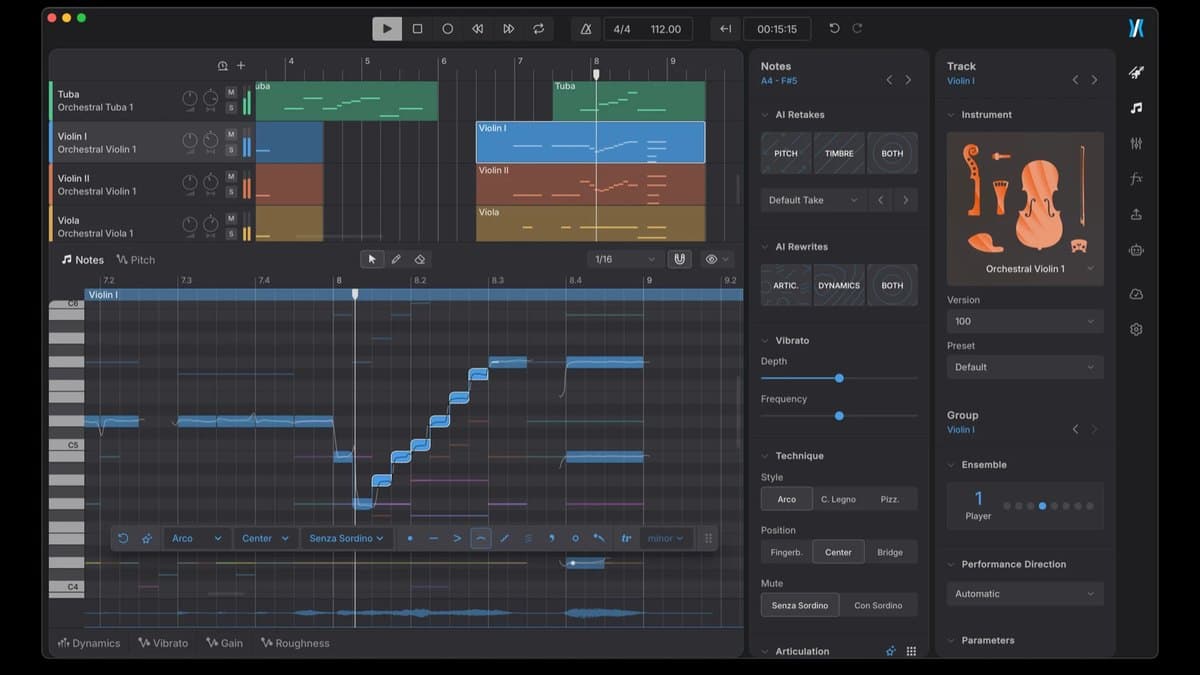
Dreamtonics shipped Instrument X on 26 August 2026. It's a neural acoustic-modeling platform for orchestral writing rather than a sample library, and the thing you actually buy is an Instrument Expansion. The host editor comes free with any of them. This is a first look at the shipping catalog. We have not used it in a session.
At a glance: the host and editor are free with any expansion. Individual expansions run $99, Orchestral Strings $249, Orchestral Woodwinds $279, Orchestral Brass $249, Orchestral Essentials $349, and the Complete Collection 2026 $649. VST3, AU, AAX, and standalone, with a 14-day editor trial and 7-day expansion trials. Buy it from Plugin Boutique or the Dreamtonics Store.
What Instrument X is
A conventional orchestra library streams recorded takes from disk. You keyswitch through longs, shorts, and swells, you wait on the load, and you live with whatever room got captured. For a sampled counterpoint, Sinphonica Maestosa Strings is IK Multimedia's symphonic string library with PALCO 3D stage placement.
Instrument X computes the performance while you write. Dreamtonics trained the models on licensed session playing, and the engine generates bow, breath, and key behavior from the notes you enter. Articulation follows pitch and length, dynamics follow the phrase, and the whole thing renders locally without a GPU or a cloud call.
This is the company behind Synthesizer V, now pointed at instruments instead of voices. Instrument X stands as its own platform next to Synthesizer V Studio 2 Pro and Vocoflex, so the workspace will feel familiar if you already write vocals there. The engine underneath is new. The current first look is Jas-i Khorlo.
It isn't a sampler, and it won't write the arrangement for you. You still enter every note, and the network's job stops at modeling the instrument.
For a sampled symphony with a real hall, see BBC Symphony Orchestra. For polyphonic physical modeling aimed at live ensembles, see Audio Modeling PolySWAM, and Pianoteq 9 is the modeled-piano version of the same idea.
How the editor works
The host is the session and the expansions are the players. You get sound only once at least one expansion is licensed or running on trial.
Unified Articulation Editor
Staccato, legato, and tenuto sit in one panel alongside instrument-specific techniques: string col legno, brass mutes, flute harmonics, clarinet and bassoon falls. You can stack techniques on a single note, so a violin line can be arco and then col legno on the same pitch, and a trumpet takes a mute without loading a second patch.
Traditional libraries keep those apart because they're separate recordings. Here the model is continuous, so blending becomes a performance choice instead of a keyswitch map.
Smart Articulation picks techniques from pitch and note length: drop MIDI, let the engine phrase it, then override the notes that matter. The manual lane is still there when the automatic choice is wrong.
Predictive Dynamics Lane
Dynamics aren't only gain here. The official brief is that the curve changes timbre, harmonic saturation, and the physical response of the model, so a louder violin is a different bow rather than a louder sample.
The lane reads context from pitch, duration, and phrase flow, and you can override it anywhere. That's what separates a mockup that breathes from one that simply gets quieter at the bar line.
AI Performance Retakes
Retakes generate another take of a selected phrase. You can reroll a whole section or target one vector: timbre drift, micro-pitch, vibrato, or intensity. It's an audition tool, not a way to invent new notes.
Use it when a line is correct on paper and stiff in the air.
Polyphony and unison
Overlapping notes render as separate voices, so chords don't cut each other off mid-bar. Unison goes to 16 voices, which means a solo expansion can thicken into a section without a second track.
That's the sketching argument in one feature: one violin expansion, one MIDI clip, a small ensemble. For a finished recorded section with real desk noise, you'll still want a sampled library.
Microphone mixer
Each expansion was captured on 8 to 11 mics covering spot, Decca tree, and room pairs, and the mixer balances those modeled feeds. Close positions suit pop, the tree suits score work, and the room pairs buy width.
MusicXML and performance instructions
MusicXML import keeps tempo, meter, articulations, and dynamics from any app that writes the format.
Five global performance instructions restyle the session from one control:
- Adagio: slow, swelling, high expression
- Allegro: fast, agile lines
- con Fuoco: aggressive, high-tension blocks
- Pop: commercial and rhythmic
- Ballade: soft contemporary backings
They're mutually exclusive. Pick one mood for the pass, then edit the notes that fight it.
The 15 launch expansions
Launch day covers 15 Instrument Expansions across strings, woodwinds, brass, and sax.
Orchestral Strings Collection ($249): Violin 1, Viola 1, Cello 1, and Contrabass 1, with pizzicato, col legno, sul ponticello, sul tasto, and modeled con sordino.
Orchestral Woodwinds Collection ($279): Flute 1, Piccolo 1, Oboe 1, Clarinet 1 (A), and Bassoon 1, with breath dynamics, register transitions, inhalation triggers, flute harmonics, and clarinet and bassoon falls.
Orchestral Brass Collection ($249): Trumpet 1 (Bb), Trombone 1, French Horn 1, and Tuba 1, with breath tracking, trombone portamento, horn stopped notes, and modeled straight, cup, and harmon mutes on trumpet and trombone.
Jazz sax, sold as singles: Jazz Alto Saxophone 1 and Jazz Tenor Saxophone 1, which sit in the Complete Collection rather than in the three orchestral boxes.
Orchestral Essentials ($349): a fixed eight-piece core of Violin 1, Viola 1, Cello 1, Contrabass 1, Flute 1, Oboe 1, Trumpet 1 (Bb), and French Horn 1, which is the traditional sketching band.
Complete Collection 2026 ($649): the host plus all 15 launch expansions, including both saxes and the three family collections.
Each expansion runs about 160 MB, which is the disk argument against a 28 GB Core orchestra.
Instrument X specifications
| Spec | Detail |
|---|---|
| Developer | Dreamtonics |
| Type | Neural acoustic-modeling instrument platform |
| Formats | VST3, AU, AAX, standalone. ARA in supported DAWs |
| OS | Windows 11, macOS 11.0+ |
| CPU | Intel Core i3-8100, AMD Ryzen 5 1600, or Apple Silicon (M1+) |
| RAM | 8 GB |
| Disk | About 160 MB per Instrument Expansion |
| Offline | Local render. No dedicated GPU. License needs a first-time login |
| Launch content | 15 Instrument Expansions (strings, woodwinds, brass, two saxes) |
| Host price | Free with any expansion or bundle |
| Single expansion | $99 |
| Strings / Brass | $249 each |
| Woodwinds | $279 |
| Orchestral Essentials | $349 (8 fixed expansions) |
| Complete Collection 2026 | $649 |
| Trial | 14-day editor, 7-day expansions, 150 notes per group, no bounce |
| Refund | 7-day full refund on the Dreamtonics Store |
| Buy | Plugin Boutique or Dreamtonics Store |
Instrument X vs BBCSO vs PolySWAM
| Instrument X | BBCSO Core | PolySWAM | Hollywood Orchestra | |
|---|---|---|---|---|
| Job | Modeled orchestra you write like notation | Sampled BBC Symphony Orchestra | Polyphonic SWAM ensembles | Sampled film orchestra |
| Street / list | $99 per expansion, $649 complete | £399 on our BBCSO card | $279 preorder / $399 | $499+ on our Hollywood card |
| Engine | Neural acoustic modeling | Recorded orchestra | Physical modeling + voice allocation | Recorded sections |
| Disk | About 160 MB per instrument | About 28 GB for Core | Desktop modeled instrument | Large library |
| Articulation | Pitch, length, stacked techniques | Keyswitches and sampled patches | Playing-driven SWAM | Keyswitches and mics |
| Best for | Fast, small-install orchestral writing | Finished mockups in a real hall | Live and sketch ensembles | Picture work that needs a recorded room |
Which to pick. Instrument X makes sense when you want strings, winds, or brass on a laptop without building a sample template. Go to BBCSO when the cue has to sound like that orchestra in that room. PolySWAM fits when the gesture is a live ensemble under your hands and you already trust SWAM. Hollywood Orchestra wins when the brief is a film-library sound rather than a modeled one.
Forma Labs Filament is a different product: it voices one keyboard across plugins you already own, and it doesn't model the instruments itself.
Who Instrument X is for
Consider it if you write to picture or to a piano sketch and you want acoustic color in the first pass, without waiting on a 20 GB load.
Consider it if you already work in Synthesizer V and you want instruments in the same ecosystem. The Producer's Bundle is $229 (Synthesizer V Studio 2 Pro, 1 Voice, Instrument X, and 1 expansion), and the Trilogy Bundle is $499 (those two plus Vocoflex, any 2 Voices, and any 2 expansions).
Consider it if one section is enough. A single Violin 1 at $99 is a complete product, so you don't have to buy the orchestra.
Skip it if your mockups live or die on a specific recorded hall, mic tree, and section noise. Buy BBCSO or Hollywood Orchestra instead.
Skip it if you need percussion, choir, or a piano, because launch day is strings, woodwinds, brass, and two saxes.
Skip it if you expected a free orchestra. The editor is free and the sound lives in the expansions.
How much Instrument X costs
Street prices as of 28 August 2026 match on the Dreamtonics Store and Plugin Boutique.
- Host / editor: free with any expansion
- Any one Instrument Expansion: $99
- Orchestral Strings Collection: $249
- Orchestral Brass Collection: $249
- Orchestral Woodwinds Collection: $279
- Orchestral Essentials: $349
- Complete Collection 2026: $649
Pick & Mix lives on the Dreamtonics Store, and the discount applies as you stack singles in the cart:
| Bundle | List | Price |
|---|---|---|
| Duo (any 2) | $198 | $159 |
| Trio (any 3) | $297 | $219 |
| Quartet (any 4) | $396 | $279 |
| 5-pack | $495 | $319 |
| 6-pack | $594 | $349 |
| 7-pack | $693 | $379 |
| Full Section (any 8) | $792 | $399 |
The 14-day editor trial and the 7-day expansion trials cap at 150 notes per group and disable bounce, which is enough to hear a phrase and nowhere near enough to print a cue.
The plugin card lives at /plugins/dreamtonics-instrument-x.
FAQ
Is Instrument X a free orchestra?
No. The editor is free with a purchase, and the sound comes from paid expansions at $99 or from a collection.
Instrument X vs BBCSO?
BBCSO is a recorded orchestra with a hall and a disk budget. Instrument X is a modeled session you can keep small and rewrite note by note.
Can I try it before I buy?
Yes. 14 days on the editor and 7 days on expansions, capped at 150 notes per group with bounce disabled. Activate trials from the Product Manager.
What formats does it run?
VST3, AU, AAX, and standalone, plus ARA in supported DAWs. Windows 11 and macOS 11+.
Do I need the Complete Collection?
Only if you want all 15 launch instruments including both saxes. A quartet on the store is $279, Essentials is $349 for the eight-piece core, and one violin is $99.
The bottom line
Instrument X is Dreamtonics pointing neural acoustic modeling at an orchestra: fifteen launch expansions, a free host, and a $649 complete box that still fits on a laptop. We have not scored it.
Run the trial on a line you already know. If the modeled bow and breath replace your sketching piano, start with one expansion or Essentials. If you need a recorded stage, stay with a sample library. Live storefronts are Plugin Boutique and the Dreamtonics Store.