Stemwire Mica: Mutable Engines in a Fast Hybrid Synth
Stemwire Mica is $59 intro through 13 September: two sources, four engines, and any-to-any modulation. Full specs, real prices, and who should buy it.
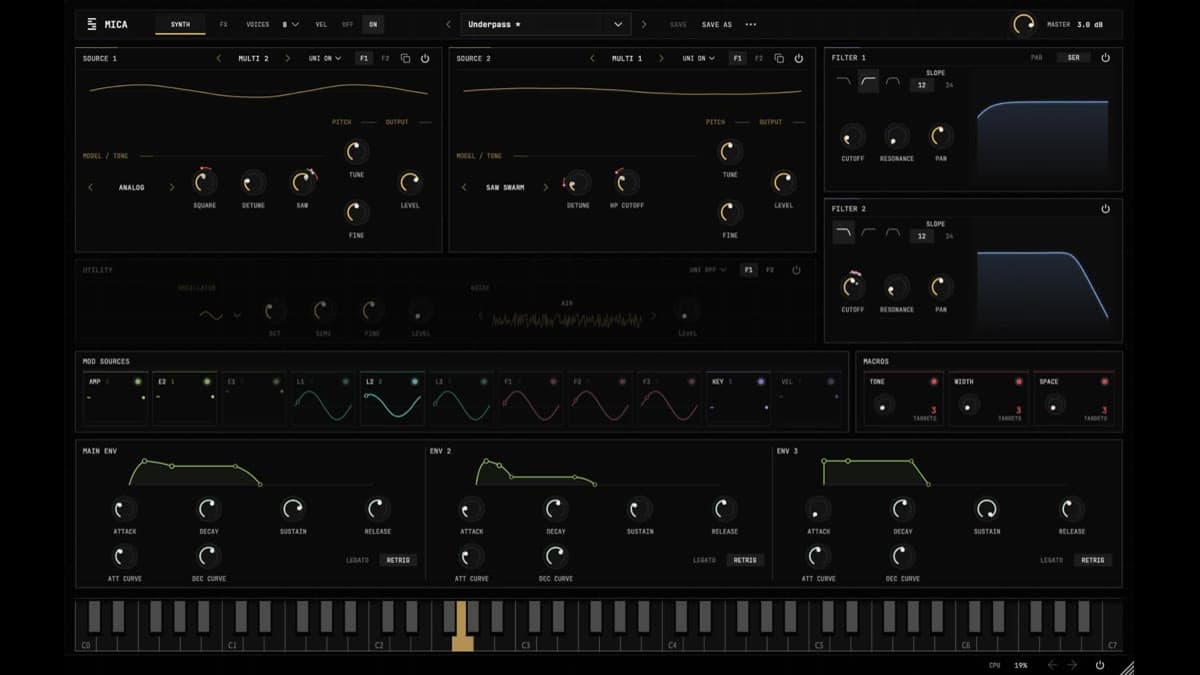
Stemwire shipped Mica on 29 August 2026, then followed with 1.0.1 a day later. It is a hybrid instrument with two source slots, four engine types, a shared filter and effects system, and modulation you drag onto any knob. Intro pricing is $59 against an $89 regular price, and that window ends 13 September. This is a first look at the live product page and the 1.0.1 build. We have not used it in a session.
At a glance: $59 intro / $89 regular through 13 September. VST3 and AU on macOS, VST3 on Windows. No iLok. Five devices. Unlimited demo with occasional noise bursts. Buy it from Stemwire.
What Mica is
Most cheap Mutable-style plugins stop at the oscillator. You get Braids or Plaits in a window, then you build the rest of the synth somewhere else. Mica treats those engines as sources inside a finished instrument. Every engine type hits the same two filters, the same four effect slots, and the same fourteen modulation sources. Switch from a macro model to modal or FM and the rest of the patch stays put.
That is the whole pitch. The engines can be wildly different. Some of the Macro models feel like changing synths. The layout does not change with them, so you can try a few directions in seconds instead of rebuilding envelopes, filters, and an effects chain for each idea.
Stemwire's other shipping plugins sit next to it on the same catalog: Levelproof at $29, plus the free Subkeeper saturator and Zero Sweep filter. Mica is the first instrument in that lineup.
If you want a free, deep software synth with a lot of oscillator types and no store login, start with Surge XT. If you want a modular hybrid you can grow for years, Phase Plant is the expensive reference. Mica sits between those two: paid, small, and built around a handful of Mutable-derived engines plus Stemwire's own FM.
The two sources and four engines
Mica gives you two source slots. Each slot can be one of four engine types: Macro 1, Macro 2, Modal, and FM. The product page uses those Macro names. The FAQ and the plugin itself also call the first two Multi 1 and Multi 2. Same pair of engines, two labels.
A sub oscillator and a noise generator sit alongside the two sources. They are not a third and fourth engine. They are the extra body and air you expect on a subtractive patch, and they stay available no matter which engine type is loaded.
Each engine type keeps its own settings. Switch from Modal to FM, then back, and Modal is where you left it. Effect slots do the same for each effect type. Version 1.0.1 also keeps modulation with the engine and copies it when you copy a source.
What the engines are actually based on
Stemwire is clear about the code. Multi 1, Multi 2, and Modal are based on Mutable Instruments Braids, Plaits, and Elements, released under the MIT licence. FM is Stemwire's own engine.
That heritage is why Mica can jump from analog-ish tones to metallic modal hits without loading a second plugin. Braids and Plaits are macro oscillators: one model knob, a few tone controls, a lot of range. Elements is the modal / physical-modeling voice. FM is the in-house digital stack for patches those three do not cover.
A free Braids or Plaits port gives you that oscillator and almost nothing else. Mica's claim is that the oscillator is only useful once it lives inside filters, unison, effects, and a modulation grid you can assign in one drag.
Filters, effects, and the modulation grid
Two filters, serial or parallel
Mica has two filters. Each can be low-pass, band-pass, or high-pass, at 12 dB or 24 dB. You can run them serial or parallel. That is a small, complete subtractive section. One filter can sit on the body while the other carves the air, or both can stack for a sharper cutoff.
Because the filters are shared, a Macro source and an FM source speak the same language after the oscillators. You are not learning a new filter per engine.
Four effect slots, twelve types
There are four reorderable effect slots. Each slot can be one of twelve types: reverb, stereo delay, chorus, granular, resonator, frequency shifter, pitch shifter, crunch, overdrive, filter, EQ, and compressor.
Four slots is not a modular playground. It is enough to finish a patch: a crunch into a delay into a reverb, or a resonator into a pitch shifter when you want the source to leave the keyboard. Reorder matters. A compressor before the granular slot is a different instrument from a compressor after it.
Fourteen modulation sources, including mod depth
Modulation is the reason to stay after the first preset. Mica lists fourteen sources: three envelopes, three LFOs, three drawable functions, three macros, key tracking, and velocity. Drag a source onto any knob and set the amount. You can add another source to that amount when the modulation itself needs to move.
Any-to-any, including modulation depth, is the line that separates a preset synth from a design synth. An LFO on filter cutoff is ordinary. A drawable function on the depth of that LFO is how a pad starts to breathe without drawing a second envelope by hand.
The three macros are the performance layer. Assign Tone, Width, and Space, or whatever you name them, and you can move a finished patch from the keyboard without opening every panel.
Voices, presets, and the 1.0.1 fixes
Polyphony is set in the header: one to eight voices, plus 16 and 32 when a patch needs the room. Set it to one and Mica is monophonic. Per-source unison stacks a source against itself, so you can thicken one slot and leave the other clean.
The factory bank is fifty patches across eight categories, plus your own. That is a starter set, not a library product. You buy Mica for the engine and the grid, then you save what you make.
1.0.0 shipped 29 August 2026. 1.0.1 shipped 30 August 2026 with those persistence and copy fixes. Take the update before you start storing patches.
Stemwire Mica specifications
| Spec | Detail |
|---|---|
| Developer | Stemwire |
| Type | Hybrid software instrument |
| Version | 1.0.1 (30 August 2026) |
| Sources | Two slots, four engine types each: Macro 1 / Macro 2 (Multi 1 / Multi 2), Modal, FM |
| Extra voices | Sub oscillator and noise generator |
| Engine sources | Multi 1, Multi 2, and Modal based on Mutable Instruments Braids, Plaits, and Elements (MIT); FM written by Stemwire |
| Filters | Two; LP / BP / HP; 12 or 24 dB; serial or parallel |
| Effects | Four reorderable slots; twelve types |
| Modulation | Fourteen sources; any parameter, including mod depth |
| Voices | 1–8, plus 16 and 32; per-source unison |
| Presets | 50 factory patches, eight categories, plus user |
| Formats | VST3 and AU on macOS; VST3 on Windows |
| Authorization | No dongle, no iLok, no subscription; activate once, then offline; 5 devices |
| Demo | No time limit; occasional noise bursts; no account required |
| Intro price | $59 through 13 September |
| Regular price | $89 |
Stemwire Mica vs a free Plaits port vs Phase Plant
A free Braids or Plaits port is the honest budget comparison. Phase Plant is the honest expensive one. Pigments 6 sits near Phase Plant if you already live in Arturia's world.
| Stemwire Mica | Free Plaits / Braids port | Kilohearts Phase Plant | |
|---|---|---|---|
| Price | $59 intro / $89 | Free | $199 on our Phase Plant card |
| Job | Finished hybrid with two sources | Oscillator, then you build the rest | Semi-modular generators and Snapins |
| Engines | Macro / Multi, Modal, Stemwire FM | Usually one Mutable model | Wavetable, analog, sample, noise, plus FM between generators |
| Filters and FX | Two shared filters; four effect slots | Whatever you add downstream | Three effects lanes and the Snapin ecosystem |
| Modulation | Drag any of 14 sources onto any knob, including depth | Host or modular wiring | Drag-and-drop generators and modulators |
| Formats | VST3, AU | Varies by port | VST2, VST3, AU, AAX |
| Authorization | 5 devices, no iLok | Usually none | Kilohearts account |
| Reach for it when | You want Mutable-style engines inside one patch | You only need the oscillator | You want a system you can expand for years |
Which to pick. Use a free Plaits or Braids port when you already have filters, effects, and a modulation environment you like. That is the right download if you work in a modular host and you only wanted the oscillator. Choose Mica when you want those engines to share filters, unison, effects, and a modulation grid without leaving the plugin. Choose Phase Plant when you need generators you can stack, cross-modulate, and grow with paid Snapins. Phase Plant costs more and asks more of you. It also goes further.
Who Mica is for
Consider it if you like Braids, Plaits, or Elements and you are tired of parking a free port in front of three other plugins.
Consider it if you want a compact hybrid for keys, bass, and odd digital leads, and you would rather drag modulation than open a modular matrix.
Consider it if you care about a clean licence: no iLok, five machines, offline after activation, and a demo you can leave on a session overnight.
Skip it if you need AAX or a Windows AU-style wrapper. Windows is VST3 only.
Skip it if you want a factory library you can finish records from. Fifty presets is a tour, not a catalog.
Skip it if you already own Phase Plant or Pigments 6 and you are happy there. Mica is smaller on purpose. It will not replace a flagship hybrid.
How much does Stemwire Mica cost?
$59 intro, $89 regular. The introductory offer saves $30 and ends 13 September. After that, the catalog price is $89.
The demo has no time limit. It adds occasional noise bursts. You do not need an account to try it. macOS downloads are VST3 and AU. Windows is VST3. Buying removes the demo limitation and emails a secure access link. One activation, then offline. Five devices. No dongle, no iLok, no subscription.
Stemwire sells Mica on its own site. Plugin Boutique and Thomann do not list it.
If you want more no-cost instruments around it, use our best free synth VSTs of 2026 and the wider plugin database.
FAQ
Is Stemwire Mica just a paid Plaits?
No. Multi 1, Multi 2, and Modal use Mutable Instruments Braids, Plaits, and Elements under MIT. The FM engine is Stemwire's. The product is the shared filters, four effect slots, fourteen-source modulation, unison, and the fact that engine settings persist when you switch types.
How long does the $59 intro last?
Through 13 September. After that, Mica is $89.
Does Mica need iLok?
No. Activate once, then work offline, on up to five devices.
What are the Stemwire Mica system requirements?
Stemwire lists VST3 and AU on macOS, and VST3 on Windows. Any DAW that hosts those formats is in scope. There is no AAX build.
What changed in version 1.0.1?
Modulation and effect-slot settings now return when you switch an engine or effect type and come back. Copying a source also copies its modulation. First release was 1.0.0 on 29 August 2026.
Verdict
Mica is a small hybrid with a specific job: put Mutable-derived engines and a Stemwire FM voice inside one modulation and effects system, then get out of the way. $59 is the intro through 13 September. $89 is the regular price. The demo is honest. The licence is simple.
It will not replace Phase Plant, and it is not trying to. If you have been stacking a free Plaits port in front of a filter and a delay, this is the version of that idea that already includes the rest of the synth. Install 1.0.1, drag an LFO onto a Macro knob, then drag a function onto that LFO's depth. That gesture is the product. The live storefront is stemwire.io/audio-plugins/mica.