Some links on this page are affiliate links. If you buy through them, Dubspot may earn a commission at no extra cost to you. It never affects our scores or what we recommend — read our policy.
Song Cage Melody Rack Writes Chords From Your Melody
Song Cage Melody Rack turns a sung melody into MIDI, then fourteen harmony-aware effects write chords and parts. $59, or $39 for owners. AU and VST3 formats.
P
Priya Raman
September 15, 2026 · 11 min read
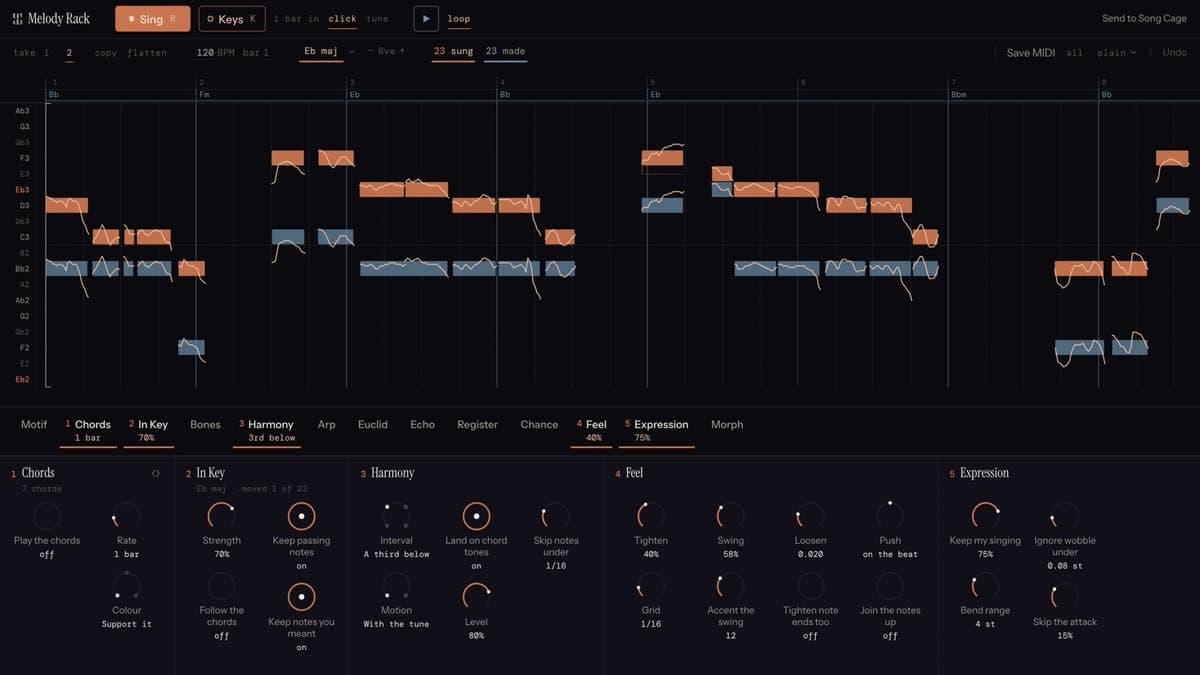
Song Cage sells Melody Rack as a MIDI effect that hears a melody and writes it onto the session grid. Fourteen harmony-aware slots then work on those notes. The licence is $59 once, or $39 if you already own Song Cage Desktop plus Plugin. A 14-day trial starts from a free Song Cage account.
At a glance: $59, or $39 for Song Cage owners. AU and VST3 on macOS 11+. VST3 on Windows 10+. Notes in, notes out. No audio engine of its own. Buy it from songcage.com.
This is a first look at the shipping plugin and the official manual. We have not run Melody Rack in a session yet.
What Melody Rack is
Melody Rack sits in front of the instrument already on the track. In Logic it loads in the MIDI FX slot. Elsewhere it goes ahead of the synth. Hum a line, play it on a controller, or let an existing clip run past. The detector lands the notes on the bar line. Chords writes a progression from that melody. Every slot after it reads the chord under each note.
That is a different job from a chord memorizer or a scale lock. Cthulhu stores voicings and arps. Scaler 3 maps harmony as a writing assistant. Iftah Sting writes acid and bass lines. Melody Rack starts from a melody you already have and keeps every rewrite inside the changes it just wrote.
It shares Song Cage's detector and music theory. It does not need the desktop app or the Song Cage plugin. One button can still file the take in a Song Cage inbox: the chords, the melody through the rack, and each part as its own take.
The official line is firm. Nothing in the rack generates a melody from a prompt. Every note comes from what went in. The hearing step is a neural model. Everything after it is deterministic music theory. The same take with the same settings renders the same result.
How a melody gets in
There are four ways in. Sing arms a count-in, or waits for the next bar if the DAW is already rolling. Keys uses the controller already routed to the track, with the same count-in and the same grid. Pass-through takes whatever MIDI the track already has. Import pulls a recording from a file, a phone, or a Song Cage inbox.
A sung note is a pitch curve, not a piano-roll block. Melody Rack keeps the frame-level pitch behind each MIDI number. That is how it tells a blue note you meant from a miss the detector guessed. Near zero from the rounded pitch means you aimed and held. Near half a semitone means the detector made a call. There is a switch to turn that test off, because correcting a transcription and correcting a performance are two different jobs.
The sung curve travels through the chain. Transpose a note and the curve moves. Reverse a phrase and the curve reverses. Drag the result out as MPE and the scoop, the drift, and the fall become per-note bend.
The plugin keeps five takes. Each take has its own rack and its own key. Copy, flatten, anchor, and length sit on that take bar.
Fourteen MIDI effects, all reading the same chords
The official product page and the manual both count fourteen effects. They run in any order. Chords writes the progression into the rack. The twelve slots after it read that progression, so a delay, a harmony line, or an arpeggiator stays inside the changes without a second clip to chase.
Chords writes a chord a bar or two from the melody, from plain support to a reharmonization. You can type a chord onto any bar yourself. Change a chord and everything downstream moves.
In Key corrects notes that fall outside the key. Follow the chords asks a second question: what is underneath, and how much does this note owe it. A sixteenth between two neighbors can stay. The same pitch held on a downbeat moves. A passing tone on a weak beat is left alone even before that second question.
Harmony writes a second line that tracks the changes. It is not a fixed interval that breaks when the chord turns minor.
Expression sets how much of the sung performance reaches the synth. At zero, flat notes. At one, the scoop and the fall are written as per-note bend.
Bones keeps the notes that carry the tune and writes a new surface on them. Hum a verse, get its chorus: same skeleton, new rhythm, new figures between the bones. Lift can send it up an octave. Roll writes another line on the same bones.
Reply writes a second half from the first. Each roll answers in a different shape and names the one it chose so you can pin it.
Morph takes two takes of the same phrase and walks one dial from the first to the second. Halfway is a real line between them, not both at once.
Arp runs the chords the rack wrote and restarts on each change. Eight directions, a roll dial on Random, and it can rest when you rest.
Motif does inversion, retrograde, augmentation, sequence, and fragment on the phrase you just hummed. Inversion is diatonic, so it comes back in the key.
Euclid turns a note into a rhythm. Hum one long note, get a pulse already in the key and in the chord.
Echo is note delay that keeps repeats in the harmony. It climbs by scale steps rather than semitones and snaps each repeat to the chord it lands on.
Register folds a part into a range. Fold keeps the shape of the line. Clamp flattens it, which is what a bass part wants.
Chance rolls a die per note, or per phrase so a whole figure happens or does not. It is seeded, so a take renders the same twice.
Feel is swing, humanize, and quantize as a dial. The official note is that most sung takes want about 40 percent.
The default chain order is documented. Reordering is the other half of the product. Put In Key after Chords if you want correction to see the progression. Put Harmony after both if the second line should follow the corrected melody.
Getting the notes out
Output is live MIDI to the instrument on the track, or a clip you drag onto one. The drag handle chooses everything, just what you sang, just the parts, or just the chords. The sung line and the parts partition the rack, so two drags onto two tracks lose nothing and double nothing. Clip names follow the choice.
The 14-day trial streams the whole rack live. Dragging a clip onto a track is what the licence adds. When the trial ends, the rack stops sending notes. Nothing in the project is deleted. Buying from the same window unlocks it again. Your own controller still reaches the track either way.
A local play button loops the take while you move a dial. That plays through the same instrument, so the audition is the sound you will keep.
Send to Song Cage files the idea without the desktop app open. Sign in inside the plugin window.
The recording, the rack settings, and the key save into the DAW project. Closing the window or reopening the session next week brings the take back with its pitch curves intact.
There is no standalone app. It is a MIDI effect for a host that can load one.
Melody Rack specifications
| Spec | Detail |
|---|---|
| Type | Harmony-aware MIDI effect (no audio of its own) |
| Inputs | Sing, Keys, track pass-through, import |
| Effects | 14 slots: Chords, In Key, Harmony, Expression, Bones, Reply, Morph, Arp, Motif, Euclid, Echo, Register, Chance, Feel |
| Output | Live MIDI, drag-out MIDI or MPE, Send to Song Cage |
| Takes | Five takes, each with its own rack and key |
| Formats | AU + VST3 on macOS; VST3 on Windows |
| System | macOS 11 (Big Sur) or later, Universal; Windows 10 or later, 64-bit |
| Trial | 14 days, full rack live; clip drag-out needs a licence |
| Account | Free Song Cage account to start the trial |
| Price | $59, or $39 if you own Song Cage Desktop + Plugin |
Melody Rack vs Cthulhu and Scaler 3
| Melody Rack | Cthulhu | Scaler 3 | |
|---|---|---|---|
| Job | Melody in, harmony-aware MIDI out | Chord memory and arps | Harmony assistant |
| Starts from | A sung, played, or imported melody | Stored voicings | Scale / progression tools |
| Makes sound | No | No | No |
| Price | $59 / $39 owners | $39 | $99 |
| Formats | AU, VST3 | VST, AU, AAX | VST3, AU, AAX |
Pick Melody Rack when the melody is already in your mouth or on a clip and you want chords, a second line, and parts that stay inside those chords. Pick Cthulhu when you already know the voicing and want it stored and arpeggiated. Pick Scaler 3 when the job is exploring progressions before a melody exists. Sting stays the acid and counterpoint writer. Roland Melody Flip is a different rewrite: it flips an existing line, it does not hear you sing.
$59 is closer to Cthulhu than to Scaler. You are buying a melody-to-rack MIDI effect, not a harmony workstation.
Who Melody Rack is for
Melody Rack suits people who write tunes by singing them and then have to get them into a DAW. It also suits anyone who already converts audio to MIDI and hates the cleanup: correction against the chord, not only the scale, plus hand fixes for the notes the detector missed. Bones, Reply, and Morph are for a second idea out of the first one.
Skip it if you wanted a plugin that makes sound. Skip it if you do not write from sung or played melodies. Skip it if your host cannot load a MIDI effect. Skip it if you needed AAX.
The trial withholds clip drag-out. Live MIDI is enough to hear the rack. Keeping the clip is the paid step.
How much does Melody Rack cost?
Melody Rack is $59 from songcage.com. Owners of the Song Cage Desktop plus Plugin licence pay $39. Both are one-time. There is no subscription.
A 14-day trial covers the whole rack live. A free Song Cage account starts it from inside the plugin window. Microphone access is required only if you sing.
Formats are Audio Unit on macOS and VST3 on macOS and Windows. macOS 11 or later, Universal on Apple Silicon and Intel. Windows 10 or later, 64-bit. The installer puts each format in the standard folder. Relaunch the DAW so it rescans.
Sold direct. There is no Plugin Boutique or Thomann listing.
FAQ
What is Song Cage Melody Rack?
A MIDI effect for macOS and Windows. You sing or play a melody, it lands on the grid, and fourteen harmony-aware effects work on it. Chords writes the progression. The rest of the rack reads it.
How much does Melody Rack cost?
$59 once, or $39 if you own Song Cage Desktop plus Plugin. A 14-day trial is available.
Does Melody Rack make sound?
No. It sends notes to the instrument on the track. In Logic it appears under MIDI FX, not under instruments.
Do I need Song Cage to use it?
No. It has its own window, installer, and licence. A free Song Cage account starts the trial. Send to Song Cage is optional.
What are the system requirements?
macOS 11 or later (AU + VST3, Universal). Windows 10 or later, 64-bit (VST3). A host that loads MIDI effect plugins.
Verdict
Melody Rack is a MIDI effect that starts with your melody and keeps every rewrite inside the chords it writes from that melody. Fourteen slots. Live MIDI or a dragged clip. $59, or $39 for Song Cage owners. It will not replace Scaler as a harmony workstation or Sting as an acid writer. If the job is getting a hummed line onto the grid and leaving with parts that still belong to that line, this is the Song Cage plugin for that sentence.