Sample Logic Animation Station Pro: Host Any Plugin
Sample Logic Animation Station Pro hosts VST3 and AU instruments and effects, then animates MIDI and FX. Specs, $89 intro versus $119 list, and who should buy.
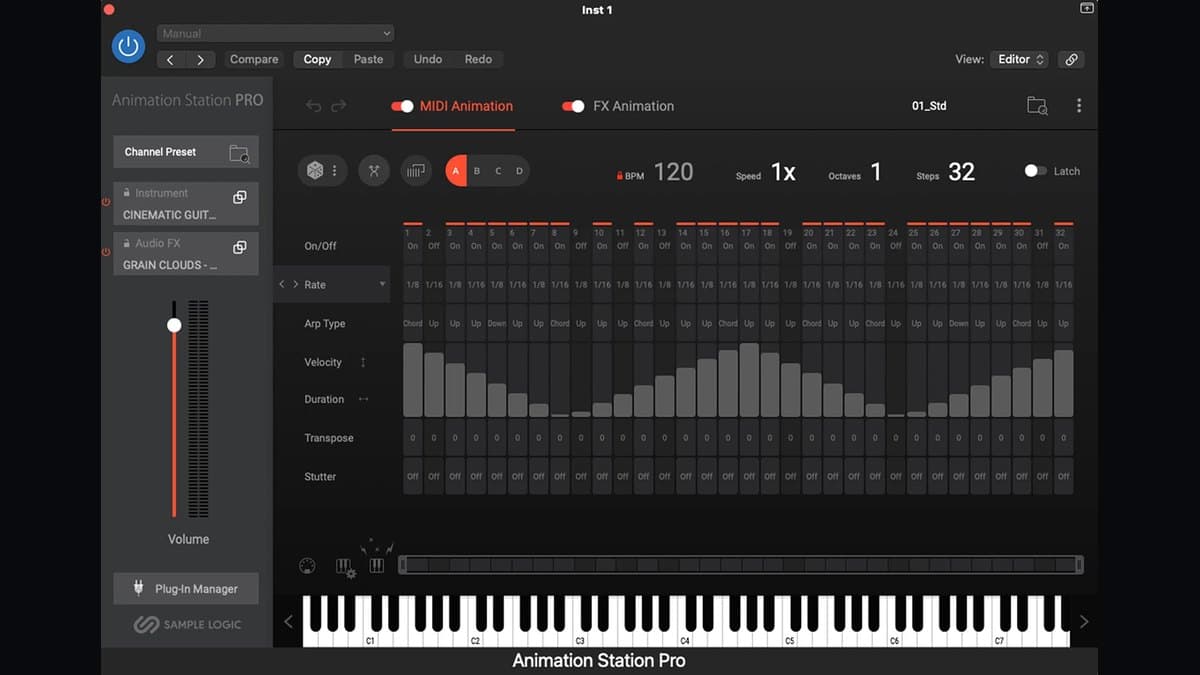
Sample Logic's newest plugin makes no sound of its own. That's the whole idea. Animation Station Pro, built in partnership with Pitch Innovations, is a virtual instrument that hosts your instruments and effects inside itself, then animates both. Animation Station 2.0 was a MIDI Step Animator and nothing more. Pro keeps that engine and builds two more around it: a Universal Instrument Host and an FX Animation Engine. One preset can now hold an instrument, an effects chain, a MIDI pattern, and the motion running on those effects. Intro pricing sits at $89 against a $119 regular price.
At a glance: $89 intro / $119 regular. VST3, AU, AAX, and standalone. macOS 10.13 or later (Intel and Apple Silicon) and Windows 10 or later, 6 GB RAM, roughly 35 MB on disk. Hosts your own AU and VST3 instruments and effects. MIDI Animation plus FX Animation, up to six animations. Not compatible with Digital Performer. Buy it from Sample Logic.
This is a first look, and we haven't had Animation Station Pro in a session yet.
What is Animation Station Pro?
Most MIDI tools sit in front of an instrument and fire notes at it, while Animation Station Pro sits around the instrument. You load a VST3 or AU instrument into the host and play it from the built-in sequencer and arpeggiator. Then you load audio effects and move their parameters with the same step sequencers, LFOs, and macros. Every engine stands alone or works with the others, so you can run it as a pure arpeggiator with nothing in the FX slots. Animate a static pad without sequencing a note, or do both on the same patch.
That's a different job from Scaler 3 or InstaChord 2. Those tools help you pick chords and then send MIDI to whatever instrument sits next in the chain. Animation Station Pro wants the instrument and its effects inside its own window. It then treats the whole stack as one playable object you can save, randomize, and carry to a gig.
Hosting an instrument plus a chain of effects and animating all of it as one performance used to be a DAW session's job. Sample Logic and Pitch Innovations have folded that session into one plugin. Open a single instance on a laptop and the instrument, the effects, and the animation you built in the studio all come with you.
Sample Logic's own trailer is the shorter pitch if you want the product in one minute.
Inside the three engines
The Universal Instrument Host
The host is the foundation: load a VST or Audio Unit instrument inside the plugin and it joins the animation engine immediately. No extra tracks, no routing to configure. The hosted instrument keeps its own sound, because you're wrapping it rather than resampling it into somebody else's engine.
There's a practical consequence that goes well beyond tidiness. Logic Pro loads Audio Units only, which has locked out every instrument and effect that never received an AU build. Animation Station Pro hosts plugins internally, so VST-only titles can now play and animate inside a Logic session, including older and niche tools nobody ever ported. Pro Tools users get the mirror image of the same trick, since AU and VST3 plugins can run inside an AAX environment.
One workflow difference to plan for: Pro is a virtual instrument, not a MIDI effect, so it lands on an instrument track. Animation Station 2.0 could load either way depending on the DAW. If your templates use 2.0 as a MIDI insert ahead of a synth, expect to rewire them.
The MIDI sequencer and arpeggiator
The sequencing engine from 2.0 carries forward intact. Real-time ABCD switching flips between four patterns on the fly, with key-switch assignment and right-click copy, paste, and reset. Set the length and attributes of each step independently, randomize as you go, or grab one step and drag it elsewhere in the sequence. Those edits now apply across instruments and effects alike, which is the genuinely new part.
Multi-directional patterns, stutters, and chromatic transpositions all live in the engine. Customizable key switches, advanced mod-wheel modulation, and octave and chromatic transpose modes carry over too. So does infinite pattern randomization. Drag-and-drop MIDI export survives as well, so you can drop the pattern onto a track and edit it by hand.
The factory library feeds that engine. Sample Logic ships 900+ combined MIDI and FX Animation presets, browsable independently, up from 750+ in 2.0. Coverage runs from plain arps through melodic and chordal sequences to drum-machine-style patterns, plus glitchy stutters that would take an afternoon to program by hand. The full Breaking Borders collection carries over from 2.0 and now works across both engines. Ben Aylon designed it, and he's a percussionist known for contemporary Senegalese drumming, so those patterns lean rhythmic rather than pretty.
The FX Animation Engine
Effects get the same treatment as instruments. Host your audio effect plugins inside Animation Station Pro and animate their parameters with the step sequencers, LFOs, and macros the instrument side uses, up to six animations at once. A filter sweep, a delay throw, or a reverb swell can move in time instead of sitting on one setting for eight bars. You aren't stuck with a built-in FX rack either, since the engine drives whatever effects you already own.
Crucially, the sequencer and the FX engine stay independent of each other. Plenty of motion plugins make MIDI and FX travel together whether that suits the track or not. Here you can animate a sustained pad with no arp running at all, or arp a bone-dry instrument and leave every effect perfectly still.
Channel Presets, the vault
Channel Presets are the piece that turns three engines into one instrument. Sample Logic's own example runs like this: build a dramatic string ostinato with the arpeggiator. Push it through a hybrid distortion chain, then set an LFO wobbling so the tone keeps evolving. The Channel Preset captures all of it in one patch: the instrument, the effects chain, the MIDI pattern, and the effects animation. Recall is instant.
That's the live-performance argument, and it's a strong one. Entire animated setups switch with a single click, and the standalone app runs the whole rig without a DAW anywhere in sight. Randomization then turns any preset into a jumping-off point rather than a fixed destination. That's how these engines earn their keep over a long session.
Sample Logic's official channel also posted a walkthrough if you want to watch a hosted instrument move under the engines.
Animation Station Pro specifications
| Spec | Detail |
|---|---|
| Type | Plugin host with MIDI animator and FX animator |
| Engines | Universal Instrument Host, Intelligent MIDI Sequencer & Arpeggiator, FX Animation Engine (up to 6 animations) |
| Hosted formats | Your own AU and VST3 instruments and effects (scan them with the Plug-in Manager) |
| Presets | 900+ combined MIDI and FX Animation presets, independently browsable |
| Extras | Channel Preset vault, Breaking Borders by Ben Aylon, drag-and-drop MIDI export, ABCD pattern switching |
| Formats | VST3, Audio Unit, AAX, standalone app |
| Systems | macOS 10.13 or later, 64-bit Intel or Apple Silicon, 6 GB RAM; Windows 10 or later, 64-bit, 6 GB RAM |
| Disk | About 35 MB |
| Known limit | Not currently compatible with Digital Performer |
| Price | $89 intro, $119 regular |
The installer stays tiny because the sounds live in the plugins you already own. Run the Plug-in Manager once after installing so it can scan and populate your AU and VST3 instruments and effects.
Animation Station Pro vs Scaler 3
Scaler 3 is the MIDI assistant most producers have already met. It listens, suggests chords, and sends scale-aware MIDI to whatever instrument follows it. Animation Station Pro leaves harmony entirely to you and spends its energy on hosting and motion.
| Animation Station Pro | Scaler 3 | |
|---|---|---|
| Job | Host, sequence, and animate instruments and effects | Chord and scale MIDI assistant |
| Hosts plugins | Yes, VST3 and AU instruments and effects inside itself | No, it talks to the next plugin in the chain |
| Motion | Step sequencers, LFOs, macros on MIDI and FX | Progressions, detection, scale-aware writing |
| Logic / VST-only | Can bring VST-only plugins into AU-only hosts | Does not host third-party instruments |
| Presets | 900+ MIDI and FX Animation presets | Chord sets, phrases, and theory tools |
| Price | $89 intro, $119 regular | $99 |
The split is clean enough: Scaler 3 answers "what chord comes next." Animation Station Pro answers "how do this synth and this delay move together?" Cthulhu belongs on Scaler's side of that line: a $39 chord memorizer and arpeggiator that fires MIDI at a separate instrument. It's cheaper and simpler. It also won't open a VST-only synth inside Logic or recall an effects animation alongside the pattern.
Against Animation Station 2.0
Sample Logic still sells 2.0 as its own MIDI-effect product at $149.99. The $89 intro on Pro looks strange until you compare feature lists. These are separate products rather than an upgrade path, and 2.0 keeps two advantages worth knowing about. Its supported DAW list includes Digital Performer 10. It also runs on older systems, back to macOS 10.11 and Windows 7, with a 32-bit Windows build. Beyond that, Pro is the larger product by a wide margin.
Who Animation Station Pro is for
Animation Station Pro suits producers who already own instruments and effects they want to perform rather than merely insert. Film and trailer writers live on ostinatos, pulses, and slowly evolving beds. They get a way to store a complete animated idea as one preset and recall it three cues later. Logic users locked out of VST-only tools get a fix that's official rather than a hack. Live players get a standalone app and one-click setup changes.
Anyone who used Animation Station 2.0 and wished the same engine worked on the audio side is the obvious upgrade candidate. The MIDI vocabulary hasn't changed, and hosting and FX animation are where the new work went.
There are clearer reasons to pass. If you want a self-contained sample library, this isn't it, because no factory instrument ships inside the host and you supply every sound. Producers who only need a chord helper will find InstaChord 2 and Scaler 3 do that job with far less ceremony. Digital Performer users are simply out for now, and that's Sample Logic's own note, not a guess. Anyone running macOS 10.12 or Windows 7 falls below the minimum too.
How much does Animation Station Pro cost?
Animation Station Pro is $89 at intro pricing against a $119 regular price. Buy it from the Sample Logic shop. Animation Station 2.0 remains a separate product on the same site at $149.99. Pro isn't a content expansion for it, and you don't need one to run the other.
FAQ
What is Sample Logic Animation Station Pro?
It's a virtual instrument plugin, built with Pitch Innovations, that hosts your VST3 and AU instruments and effects. A MIDI sequencer/arpeggiator and a separate FX Animation engine then animate them, and a Channel Preset stores the whole stack as one recallable patch.
Can Animation Station Pro load VST-only plugins in Logic Pro?
Yes. Logic Pro loads Audio Units only. But Animation Station Pro hosts plugins internally, so VST-only instruments and effects can play and animate inside a Logic session.
Does Animation Station Pro include its own sounds?
It includes 900+ MIDI and FX Animation presets, Breaking Borders by Ben Aylon among them. There's no sample library in the box, so you load your own AU and VST3 instruments and effects.
Animation Station Pro vs Animation Station 2.0?
2.0 is a MIDI Step Animator. Pro keeps that engine and adds a Universal Instrument Host, an FX Animation Engine, Channel Presets, and standalone performance, and they're separate products with separate prices.
What are the system requirements?
macOS 10.13 or later with a 64-bit Intel or Apple Silicon CPU and 6 GB RAM, or Windows 10 or later, 64-bit, with 6 GB RAM. You'll need about 35 MB of disk space. Formats are VST3, AU, AAX, and standalone, and it's not currently compatible with Digital Performer.
Verdict
Animation Station Pro reads less like an arpeggiator and more like a portable mini-session. The host is the real product here. Sample Logic already knew how to build the MIDI engine, and 2.0 proved it. The FX Animation engine matters more. It's what lets a Channel Preset feel like an instrument, not a MIDI clip parked in front of a synth. And the VST-only workaround is a concrete daily reason to own it in an AU-only host. You still have to bring the sounds, and Digital Performer users are stuck for now. At $89 intro, the trade looks easy to justify if you've got a folder of instruments you'd rather perform than insert. Browse the plugin database for the MIDI tools and hosts it sits next to.