ResoPlate Models Four Metal Plates in Real Time
Reso Audio ResoPlate is a physically modeled plate reverb that solves four metal plates in real time, with six metals, MIDI control, and sidechain motion.
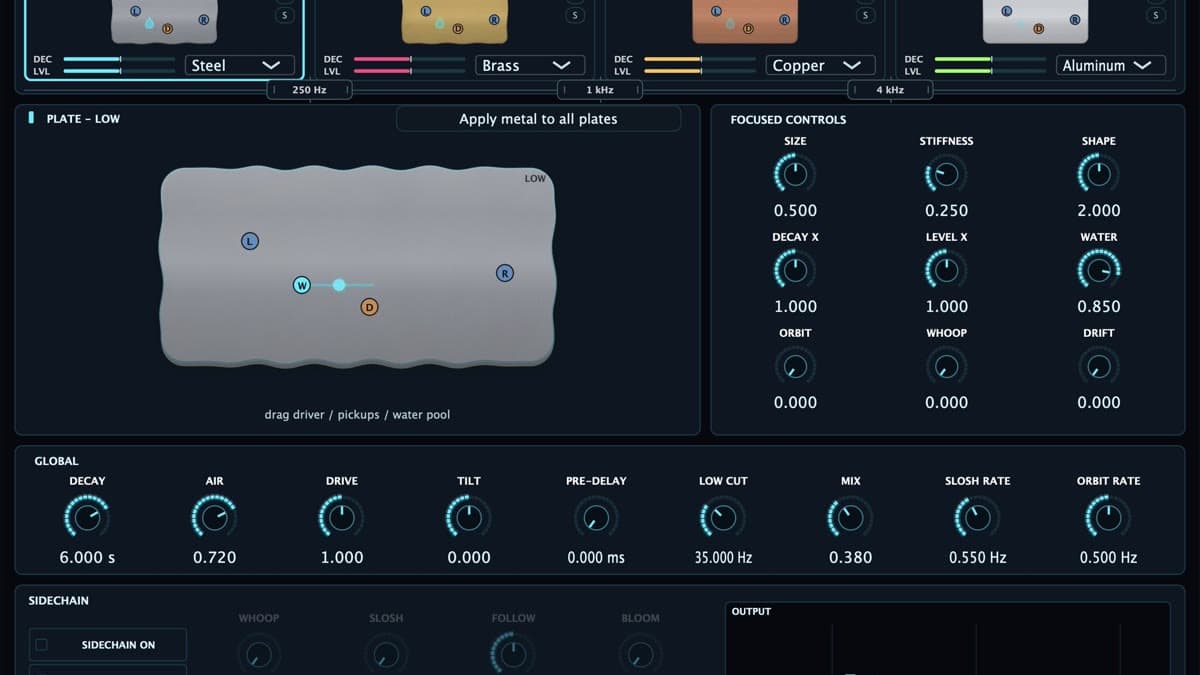
Reso Audio has released ResoPlate, a plate reverb that models four metal plates from physics in real time rather than replaying recorded impulses. It is the first paid plugin from Reso Audio, the new commercial name behind the well-known free Sympiano piano, and it arrived in late September 2026. This first look draws on the official product page and Reso Audio's own audio examples. It is not a hands-on review.
At a glance: ResoPlate carries a $39 introductory price, rising to $59 once the launch window closes on 31 October 2026. It runs as AU, VST3, and standalone on macOS, and as VST3 and standalone on Windows, with a perpetual license that covers both platforms. Up to four modal plates run at once, each with its own size, material, and decay, drawn from six metals. Because it solves the physics instead of using impulse responses, changing a material or size retunes the whole tail in real time.
What is ResoPlate?
A plate reverb recreates the sound of a real studio plate. A large sheet of metal is set vibrating by the signal, and its dense, bright decay gets picked up and mixed back in. Most software plates reach that sound one of two ways. They sample a real plate as an impulse response, or they approximate the sound with an algorithm. ResoPlate takes a third path. It treats each plate as a modal resonator and solves its physics as you play, so the tail behaves like struck metal instead of a fixed recording.
That difference is the point of the plugin. The model runs live, so the plate is never locked to one captured moment. Nudge the material or the size and the entire mode structure retunes on the spot, which an impulse-response plate simply cannot do. Reso Audio puts it plainly: a plate reverb that is solved, not sampled.
What ResoPlate gives you
Four independent plates at once. ResoPlate runs up to four modal plates in parallel, each with its own size, material, and decay. Layer them for a lush, hall-like wash. Detune them against each other for a shimmering ensemble. Treating the plates as separate voices turns a single reverb into a small resonant instrument.
Modal synthesis, not convolution. Every plate is a solved modal resonator rather than an impulse response. That is why the material and size controls do more than tint the sound. Change them and the mode structure recalculates in real time, retuning the pitch and decay of the plate the way a physical object would. The result sits closer to sound design than to recall of a captured space.
Six real plate metals. You choose from six metals, each carrying representative stiffness and loss values. Steel is the reference. The others, including brass, copper, and aluminum, shift the pitch and decay of the model toward how that alloy actually behaves. A bright aluminum plate and a darker bronze one are genuinely different resonators, not the same tail with an EQ tilt.
Calibrated decay and a single Air control. Decay is set at a musical reference point rather than an arbitrary scale. One Air control opens up long, natural high frequencies without the harsh metallic ring that loud chords used to trigger on plate emulations. It keeps a long tail smooth instead of brittle.
A live output spectrum. A real-time analyzer shows the plate output as you play, so you can watch the tail settle and shape the tone against what you actually hear. For mixing, seeing where a reverb piles up energy is often faster than guessing by ear alone.
A reverb you can play. Pitch bend and the mod wheel drive the plate motion, which turns the reverb into a performable, expressive voice instead of a static send. That opens ResoPlate up to ambient and sound-design work, where the reverb is part of the instrument rather than a finishing touch.
Motion that reacts to your mix. Feed ResoPlate a sidechain signal and an envelope follower steers the plate's movement, so the tail bends and breathes in time with the track. Two controls, Follow and Bloom, set how strongly it responds. It is a clean way to keep a big reverb from swamping a busy section.
Eight skins. The interface offers eight looks, from the default Brushed Steel to Neon Grid '86, switched with a right-click. The visuals change but the sound never does, so the choice is purely taste.
ResoPlate specifications
| Spec | Detail |
|---|---|
| Type | Physically modeled multi-plate reverb |
| Developer | Reso Audio |
| Engine | Modal synthesis, four independent plates solved in real time |
| Materials | Six metals (steel reference, plus brass, copper, aluminum and more) |
| Key controls | Size, material, decay per plate, plus Air and calibrated global decay |
| Performance | MIDI pitch bend and mod wheel drive plate motion |
| Sidechain | Envelope follower with Follow and Bloom controls |
| Metering | Live output spectrum analyzer |
| Skins | Eight, switchable by right-click, no effect on sound |
| macOS | AU, VST3, standalone, macOS 11 or later, universal (Apple Silicon and Intel) |
| Windows | VST3, standalone, Windows 10 or later, 64-bit (x64 and Arm64) |
| Activation | Offline license key, no account |
| Price | $39 intro through 31 October 2026, then $59 |
ResoPlate vs Valhalla Plate
The obvious rival is Valhalla Plate, the cult-favorite plate reverb that many mixers already own. Valhalla Plate is algorithmic, inexpensive, light on CPU, and covers a wide range of plate tones through its modes. ResoPlate takes the physical-modeling route, which trades some of that simplicity for a plate you can retune, play, and drive from a sidechain. Both answer the same brief in different ways.
| ResoPlate | Valhalla Plate | |
|---|---|---|
| Method | Physical modeling (modal) | Algorithmic |
| Plates at once | Up to four | One |
| Materials | Six metals, retunable | Multiple plate modes |
| Playable by MIDI | Yes | No |
| Sidechain motion | Yes (Follow, Bloom) | No |
| Standalone | Yes | No, plugin only |
| Price | $39 intro, $59 after | Around $50 |
Which to pick. For a classic plate sound that is cheap, light, and instantly familiar, Valhalla Plate is hard to beat. For a plate that behaves like a real resonating object, one you can tune, perform, and lock to the groove, ResoPlate offers something the algorithmic options do not. If you want a do-everything algorithmic reverb at the high end, FabFilter Pro-R 2 remains the premium pick. Our roundup of the best reverb plugins of 2026 puts all three in context.
Who ResoPlate is for
Buy it if you want a plate reverb with real character and you like to shape it rather than pick a preset and move on. Sound designers, ambient producers, and mixers who enjoy sculpting tails will get the most from the modal engine, the six metals, and the MIDI control.
It is also a strong pick if you work with dense arrangements and want the sidechain-driven motion to keep a large reverb out of the way. The standalone build helps too, if you like designing sounds outside a DAW.
Skip it if you just need a quick, familiar plate on a vocal or snare and already own something like Valhalla Plate or Seventh Heaven Professional. ResoPlate rewards tweaking, and a simpler tool will do if you never plan to tweak.
How much does ResoPlate cost?
ResoPlate is $39 as an introductory price through 31 October 2026, then $59 at the regular price. It is a one-time purchase with a perpetual license, every 1.x update is free, and students and educators get 40 percent off the regular price. One license covers both macOS and Windows. There is a full-featured demo with no time limit, though its output briefly fades to silence at intervals, plus a 14-day refund policy. Checkout runs through Lemon Squeezy, and activation is offline with no account and no always-on check. The demo and the paid version share the same download, so a license key simply unlocks the copy you already installed.
FAQ
How is ResoPlate different from a normal plate reverb?
Most plate plugins either sample a real plate as an impulse response or approximate it with an algorithm. ResoPlate solves the physics of four metal plates in real time, so changing the material or size retunes the whole tail rather than swapping to a different fixed sound.
What formats and systems does ResoPlate support?
On macOS it runs as AU, VST3, and standalone, needs macOS 11 or later, and is universal for Apple Silicon and Intel. On Windows it runs as VST3 and standalone, needs Windows 10 or later, and supports both x64 and Arm64. One license covers both platforms.
Can you play ResoPlate like an instrument?
Yes. Pitch bend and the mod wheel drive the plate motion, and a sidechain input with an envelope follower moves the tail in time with the track, so the reverb becomes an expressive, performable voice rather than a static send.
Is there a free trial of ResoPlate?
Yes. The demo is the full plugin with no time limit, though the output fades to silence for a moment at intervals while you play. Presets and sessions save and recall normally, and buying a key unlocks the copy you already have.