Quantastical CORRIDOR Builds Reverb From Coupled Rooms
Quantastical CORRIDOR is a network reverb of coupled rooms with freeze, inverse freeze, and a live flow display. Intro $49 until 14 September 2026, then $69.
Most reverbs hand you one space and a size knob. Quantastical Sound's CORRIDOR hands you several rooms at once, coupled through resonant corridors, with the sound bleeding between them. Intro pricing sits at $49 until 14 September 2026, then it moves to $69. A 14-day trial ships fully functional, with no noise and no interruptions.
At a glance: $49 intro through 14 September 2026, then $69. AU, VST3, AAX, and standalone on macOS and Windows. 13 room configurations. The center display is a live, draggable signal-flow map. Freeze and inverse freeze on board. 14-day full trial. Buy it from Quantastical Sound.
This is a first look at the shipping plugin and its published architecture. We haven't run CORRIDOR on a mix yet.
What is CORRIDOR?
A conventional algorithmic reverb simulates one space. You pick a room, a hall, or a plate, then you set size, decay, and mix. CORRIDOR starts from a different picture. You're standing in the middle of several rooms at the same time, each with its own size and its own material, and the corridors between them carry resonance from one space into the next.
Jonas Quant built it, and the product page traces the idea back to a real floor of empty concrete rooms. While recording Hurts Happiness, he rented a studio with a whole floor of big empty corridors and side rooms. He'd put a cheap portable recorder in different spots out there and sing vocal overdubs into the space, wet. It sounded fantastic. CORRIDOR is the attempt to build that floor into a plugin.
The engine isn't new to the shop. It sat inside STRÄNG, Quantastical's instrument, as the Corridor section. CORRIDOR pulls that engine out, gives it a dedicated panel, and adds considerably more control. If you already own STRÄNG, this is the space tool on its own. If you don't, you can buy the reverb without buying the instrument.
That framing also tells you what CORRIDOR isn't: it's not a convolution loader, not a vintage plate with a 1970s color mode, and not a one-knob "make it bigger" send. You place rooms, you listen to how they bleed, and you sculpt from there.
A network, not a single space
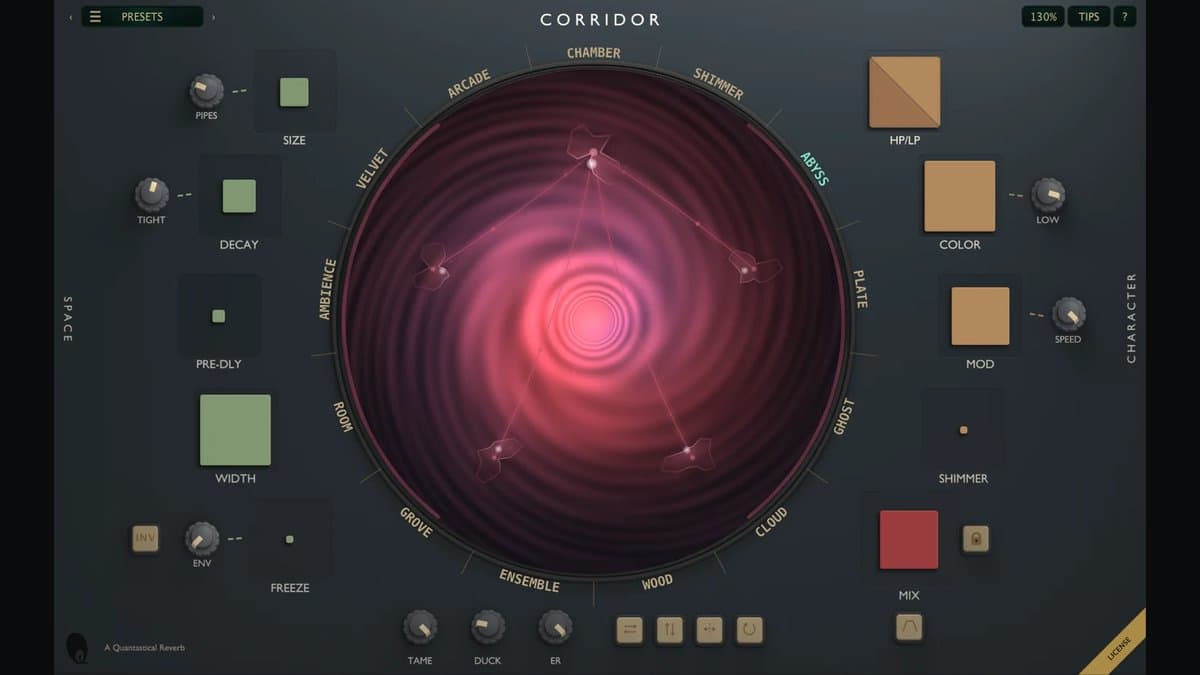
Thirteen room configurations make up the starting kit: Velvet, Arcade, Chamber, Shimmer, Abyss, Plate, Ghost, Cloud, Wood, Ensemble, Grove, Room, and Ambience. Each one is a different way the rooms couple, not just a new decay time wearing a new name. Think floor plans rather than hall sizes. A tight pair of rooms behaves like a short, chatty space, while a longer chain lets energy wander before it comes back to you.
Every room keeps its own size and material, and that split is the practical difference from a conventional reverb. In Valhalla Room you commit to one algorithm and shape it. In CORRIDOR you commit to a network, then decide which rooms in that network get the energy. Material changes how a room speaks. Size changes how long it holds the note. Coupling changes when the next room answers.
For producers who already write in architectural terms, this is the whole point. A concrete stairwell into a dry booth. A tiled bath into a longer hall. You're mixing spaces rather than picking a preset called Large Hall 3 and hoping the tail sits.
The wet/dry balance is still where you'd expect it, and Quantastical exposes that control on the product page so you can audition presets at your own mix setting. Use it the way you'd use any send: find the network with the right motion first, then decide how much of it belongs on the track.
The center display is the instrument
The middle of the plugin is a live signal-flow display, and it isn't decoration. Nodes are draggable. You watch how the rooms connect while audio is running, and you move those connections directly instead of translating the idea into a row of hidden parameters.
On a reverb, that matters more than it sounds. Spatial plugins usually hide their topology behind mode names. Here the topology is the interface. Drag a room, change the coupling, hear the bleed move. Anyone who already patches delays into reverbs, or who thinks in modular terms, will recognize the habit immediately.
It also means learning CORRIDOR is a visual exercise. You'll spend the first evening moving rooms around rather than hunting for a density knob. That's a pleasure if you like to see the signal path. It's friction if you wanted two sliders and a mix control.
Freeze, and the inverse
Freeze holds the current state of the network, so a tail can become a pad, a riser, or a bed you play against. Inverse freeze runs the other direction. Rather than locking the bloom in place, it inverts that hold so the frozen energy behaves like a sculpting tool instead of a sustain pedal.
Those two controls are why CORRIDOR belongs next to sound-design reverbs and not only mix reverbs. Send a vocal into the network, freeze it into a chord-shaped space, then release it back into the coupled rooms. A synth stab turns into architecture. Valhalla FutureVerb covers related ground with its Frozen and Nonlin modes inside a dual reverb and granular-delay engine, but it gets there by switching algorithms. CORRIDOR gets there by locking a room network.
Reach for freeze when the tail is the part you want to keep writing over. Reach for inverse freeze when the hold should carve rather than bloom. Either way, the 14-day trial is where those words become sounds on your own sources. A network reverb is far easier to hear than to describe.
CORRIDOR specifications
| Spec | Detail |
|---|---|
| Type | Network reverb (coupled rooms, resonant corridors) |
| Configurations | 13 room configurations |
| Interface | Live signal-flow display, draggable nodes |
| Special | Freeze and inverse freeze |
| Lineage | Corridor engine from STRÄNG, now a dedicated plugin |
| Formats | AU, VST3, AAX, standalone |
| Systems | macOS and Windows |
| Trial | 14 days, fully functional, no noise or interruptions |
| Price | $49 intro until 14 September 2026, then $69 |
CORRIDOR vs Valhalla Room and FutureVerb
| CORRIDOR | Valhalla Room | Valhalla FutureVerb | |
|---|---|---|---|
| Idea | Several coupled rooms, one network | One natural room or hall algorithm | Dual engine: reverb plus granular delay |
| Control | Draggable live signal-flow display | Mode, size, and decay controls | Mode-driven, including Frozen and Nonlin |
| Freeze | Freeze and inverse freeze | Standard reverb shaping | Frozen and related texture modes |
| Formats | AU, VST3, AAX, standalone | VST2.4, VST3, AU, AAX | VST3, AU, AAX |
| Price | $49 intro, $69 regular | $50 | $50 |
Valhalla Room remains the $50 answer for a clean, natural room or hall on drums, vocals, and acoustic sources. It's one space, done with real care. CORRIDOR is the pick when you want rooms talking to each other, and when the display is part of how you mix rather than a window you ignore.
FutureVerb is the closer creative rival. It already produces freeze-style textures, and it adds a granular delay engine that CORRIDOR doesn't claim. FutureVerb is the broader texture tool; CORRIDOR is the narrower architectural one. If what you actually want is a plate with hardware color, the UAD EMT 140 and 250 route does a different job entirely.
Price isn't the differentiator during the intro window. $49 against $50 is noise. After 14 September, CORRIDOR sits at $69 against Valhalla's $50, so the network idea has to be the reason you pay the difference.
Who CORRIDOR is for
CORRIDOR suits producers who treat reverb as architecture. Film and game work that needs a space with interior rooms, rather than a pretty hall, is the obvious fit. Sound designers who already freeze tails into pads will understand inverse freeze within minutes. Anyone who liked the Corridor section inside STRÄNG and wants it on every track, without loading the instrument, is the other clear buyer.
Pass on it if you want a set-and-forget vocal hall, because Valhalla Room and a dozen other $50 reverbs handle that with far less to learn. Pass if you need convolution of a real space you've already measured, or if a plate or a spring is the only thing on your list. And if $69 after the intro feels steep for one spatial idea, the 14-day trial is the entire sales process. Let it expire if the network doesn't earn an insert.
How much does CORRIDOR cost?
CORRIDOR is $49 until 14 September 2026, then $69. The trial runs 14 days, fully functional, with no noise and no interruptions. Formats are AU, VST3, AAX, and standalone on macOS and Windows. Buy it from the CORRIDOR page on Quantastical Sound.
STRÄNG stays a separate $59 instrument with its own 14-day trial, if you want the synth that this reverb grew out of. You don't need either one to run the other.
FAQ
What is Quantastical CORRIDOR?
CORRIDOR is a reverb plugin that runs a network of coupled rooms connected by resonant corridors. Instead of one simulated space, several rooms bleed into each other, and you place them on a live signal-flow display.
How much does CORRIDOR cost?
$49 through 14 September 2026, then $69. A 14-day full trial is included.
Does CORRIDOR have a freeze function?
Yes. Freeze holds the current network in place. Inverse freeze turns that hold into a sculpting control rather than a simple sustain.
CORRIDOR vs Valhalla Room?
Valhalla Room is a $50 natural room and hall reverb with twelve modes. CORRIDOR is a network of rooms with a draggable flow display, freeze, and inverse freeze. Choose Room for clean, conventional spaces. Choose CORRIDOR when the coupling between rooms is the sound you're after.
What formats does CORRIDOR support?
AU, VST3, AAX, and standalone on macOS and Windows.
Is CORRIDOR the same as STRÄNG?
No. STRÄNG is Quantastical's instrument. CORRIDOR is the room-network engine from that instrument, released as its own effect with more control on top.
First impressions
CORRIDOR reads as a point of view rather than a Swiss-army reverb. Jonas Quant wanted the sound of rooms leaking into rooms, and this is that idea with a map in the middle of it. Thirteen configurations, freeze, inverse freeze, and a two-week trial give you plenty to decide whether the map belongs on your sends.
At $49 the intro is easy money. At $69 it has to beat tools that already build beautiful single spaces for $50, and that's a real bar. If you've been faking multi-room bleed with two reverbs and a delay, though, this is the dedicated version of that patch. Browse the CORRIDOR plugin page and the rest of our reverb coverage to see where it sits next to Room, FutureVerb, and the plates.