Polyend Loop Packs Loops and Drums in One Pedal
Polyend Loop is a $599 pedal with four loop tracks, four drum tracks, and 100+ effects. Shipping starts mid-October 2026. Thomann lists it at £524 in the UK.
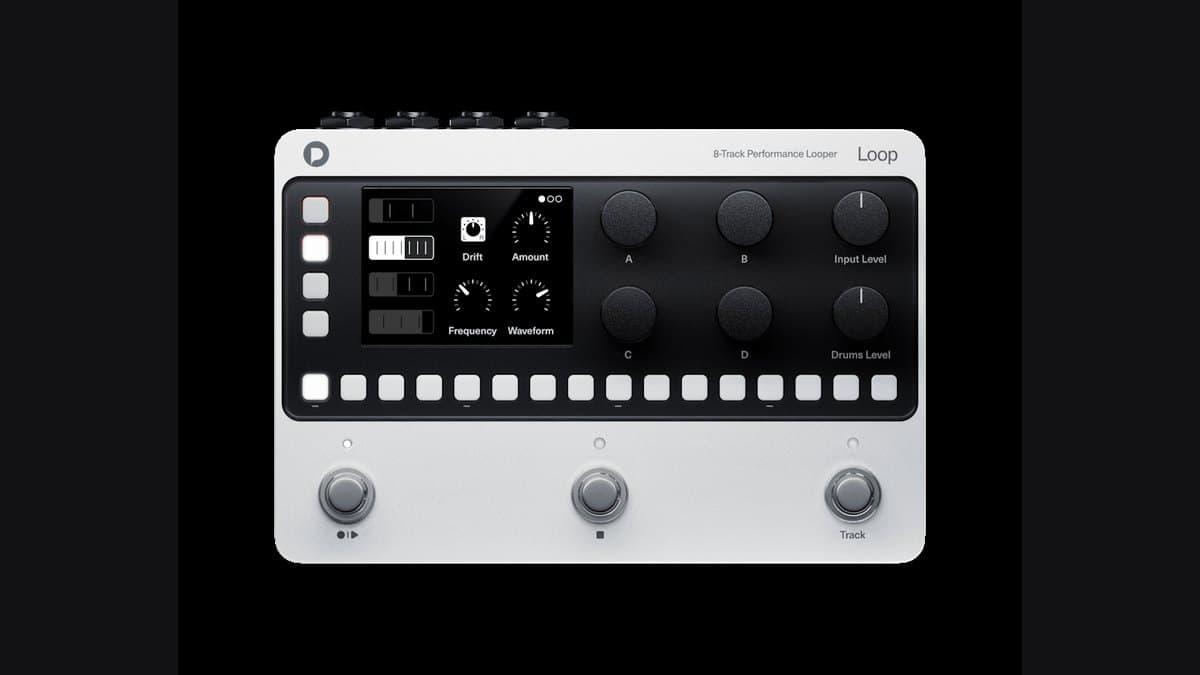
Polyend announced Loop on 24 September 2026. It's a floor pedal that records four audio loops and sequences four drum tracks from the same clock. The price on polyend.com is $599, and orders are set to ship in mid-October. In the UK, Thomann lists it at £524 under item 654242. If you've been following Polyend Drums, note that this is a separate, much smaller instrument.
At a glance: $599 at Polyend, £524 at Thomann. Four mono or stereo loop tracks (52 seconds each in mono), four sample drum tracks, 100+ effects, and up to 1,000 scenes. MIDI runs over USB-C and standard jacks. The power supply isn't included.
What Loop is
Polyend calls Loop an idea machine, and the description fits. You plug in a guitar, a line-level source, or a dynamic microphone, record a phrase, and the drums lock to the same tempo. Scenes hold the sections of a song, so an intro, verse, chorus, and bridge each live in their own slot. When you queue the next scene, it lands at the end of the bar.
Think of it as a songwriter's looper with a drum machine built in. Polyend Drums, by contrast, is an eight-track hybrid with four analog voices and four digital tracks, and it costs $2,699. Loop's drums are samples: four tracks, four samples per kit, one sample per track. That's enough rhythm to write over, but you won't find analog voices here.
Every audio track can run in mono or stereo with its own level, and each one plays forward, in reverse, or ping-pong. You pick one effect from the 100+ list for each loop. That effect shapes what you hear while playing, but it stays out of the file. When you copy a track off the card, the WAV is dry.
Loops, drums, and scenes
Each loop track holds up to 52 seconds in mono or 26 seconds in stereo. Overdubs are unlimited, and you get a single undo for the most recent layer. Loop length can follow the tempo or run free.
Tempo changes work differently from what DAW users might expect. With Varispeed on, a loop's speed and pitch move together as the scene tempo changes. With it off, the loop keeps the speed and pitch you recorded. There's no time-stretch, so a loop you speed up will also rise in pitch. That can be a useful effect, but it limits free tempo changes.
You don't have to record everything live. Loops can load from microSD, and you can sample your own drum sounds through the audio input. Out of the box, Loop ships with 500+ drum kits, 350+ rhythm patterns, 2,000+ drum samples, 180+ loops, and 100+ effects.
The drum sequencer runs 16 steps. Each scene stores 16 patterns, which you can cue one at a time or chain together. Tempo covers 40 to 280 BPM, and Loop can follow external MIDI clock. Scene changes, pattern changes, and synced loops all share that clock, while anything you want to breathe can sit on a free-length track.
With up to 1,000 scenes, there's room for a full set of songs. A scene saves its loops, drums, patterns, tempo, effects, and performance settings. The footswitches handle recording, playback, overdubs, undo, and moving to the next or previous scene. Editing parameter values or drum steps is a hands-on job, though, unless you map those controls to an expression pedal or to MIDI.
Inputs, outputs, and power
The input is a single 6.3 mm TRS jack. It takes a stereo signal or two mono signals at instrument level, line level, or from a dynamic microphone. There's no phantom power, so condenser mics need an external preamp.
Outputs are separate left/mono and right 6.3 mm jacks, and a headphone adapter comes in the box. A 6.3 mm expression input accepts an assignable pedal. You'll need to supply your own power: Loop wants 9 to 18 V DC at 500 mA or more, and it accepts centre-negative or centre-positive polarity.
MIDI, files, and the side panel
USB-C carries MIDI in both directions, but it doesn't carry audio or move files. Beside the USB socket sit MIDI in and MIDI out jacks, so hardware clock can arrive over a cable just as easily as over USB. Clock and transport both follow incoming MIDI.
Files live on microSD. That card holds scenes, samples, loops, firmware, and one WAV per audio loop track. Those WAVs are your route into a DAW. Polyend states clearly that effects aren't printed into the recordings, so you get the dry performance, track by track, ready to mix later. If an effect was central to the part, you'll either rebuild it in your session or record the pedal's outputs directly.
The chassis measures 180 × 120 × 57 mm, with the knobs counted in the height, and weighs 0.93 kg. It's sized for a pedalboard rather than a desk.
Polyend Loop specifications
| Spec | Detail |
|---|---|
| Price | $599 at Polyend. £524 at Thomann, item 654242, VAT included |
| Shipping | Mid-October 2026 per Polyend. Thomann shows 3 to 4 weeks |
| Announced | 24 September 2026 |
| Loops | 4 independent mono or stereo tracks. 52 s mono, 26 s stereo |
| Overdub | Unlimited, single-level undo |
| Playback | Forward, reverse, or ping-pong per track |
| Timing | Tempo-sync or free length. Varispeed ties speed and pitch to tempo. No time-stretch |
| Effects | One of 100+ effects per loop track. Dry WAV on export |
| Drums | 4 sample tracks, 4 samples per kit. 16 patterns per scene, 16 steps, cue and chain |
| Factory content | 500+ kits, 350+ patterns, 2,000+ samples, 180+ loops |
| Scenes | Up to 1,000. Changes land at the end of the bar |
| Tempo | 40 to 280 BPM, plus MIDI clock |
| Audio in | 6.3 mm TRS. Instrument, line, or dynamic mic. No phantom power |
| Audio out | 6.3 mm left/mono and right. Headphone adapter included |
| Expression | 6.3 mm TRS, assignable |
| MIDI | MIDI in and out jacks, plus USB-C MIDI. USB doesn't carry audio or files |
| Storage | microSD. One WAV per loop track |
| Size | 180 × 120 × 57 mm. 0.93 kg |
| Power | 9 to 18 V DC, minimum 500 mA, either polarity. Supply not included |
Loop vs Polyend Drums vs a delay-looper
Polyend Drums is the company's flagship drum instrument. Chase Bliss Big Time is a $999 hybrid delay with motorized faders that can also loop, though it isn't a four-track phrase sampler. Loop costs less than either and covers a different job: stacking song sections over a beat, controlled from the floor.
| Polyend Loop | Polyend Drums | Chase Bliss Big Time | |
|---|---|---|---|
| Price | $599 / £524 | $2,699 | $999 |
| What it is | 4 loop tracks + 4 sample drum tracks in a pedal | 8-track hybrid drum machine, 4 analog + 4 digital | Stereo delay and looper with motorized faders |
| Drums | Samples. 16-step patterns, 16 per scene | Analog voices plus digital tracks and sampling | No drum machine |
| Loops | 4 tracks, 52 s mono / 26 s stereo, unlimited overdub | Not a phrase looper | Loop mode on a delay engine |
| Effects | 100+, one per loop, not printed to the WAV | Per-step insert effects | The delay itself: mod, slap, long, loop |
| Sync | MIDI clock, USB-C MIDI, MIDI jacks, 40 to 280 BPM | TRS connectivity. No CV or DIN MIDI listed | Pedal, not a drum sequencer |
| Reach for it when | You want a song section, a beat, and both hands on a guitar | The drums are the instrument | You want one expressive delay you can freeze |
Which one fits
Loop makes sense when what you're missing is a pedal that remembers your verses and plays a kit underneath them. Four tracks and a thousand scenes add up to a full set, and the dry WAV export gives each idea a clear path into a proper mix.
Polyend Drums suits players who want analog voices, per-step effects, and a sequencer that serves as the performance itself. It costs more than four times as much as Loop and doesn't replace a looper. Big Time is the pick when the delay is what you perform and looping is a bonus. It won't sequence four drum tracks or give you 500 kits.
A keyboard looper such as the Svensson 49 grabs whatever you just played on the keys. Loop is built for your feet.
Who Loop is for
Consider it if you write on guitar, bass, or a mic and want drums in time without opening a laptop.
Consider it if your songs have distinct sections. Scenes act as the arrangement, so you can queue the chorus and keep playing.
Consider it if you plan to finish tracks in a DAW. Each loop track is already a dry WAV on the card, which makes the pedal a capture tool as well as a performance tool.
Consider it if your budget is $599 and a flagship drum machine is out of reach. You're getting sample drums and a looper, without analog voices.
Skip it if you need time-stretch. Varispeed moves pitch along with speed, so a loop recorded at the wrong tempo either stays there or changes key.
Skip it if your mic needs phantom power. The input handles dynamic mics, instruments, and line sources, so a condenser needs a preamp supplying 48 V.
Skip it if you expected a power supply in the box. Budget for a 9 to 18 V pedal supply rated at 500 mA or more.
Skip it if the effect on a loop is part of the finished record. Exports are dry, so you'll need to record the outputs to keep the effect.
Skip it if you were really after Polyend Drums. It's a different product with a different sound source.
How much does Polyend Loop cost?
Polyend sells Loop for $599 on polyend.com/loop, with shipping listed for mid-October. Thomann has it at £524 including VAT, article 654242, with a stock estimate of 3 to 4 weeks. That's the current UK street price.
The Thomann link above is our affiliate route.
FAQ
When does Polyend Loop ship?
Shipping starts in mid-October 2026. Thomann expects stock within 3 to 4 weeks.
How long can a loop be?
Each track holds 52 seconds in mono or 26 seconds in stereo. Polyend doesn't state a layer limit for overdubs, and you can undo the latest overdub once. Tracks can share the scene tempo or run at their own length.
Does it time-stretch?
No. With Varispeed on, speed and pitch follow the scene tempo together. With it off, the loop keeps its original speed and pitch. There's no way to change one without the other.
Can I move the loops into a DAW?
Yes. Each audio loop track saves as its own WAV on microSD, without effects printed in. USB-C handles MIDI only and won't transfer audio, so you'll copy files from the card.
How is Loop different from Polyend Drums?
Drums is an eight-track drum machine with four analog voices, priced at $2,699. Loop is a $599 pedal with four audio loopers, four sample-based drum tracks, scenes, and 100+ effects. Drums is built around the drum sounds, while Loop is a looping pedal that also plays kits.