Pad Works DAMP Review: A 39-Dollar Resonance Suppressor
Pad Works DAMP is a 39-dollar dynamic resonance suppressor for macOS that tames ring and harshness only while it happens. Full review of features, specs and price.
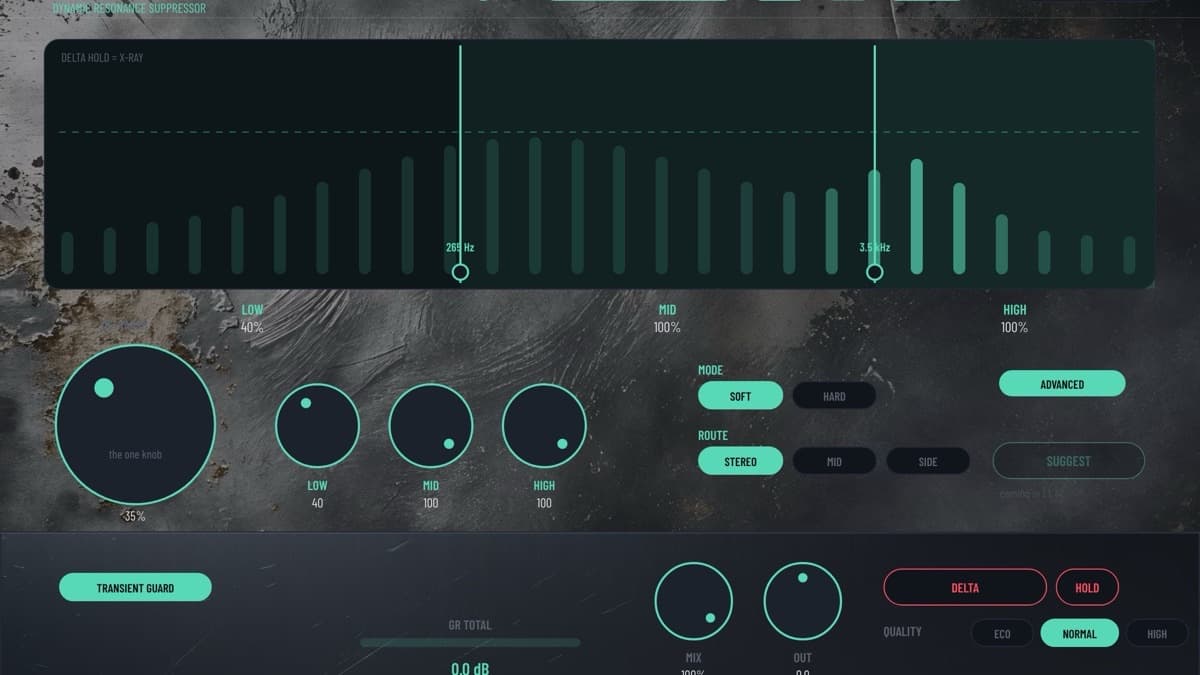
See full specs, price, and alternatives in the plugin database →
Pad Works released DAMP on 16 September 2026, a dynamic resonance suppressor for macOS that goes after the problems a good take still leaves behind: the box around a vocal, the ring on a snare, the boom in an acoustic guitar. It listens while the track plays and pulls a resonance down only while it rings, then gets out of the way. At 39 dollars, it lands in a category that usually costs five times as much.
At a glance: 39 dollars, perpetual license, no subscription. DAMP runs as a VST3 and AU on macOS 10.13.4 or later, as a universal binary for Apple Silicon and Intel, and it is Apple-notarized. It works on a single track, a bus or the whole mix.
What is Pad Works DAMP?
A resonance suppressor solves a specific problem. Rooms, cheap microphones and resonant instruments all create frequencies that jump out and ring when a note or transient hits them. A static EQ cut fixes the ring but also thins the sound everywhere else, because the cut is always on. A dynamic suppressor only acts when the resonance actually spikes, so the rest of the tone stays where it was.
DAMP is built entirely around that idea, and it keeps the interface small on purpose. Nothing moves until a frequency starts to ring; when it does, DAMP ducks it and then releases. That is the whole promise, and the design pushes you toward a fast decision rather than a deep engineering session. It slots in wherever harshness shows up, from a single vocal to a bus to a full master.
What DAMP does, feature by feature
The main panel is deliberately spare, with a deeper set of controls tucked into an advanced view. Here is what each part does.
- Three zones: LOW, MID, HIGH. The spectrum is split into three bands with movable edges, so you can aim the processing at boomy lows, boxy mids or harsh highs independently. It is a faster mental model than drawing nodes across a full graph.
- The DE-HARSH knob with SOFT and HARD modes. A single control sets how hard DAMP works, and the two modes change its character: SOFT for transparent, gentle taming, HARD for stubborn, aggressive resonances. Most of your mixing is one knob and one mode choice.
- DELTA, with HOLD. DELTA plays only what DAMP is removing, so you can hear whether you are catching the resonance or eating into the good part of the sound. HOLD keeps DELTA active while you adjust parameters, which makes dialing it in far less fiddly.
- Advanced view. Expanding the panel exposes attack and release, a ratio for the suppression curve, and the detector controls that decide which frequencies get targeted, plus sharpness, memory and stereo link. The depth is there when a source needs it, hidden when it does not.
- Mid/side and stereo routing. You can process the sides differently from the center, which is the trick for taming a harsh vocal or cymbal wash without collapsing the stereo image.
- Transient Guard. A toggle that protects transients from being softened by the suppression, so drums keep their snap while their ring gets tamed.
Pad Works DAMP specifications
| Spec | Detail |
|---|---|
| Type | Dynamic resonance suppressor |
| Formats | VST3, AU |
| Operating system | macOS 10.13.4 or later |
| Architecture | Universal binary (Apple Silicon and Intel), Apple-notarized |
| Bands | Three zones (LOW, MID, HIGH) with movable edges |
| Key controls | DE-HARSH knob, SOFT/HARD modes, DELTA, HOLD, Transient Guard |
| Advanced controls | Attack, release, ratio, detector, sharpness, memory, stereo link |
| Routing | Stereo and mid/side |
| Latency | 2048 samples standard, 4096 samples in high quality |
| Presets | 7 factory presets |
| Parameters | 21 adjustable |
| Price | 39 dollars, perpetual single license |
How it compares
DAMP arrives in a category defined by two premium tools: oeksound's soothe3 and Soundtheory's Gullfoss. Here is where it sits.
| Pad Works DAMP | oeksound soothe3 | Soundtheory Gullfoss | |
|---|---|---|---|
| Price | 39 dollars | 259 dollars | 199 dollars |
| Platforms | macOS only | macOS, Windows | macOS, Windows |
| Formats | VST3, AU | VST3, AU, AAX | VST3, AU, AAX |
| Approach | Targeted dynamic resonance suppression | Full-spectrum dynamic resonance suppression | Broadband automatic tonal balancer |
| Monitoring | DELTA with HOLD | Delta and detailed detection graph | Visual balance display |
| Best for | Affordable, focused harshness control on macOS | The deepest, most surgical suppression | Overall tonal balance rather than targeted rings |
soothe3 remains the deepest tool in the category, with the most detailed detection and cross-platform support, and our soothe3 review covers why it earns its price. Gullfoss is a different animal, a broadband balancer rather than a targeted suppressor. DAMP does not out-feature either one. What it does is deliver the core job, dynamic resonance control that preserves tone, for a fraction of the money, with a workflow you can learn in an afternoon. If you want a dynamic EQ angle instead, the free TDR Nova is also worth a look, and a clean surgical EQ like FabFilter Pro-Q 4 pairs well alongside any of these. If you would rather buy a comparable spectral shaper from a retailer with a trial and rewards, Baby Audio Smooth Operator Pro is on Plugin Boutique.
Who Pad Works DAMP is for
DAMP is for macOS producers and mixers who keep running into harshness and ring and do not want to spend flagship money to fix it. It suits people who like a fast, decisive workflow and who value the DELTA monitoring that shows exactly what is leaving the signal. On vocals, snares, cymbals and acoustic instruments it does the everyday job well.
Who should skip it: Windows users, since there is no Windows build, and anyone tracking or monitoring in real time, because the fixed latency of 2048 samples, or 4096 in high quality, is far too much for live use. Engineers who want the deepest possible detection and surgical control will still reach for a premium suppressor.
How much does Pad Works DAMP cost?
DAMP is 39 dollars for a perpetual single license, sold directly by Pad Works, with no subscription. That price is the headline: dynamic resonance suppression usually starts near 200 dollars, so DAMP undercuts the field heavily. It runs as a VST3 and AU on macOS 10.13.4 or later, as a universal binary, and it is Apple-notarized, so installation on modern macOS is clean.
FAQ
What does Pad Works DAMP do?
It is a dynamic resonance suppressor. It finds ringing frequencies while a track plays and reduces them only while they ring, which tames harshness and boom without permanently cutting the tone the way a static EQ would.
Is DAMP available on Windows?
No. At launch DAMP is macOS only, available as a VST3 and AU. There is no Windows version.
Can I use DAMP while recording?
It is not designed for that. DAMP reports a fixed latency of 2048 samples, or 4096 samples in high quality, so it belongs on mixing and mastering duties rather than live tracking or low-latency monitoring.
Is DAMP worth it against soothe3?
For most home and project mixers, DAMP covers the everyday resonance and harshness work at 39 dollars against soothe3's 259. soothe3 goes deeper and runs on Windows too, so choose it if you need the most surgical control or cross-platform support; choose DAMP if you want the core job done affordably on macOS.