orph ALIAS Colors Any Track Like a Worn Sampler
orph ALIAS colors any track with sampler crunch, tape wear, vinyl warp, and CD read errors. Price is €39 including VAT, VST3 and AU, macOS and Windows.
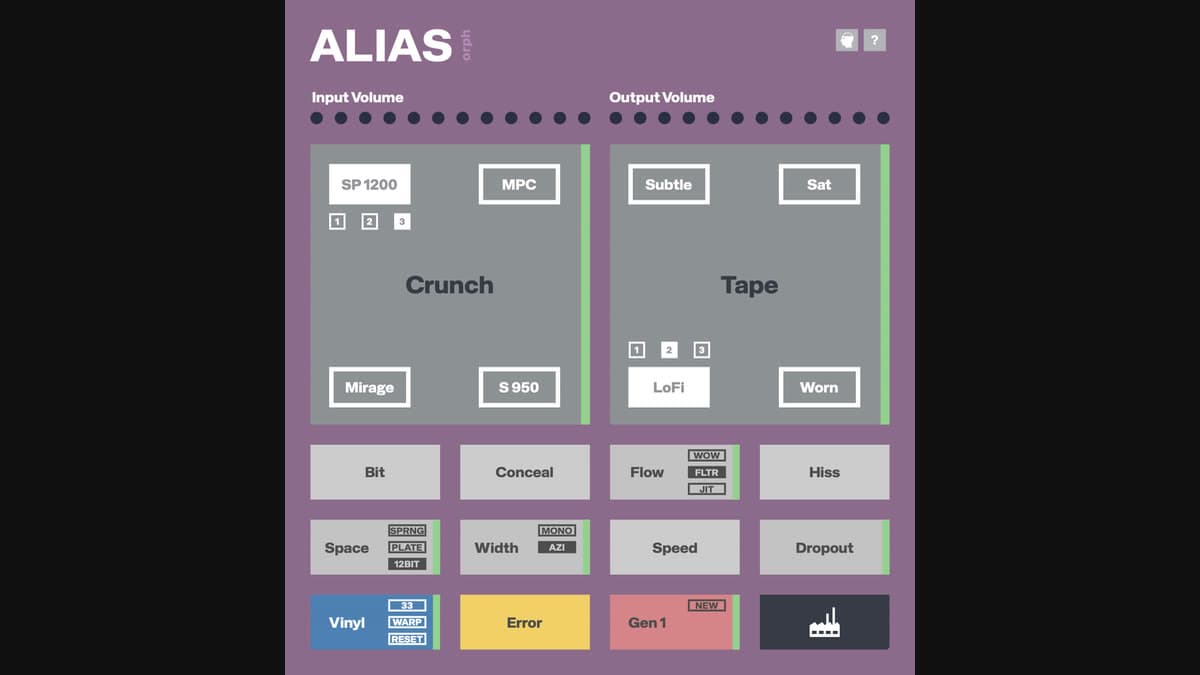
orph has released ALIAS, a character processor that puts sampler crunch, tape wear, vinyl, and CD read errors on whatever you feed it. The official price is €39 including VAT. The same checkout lists $39. Formats are VST3 and AU, on macOS 10.13 or later and Windows 10 or 11. A 7-day trial is on the orph site.
At a glance: €39 / $39, tax included. Four sampler characters and twelve tape settings, then eleven wear tiles in a fixed order. Constant latency of 1011 samples, 22.9 ms at 44.1 kHz. About 350 MB installed and 110 MB of RAM per instance. This is a first look at the official ALIAS page and orph's own video. We have not used it in a session.
What is ALIAS?
ALIAS is a colour box with a specific past. orph roots it in 1980s and 1990s sampling and tape: inner-groove wear, and noise floors taken off VHS and Betamax, not a generic "vintage" knob. A clean track goes in. It comes out with converter grain, tape drift, cassette generation loss, and oxide dropouts.
The company is plain about what it is not. The sampler and tape characters are inspired by classic hardware, not rebuilt from circuit boards or dumped ROMs. The components are orph's. The twelve tape settings sit at one level, so changing colour does not change loudness. There is no generative model making choices for you. You pick the machine, then you stack the damage.
That fixed order matters in a mix. Sampler crunch happens, then tape, then the tiles: bit depth, CD errors, generation loss, dropouts, speed, vinyl, wow and flutter, width, hiss, and space. A record can also be a worn cassette copy because the tiles stack, not because you loaded a second plugin.
Sampler characters
Crunch offers four machines, three variants each. orph prints the rates, which is more useful than a vibe word.
- SP-1200. 12-bit at 26.04 kHz. Variants: Classic, Filtered, Hot. This is the short, thick sampler colour people mean when a drum bus should sit in a late-80s pocket.
- MPC60. 40 kHz with an 18 kHz brickwall, plus an MPC3000 path and an MPC60 Hot variant. Brighter than the SP path, still not a modern converter.
- S950. 12-bit. Clean at 19.2 kHz, Warm at 10 kHz, Dark at 7 kHz. The Dark variant is a filter decision as much as a bit decision. Use it when the top end is the problem.
- Mirage. 8-bit. Full, Dark, or Crushed. This is the smallest word length in the row. It will alias on purpose. If you need a primer on aliasing as a technical fault rather than a colour, that is a different article: our guide to audio aliasing. ALIAS is the colour. The guide is the problem you usually remove.
You are not loading the original instruments. You are choosing a conversion character, then leaving it in the chain while the tiles do the rest.
Tape states
Tape is four states, three variants, twelve settings, level-matched.
- Subtle. Studio reel at 38 cm/s, home reel at 19 cm/s, and a chrome cassette. This is the "barely on" row.
- Sat. Ferro, chrome, and metal. Saturation without jumping to a destroyed cassette.
- Worn. Stretched, creased, and sticky-shed. The names are the condition of the tape, not a drive amount.
- LoFi. An old ferro cassette, a microcassette, and 8-track.
Because the twelve settings share a level, you can automate or click between them without riding a trim after every change. That is the practical difference from a tape plugin whose input drive is also the colour.
The eleven tiles
After sampler and tape, eleven tiles add one kind of wear each. FACTORY reshapes two to four of them to musical amounts if you want a starting point and then intend to edit.
Digital
- Bit runs from 16-bit down to 4-bit and follows the sampler you chose. The sampler already has a word length. Bit is the extra reduction on top.
- Error is a CD read error, from one sector up to 250 ms. Host tempo sync puts the error grid on the transport, so the glitch can sit on a division instead of wandering.
- Conceal is the player's interpolation across that gap. Error without Conceal is a hole. Conceal is the smear a cheap player used to hide it.
Tape
- Generation copies the tape up to eight times.
- Dropout is oxide loss in events of 8 to 90 ms.
- Speed is half or double tape speed. Half speed is an octave down and a darker noise floor. Double is the opposite. It is a musical switch, not a fine varispeed.
Vinyl and motion
- Vinyl runs the platter at 0.556 Hz (33 1/3 rpm) or 0.75 Hz (45 rpm).
- Flow is wow, flutter, and clock jitter.
- Width dulls one side. Azimuth error goes up to 40 microseconds. That is a stereo image decision: the top end collapses the way a misaligned head does, not the way a widener plugin does.
Noise and space
- Hiss is ten recordings, looped cleanly, at −30 dBFS RMS. They are captures, including video-tape noise, not a synthesized noise oscillator.
- Space is spring, plate, or a 12-bit reverb. Small, and last in the chain, so the room is dirty in the same way as the source.
Noise and wear are seeded, and the seed travels with the session. Render the bounce twice and the hiss pattern should match. Forty-two parameters automate. There is no MIDI in or out, and no sidechain. The signal path is 32-bit float, from 44.1 to 96 kHz, mono or stereo.
ALIAS specifications
| Spec | Detail |
|---|---|
| Price | €39 / $39, tax included, from orph |
| Trial | 7 days |
| Sampler row | SP-1200, MPC60 / MPC3000, S950, Mirage, three variants each |
| Tape row | Subtle, Sat, Worn, LoFi, three variants each, level-matched |
| Tiles | Bit, Error, Conceal, Generation, Dropout, Speed, Vinyl, Flow, Width, Hiss, Space, plus FACTORY |
| Latency | 1011 samples, 22.9 ms at 44.1 kHz, constant |
| Audio | 32-bit float, 44.1–96 kHz, mono or stereo, no sidechain |
| Automation | 42 parameters, host tempo sync on the error grid |
| Install | About 350 MB for all formats, about 110 MB RAM per instance |
| Formats | VST3 and AU. No AAX. No CLAP |
| macOS | 10.13 or later, Universal (Apple Silicon and Intel), 64-bit |
| Windows | 10 or 11, 64-bit |
| Activation | Internet for activation and the update check. No sample download |
| Hosts | Any AU or VST3 host |
ALIAS vs RC-20 Retro Color vs Decimort 2
XLN RC-20 Retro Color is the six-module lo-fi suite: noise, wobble, distort, degrade, space, and volume drops, with one Magnitude knob. D16 Decimort 2 is a bitcrusher and sample-rate reducer with two converter paths. ALIAS overlaps both and then spends its panel on named machines and a fixed wear order.
| orph ALIAS | RC-20 Retro Color | Decimort 2 | |
|---|---|---|---|
| Price | €39 / $39 | $99 regular on our RC-20 deal history | €49 on the Decimort 2 card |
| Job | Sampler character, then tape, then specific faults | Broad vintage colour with a global Magnitude | Designed bitcrush and sample-rate reduction |
| Machines | SP-1200, MPC, S950, Mirage rates printed on the panel | Modules, not named samplers | Two ADC paths, not a tape deck |
| Tape | Twelve level-matched settings, generation loss, dropouts, half/double speed | Wobble and noise, not a generation counter | Not a tape emulator |
| Extra faults | CD errors with conceal, vinyl at 33 or 45, azimuth to 40 µs | Volume drops, space, distort | The crush itself is the effect |
| Formats | VST3, AU | VST, AU, AAX | VST3, AU, AAX |
| Latency | 22.9 ms at 44.1 kHz | Low enough for the RC-20 workflow | Effect-style, not a sampler ROM |
| Reach for it when | You want a machine, then the damage, at a matched level | You want one knob across six lo-fi tricks | You want crush without a cassette story |
Which to pick. Choose ALIAS when the picture in your head is a specific converter and a specific tape condition, and you still want CD errors or a 45 rpm warp afterward. Choose RC-20 when you want Magnitude and you already know that panel. Our card puts the regular price at $99, and it goes on sale often. Choose Decimort 2 when the only goal is musical sample-rate and bit reduction, at €49, including AAX. If you wanted a full tape machine for glue and delay, that is u-he Satin at €129, and it is a different plugin. ALIAS will not replace it.
Level-matched tape settings are the detail to test in the trial. If every colour change also jumps the gain, you mix the jump. orph removed that jump on purpose.
Who ALIAS is for
Consider it if drums, vocals, or a whole bus should sound like they left a 12-bit sampler and a tired deck, and you want the rates written down.
Consider it if €39 is the budget and you do not need Pro Tools. VST3 and AU cover Live, Logic, Bitwig, Cubase, Reaper, and Studio One.
Consider it if repeatable noise matters. The seed is stored with the session, so the hiss you approved is the hiss you bounce.
Skip it if you track live through the insert. 22.9 ms at 44.1 kHz is constant, and it is late for a singer on headphones. Print it after the take.
Skip it if you need AAX, CLAP, or Linux. None of those are on the format list.
Skip it if you wanted the original SP-1200 or MPC ROM. orph says the characters are inspired by those machines. They are not the machines.
How much does ALIAS cost?
€39 including VAT, and $39 at the same checkout, from orph. There is no Plugin Boutique, Thomann, or Best Service SKU. A 7-day trial is on the product page.
orph's terms price products in euros, tax included, and treat the download as immediate delivery. The published refund policy says sales are final once that download starts, because the withdrawal right for digital goods ends when delivery begins. Statutory rights for a product that will not run on a system that meets the requirements stay in place. Read the trial before you pay. Educational pricing on the orph site is aimed at other products, MONOCHORD in particular. ALIAS at €39 may not be on that list. Ask orph if you are buying seats for a lab.
Activation needs a network once, plus the update check. There is no multi-gigabyte sample install. The noise recordings ship inside the plugin. Installed size is about 350 MB for the formats together.
FAQ
Is ALIAS a sample of an SP-1200 or an MPC?
No. The crunch row is orph's own processing, with rates and filter choices inspired by the SP-1200, the MPC60 and MPC3000, the S950, and the Mirage. You get the conversion character. You do not get those instruments' sample memory or sequencer.
What latency does ALIAS add?
1011 samples, constant. At 44.1 kHz that is 22.9 ms. Fine on a printed drum bus. Poor as a live vocal insert. The plugin does not claim a zero-latency mode.
ALIAS vs RC-20?
RC-20 is a six-module lo-fi colour suite with a Magnitude macro and an AAX version, regularly $99. ALIAS is €39, VST3 and AU only, and it spends the panel on named sampler characters, twelve level-matched tape settings, and tiles for CD errors, generation loss, and vinyl speed. Pick RC-20 for the macro and Pro Tools. Pick ALIAS for the machine-plus-fault chain.
Does the noise stay the same on every bounce?
orph seeds the noise and the wear, and the seed is stored in the session. The hiss files themselves are ten looped recordings at −30 dBFS RMS, not a new random draw on every play.
What are the system requirements?
macOS 10.13 or later, Universal, 64-bit, and Windows 10 or 11, 64-bit. VST3 and AU. About 350 MB on disk and 110 MB of RAM per instance. Sample rates from 44.1 to 96 kHz. Internet for activation. Any AU or VST3 host.