Native Instruments SuperStarSaw: A.G. Cook's Supersaw Synth
Native Instruments SuperStarSaw is a dedicated supersaw synth built with A.G. Cook: dual saw layers, a 4-corner X/Y Morpher and star motion, from $99.
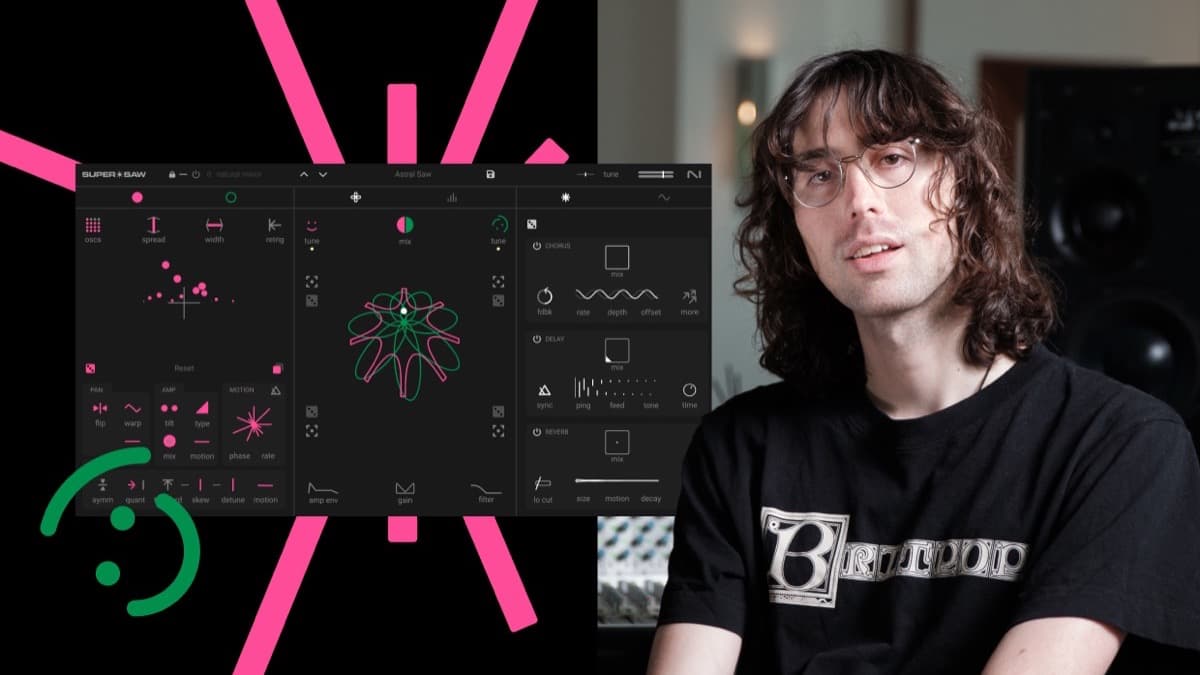
Native Instruments has built an entire synth around one sound. SuperStarSaw (styled Super*Saw) arrived on July 16, 2026, co-created with producer A.G. Cook. It does one thing with obsessive focus. It stacks detuned sawtooth waves into the huge, euphoric leads that define modern pop and rave. This is Native Instruments' first net-new software synth in years. At $99, it targets producers who reach for a supersaw and want it finished on the first note.
At a glance: dual 8-voice stacked-saw layers, a 4-corner X/Y Morpher, a star-shaped motion modulator, chorus/delay/reverb, and LP/BP/HP filters. Formats are VST3, AU and AAX for macOS (Apple Silicon and Intel) and Windows. Price: $99 / EUR 99 / GBP 89. Verdict: a narrow, superbly executed one-trick synth, not a do-everything workstation.
What is SuperStarSaw?
The supersaw is not a new idea. Roland popularized the stacked-saw waveform in the late 1990s, and it has powered trance, EDM, hyperpop and festival anthems ever since. Producers usually build one inside a general-purpose synth, layering unison voices and detuning them by ear. SuperStarSaw removes that step. It is a purpose-built instrument for the sound, designed with A.G. Cook, the Grammy-winning UK producer, PC Music founder and 2025 BRIT Producer of the Year known for his work with Charli XCX, Caroline Polachek and Oklou.
The pitch is simple. Instead of a blank subtractive synth that can make a supersaw, you get a synth that starts as a supersaw and gives you fast, tactile ways to reshape it. The factory library is built from Cook's own patches, so the presets lean into his signature palette: blissed-out harmonies, metallic dissonance, ravey leads and impossible glides. This is a signature instrument in the truest sense, closer in spirit to an artist collaboration than a spec-sheet flagship.
What's new in SuperStarSaw?
The architecture is deliberately small, and every control earns its place.
Dual stacked-saw layers. Two independent oscillator sections, color-coded pink and green, each stack up to eight detuned saw voices. Tune them apart for width, pull them into unison for thickness, or run them as two contrasting timbres. Spread and width controls handle the classic detune-and-widen move without menu diving. A copy function clones one layer onto the other. A randomizer rerolls both, which turns patch design into fast, happy-accident exploration rather than slow parameter-tweaking.
The 4-corner X/Y Morpher. This is the centerpiece. The Morpher captures four complete patch states, one per corner, and lets you interpolate continuously between them by dragging a single point across the pad. Move toward one corner and the chord shape, detune rate and modulation shift together in real time. It is a performance tool as much as a design tool: assign the pad to a mod wheel or automation lane and a static chord becomes an evolving, breathing texture across a drop.
The star-shaped motion modulator. SuperStarSaw's second signature control is a star-shaped motion source you can route to panning, amplitude or pitch. It adds rhythmic, animated movement, the kind of shimmer and wobble that makes a lead feel alive instead of sampled. Because it targets pan and amplitude as well as pitch, it doubles as an auto-panner and a tremolo-style shaper, not just a vibrato.
Filters and built-in effects. A single multimode filter offers low-pass, band-pass and high-pass shapes to tame or brighten the stack. Downstream sit chorus, delay and reverb, so a patch arrives mixed and spacious without loading a channel of send effects. Chord and scale quantization tools keep the harmonically dense patches in key. Mono and poly modes with per-voice glide cover both screaming monosynth leads and wide polyphonic pads.
The honest read: this is a focused feature set, not a deep modulation system. There is no wavetable engine, no FM, no granular oscillator and no free-assign modulation matrix. That is the point. SuperStarSaw trades breadth for a workflow that gets you to a great supersaw in seconds.
SuperStarSaw specifications
| Spec | Detail |
|---|---|
| Type | Dedicated supersaw software synth (subtractive / virtual analog) |
| Oscillators | Two independent layers, each stacking up to 8 detuned saw voices |
| Signature controls | 4-corner X/Y Morpher, star-shaped motion modulator |
| Filter | Multimode: low-pass, band-pass, high-pass |
| Effects | Chorus, delay, reverb (built in) |
| Extras | Layer copy/randomize, chord & scale quantization, per-voice glide, mono/poly modes |
| Formats | VST3, AU, AAX (64-bit) |
| Platforms | macOS (Apple Silicon + Intel), Windows 10/11 |
| System | Intel Core i5 or Apple Silicon, 4 GB RAM (6 GB recommended), internet for install |
| Price | $99 / EUR 99 / GBP 89 |
| Released | July 16, 2026 |
SuperStarSaw vs Sylenth1
The closest reference point is not a modern mega-synth but Sylenth1, the CPU-light virtual analog workhorse that a generation used to build supersaw and trance leads. Both sit in the same price bracket and both are subtractive at heart, which makes the comparison the fairest test of whether a dedicated tool beats a general one.
| SuperStarSaw | Sylenth1 | |
|---|---|---|
| Developer | Native Instruments | LennarDigital |
| Price | $99 / EUR 99 / GBP 89 | ~$139 |
| Engine | Dedicated dual stacked-saw layers | 4 unison oscillators, general subtractive |
| Best at | Supersaws, euphoric leads, motion | Leads, basses, pads, all-round analog |
| Signature workflow | X/Y Morpher + star motion | Classic knob-per-function panel |
| Effects | Chorus, delay, reverb | Chorus, phaser, EQ, delay, reverb, distortion |
| Formats | VST3, AU, AAX | VST, VST3, AU, AAX |
Which should you pick? If you want one instrument that makes supersaws faster and more expressively than anything else, and you value the Morpher and motion for performance, SuperStarSaw wins on focus. If you want a single affordable synth that also covers basses, plucks and pads, Sylenth1 is the more versatile buy. For the full do-everything option a step up in price, the five-engine Serum 2 makes any of these sounds and far more, at the cost of speed and simplicity.
Who SuperStarSaw is for
SuperStarSaw is for producers who make supersaws constantly and want them to sound great with less fuss: hyperpop, trance, festival EDM, pop toplines and anything built on a wall of detuned saws. If A.G. Cook's productions are a reference point, the factory library alone may justify the price. Live performers benefit too, since the Morpher and motion pad are built for hands-on, automatable movement.
Who should skip it? Anyone who needs one synth to do everything. If you already own a flexible instrument like Serum 2 or a full Komplete bundle, you can build a supersaw there, and SuperStarSaw becomes a convenience purchase rather than a capability you lack. Sound designers who live in modulation matrices and alternative oscillator types will also find it deliberately shallow. And if budget is the whole story, our roundup of the best free synth VSTs covers no-cost saw stacks first.
How much does SuperStarSaw cost?
SuperStarSaw is a single-tier purchase at $99 / EUR 99 / GBP 89. There is no subscription and no separate editions. There is no free player version either, though Native Instruments typically offers a time-limited demo. Owners of the paid Komplete bundles should check whether it is included or offered at a discount before buying standalone, since Native Instruments folds many instruments into those tiers over time. You can buy Super*Saw on Plugin Boutique or direct from the official Native Instruments product page.
Check SuperStarSaw price at Plugin BoutiqueThis launch also fits a wider pattern for the brand. After Native Instruments was acquired by inMusic, a headline artist collaboration like this signals a push toward focused, culturally current instruments rather than only big bundle updates.
FAQ
Is SuperStarSaw worth buying if I already own Serum or Sylenth1?
It depends on how often you make supersaws. Serum 2 and Sylenth1 can both build the sound, so SuperStarSaw is not filling a gap in raw capability. What it adds is speed and A.G. Cook's ready-made palette, plus the Morpher and motion pad for expressive, performable movement. If supersaws are core to your music, that workflow is worth the $99. If they are occasional, stick with what you have.
What formats and systems does SuperStarSaw support?
SuperStarSaw runs as a VST3, AU and AAX plugin in 64-bit hosts, so it works in Ableton Live, Logic Pro, FL Studio, Cubase, Pro Tools and other major DAWs. It supports macOS on both Apple Silicon and Intel, and Windows 10 or 11. Native Instruments lists an Intel Core i5 or Apple Silicon chip and 4 GB of RAM as the minimum, with 6 GB recommended.
What makes SuperStarSaw different from a normal synth's supersaw?
A normal synth makes a supersaw by stacking unison voices you detune yourself. SuperStarSaw starts as two dedicated stacked-saw layers and hands you purpose-built controls, the 4-corner X/Y Morpher and the star-shaped motion modulator, to reshape and animate that sound quickly. It trades a general synth's breadth for a faster, more expressive route to one specific result.
Who is A.G. Cook and why did he co-create it?
A.G. Cook is a Grammy-winning UK producer, the founder of PC Music and the 2025 BRIT Producer of the Year, known for work with Charli XCX, Caroline Polachek and Oklou. The supersaw is central to his sound, so the instrument is built from his own patches and reflects his signature approach to stacking detuned saws, making the factory library as much a selling point as the engine.