Some links on this page are affiliate links. If you buy through them, Dubspot may earn a commission at no extra cost to you. It never affects our scores or what we recommend — read our policy.
Inside MAP Audio MFX: Four Cells and an AI Control Bridge
MAP Audio MFX is a modular multi-FX plugin: four routable cells, a 33-effect library, deep modulation, and an MCP bridge that lets AI agents control it. $80, browser demo.
T
Theo Nakamura
November 2, 2026 · 8 min read
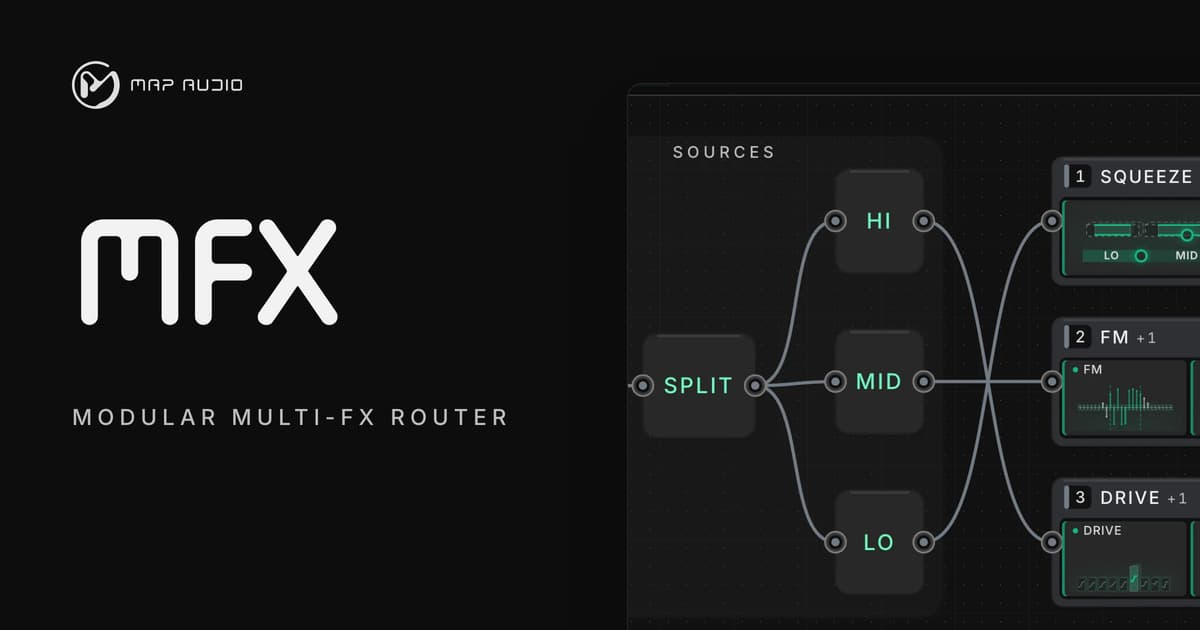
MAP Audio released MFX in late October 2026, a modular multi-effects plugin that treats an effects rack like a patchable instrument. You get four effect cells, a library of processors to drop into each, and free routing between them. Most multi-FX plugins lock you to a fixed chain or a set of bands. MFX hands you the cables instead. It also does something no mainstream effects plugin has shipped before: an MCP bridge that lets an AI agent reach in and turn the knobs.
At a glance: MFX is a modular multi-effects plugin in VST3, AU, AAX, CLAP and standalone for macOS, Windows and Linux. It routes four cells, each drawing on a library of 33 effects, with deep modulation, 8 bar-synced variations, 8 master effects, and third-party plugin hosting. Its standout is an MCP bridge for AI control. It costs $80, with a full browser demo.
What is MAP Audio MFX?
MFX sits in the modular effects category, the same broad space as Kilohearts Multipass and Bitwig's Grid-style tools, but it takes its own route. Instead of splitting audio into frequency bands, it gives you four cells you can chain in any order, with a gain control between each one. Each cell loads from a shared library of 33 effects. Stack a grain processor into a tape stage into a spectral delay, run cells in parallel, and reshape the signal path as freely as a modular rack.
The effect library covers the staples and the strange. Drive, Freq Shift, FM, Spectral Delay, Tape, Grain, Noise Gate and Codec all appear, alongside filters, EQ, compression, delays, resonators and pitch tools. The range runs from clean mix processing to full sound mangling, no second plugin required.
What MFX does, feature by feature
Four routable cells. Routing is the heart of MFX. Four cells, a 33-effect library, gain staging between each, and the freedom to order them in whatever way the sound needs. The cell grid is the main view, and it keeps the signal path readable even when a patch gets dense.
Deep modulation. Static effects are the easy part. MFX animates them with envelopes, LFOs and a parameter sequencer, so cutoff, grain size or delay time can move in time with the track. The modular approach pays off here, because any modulator can reach any parameter across every cell.
Eight variations per patch. Each patch holds eight variations, and you can switch them in sync with the bar. That turns MFX into a performance and arrangement tool as much as a processor. A verse and a chorus can run different effect states from one instance.
Master section and plugin hosting. The output stage carries eight master effects, and MFX can host third-party plugins inside its chain. You're not limited to the built-in library, so your own favorite processors stay in play.
The MCP bridge: AI agents in the effects chain
The MCP bridge is what sets MFX apart. MAP Audio ships a package, @map-audio/mcp-server, and running map-mcp --product=mfx connects an AI agent to an MFX instance already open in your DAW. From there, the agent reads the current state and changes parameters from outside the session.
This matters beyond the novelty. The Model Context Protocol is the same standard that connects AI assistants to tools across software. Seeing it inside an audio plugin points at a studio where an agent can audition settings, recall states or sweep a parameter on request. It's early, and most producers will use MFX without touching the bridge. Even so, it's a first for a music effects plugin, and one worth watching.
MAP Audio MFX specifications
| Spec | Detail |
|---|---|
| Developer | MAP Audio |
| Type | Modular multi-effects plugin |
| Architecture | Four routable cells with gain between each |
| Effects | Library of 33, including Drive, Freq Shift, FM, Spectral Delay, Tape, Grain, Noise Gate, Codec |
| Modulation | Envelopes, LFOs and a parameter sequencer |
| Variations | 8 per patch, switchable bar-synced |
| Master section | 8 master effects plus third-party plugin hosting |
| AI control | MCP bridge via @map-audio/mcp-server (map-mcp --product=mfx) |
| Formats | macOS: AU, VST3, CLAP, Standalone (AAX from 1.1.7); Windows: VST3, CLAP, Standalone; Linux: VST3, CLAP, Standalone (1.1.7+) |
| System | macOS 12+ (Apple Silicon and Intel); Windows 10/11 (64-bit); Linux glibc 2.35+ |
| Price | $80, full browser demo |
MAP Audio MFX vs Kilohearts Multipass
The nearest rival is Kilohearts Multipass, the other modular effects host producers reach for. The two start from a similar idea but split on method. Multipass divides audio into up to five frequency bands, each with its own Snapin chain, so it shines at surgical, frequency-conscious work. MFX routes four free-form cells and leans into open-ended sound design, with the AI bridge on top.
| MAP Audio MFX | Kilohearts Multipass | |
|---|---|---|
| Price | $80 | $99 |
| Structure | Four free-routed cells | Up to five frequency bands |
| Effects | Library of 33 built in | Kilohearts Snapins (Essentials bundled) |
| Modulation | Envelopes, LFOs, sequencer | Envelopes, LFOs, randomization |
| Plugin hosting | Third-party hosting | Snapin ecosystem |
| AI control | MCP bridge | None |
| Best for | Free-form modular design | Per-band surgical processing |
If band-split precision is the goal, Kilohearts Multipass is the more focused tool, and the free Snap Heap is an easy way into the same Snapin world. If you want free routing, a wide built-in library and the AI bridge, MFX is the more open canvas. For modulation on third-party synths rather than effects, the Stride Engine plugin host writes tempo-locked automation on any mapped knob, while Rast Sound Splitz splits by level or transient to host your own plugins per part.
Who MFX is for
MFX suits sound designers and producers who like to build effect chains from the ground up and modulate them hard. The free routing and the 33-effect library reward experimentation, and the eight variations make it useful on stage and in arrangement. It's also the obvious pick for anyone curious about AI in the studio, because the MCP bridge is a real, working example rather than a slogan.
It's less suited to anyone who wants a fixed, no-decisions processor. Free routing carries a learning curve, and if all you need is a channel strip or a simple multiband compressor, MFX is more than the job calls for. The lack of a traditional trial download is a small friction, though the browser demo takes most of the risk out of the decision.
How much does MFX cost?
MFX costs $80. There's no separate trial to install, but a fully functional browser demo runs right on the product page, so you can route cells and hear the effects before you buy. It installs as VST3, CLAP and standalone on macOS, Windows and Linux, with AU on Mac, and AAX for Pro Tools from version 1.1.7.
See MFX on MAP AudioFor more ways to shape tone and color, see our best saturation plugins of 2026.
FAQ
What is MAP Audio MFX?
It's a modular multi-effects plugin. You get four routable cells, each loaded from a library of 33 effects, plus deep modulation, eight variations per patch, eight master effects and third-party plugin hosting.
Can an AI agent really control MFX?
Yes. MAP Audio ships an MCP bridge through the @map-audio/mcp-server package. Running map-mcp --product=mfx lets an AI agent read and change parameters on an MFX instance already open in your DAW.
How much does MFX cost and is there a demo?
MFX is $80. There's no separate trial, but a fully functional browser demo runs on the product page, so you can try the routing first.
What formats and systems does MFX support?
It runs as VST3, CLAP and standalone on macOS, Windows and Linux, with AU on Mac and AAX from version 1.1.7. It needs macOS 12 or later, Windows 10 or 11, or Linux with glibc 2.35 or newer.
MFX or Kilohearts Multipass?
Choose MFX for free-form routing, a wide built-in library and the AI bridge. Choose Kilohearts Multipass for surgical per-band processing inside the Snapin ecosystem.
Verdict
MFX is a smart, forward-looking take on the modular effects plugin. The four-cell routing and 33-effect library give it real range, the modulation system makes patches move, and the eight variations push it toward performance as much as processing. The MCP bridge is the part people will quote, and rightly so. A working example of an AI agent driving an audio plugin is new, and it points somewhere interesting. Free routing asks more of you than a fixed rack, and there's no trial download to lean on. The browser demo answers that, and at $80 MFX undercuts most of its modular rivals. For the band-split alternative, start with Kilohearts Multipass.